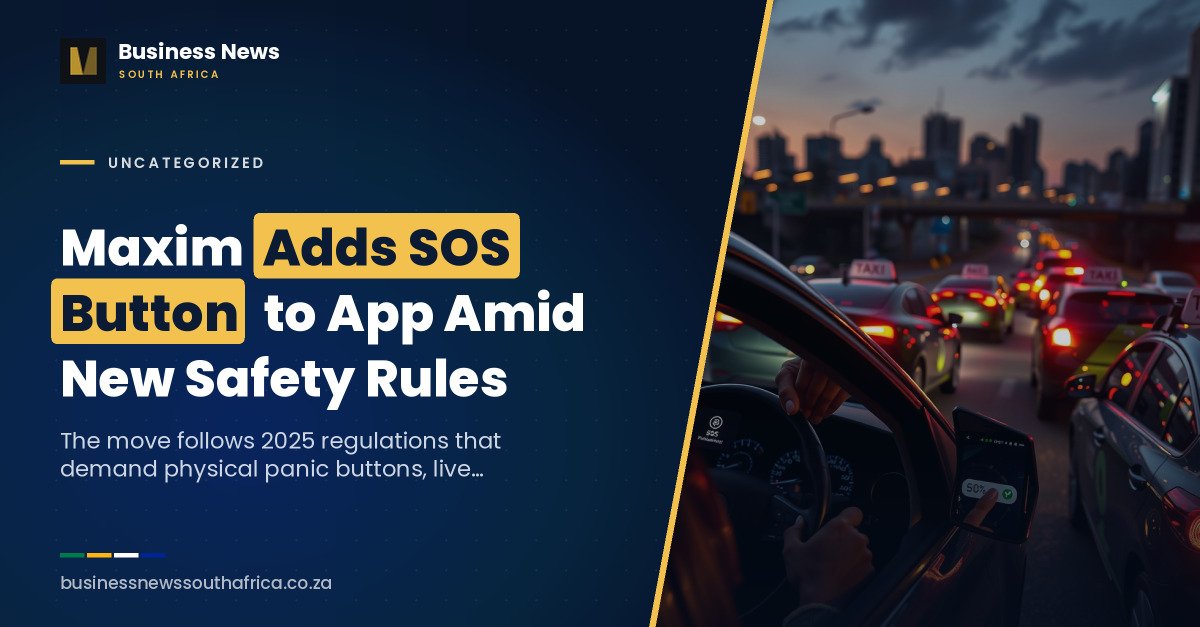
Maxim, the e-hailing platform that operates in more than a dozen South African cities, says it has added an SOS button to its driver app. According to a company statement sent to us on 21 October 2026, the button lets a driver call 112, text an emergency contact with a map link, or send an alert to nearby Maxim drivers. The statement gives no launch date, no driver numbers and no safety figures, so here is what the button does, how it compares with what Uber and Bolt offer, and what the law now requires.
What this means for your business: if you own e-hailing vehicles, run a fleet, or pay for staff rides or deliveries through these apps, driver safety is now a licensing and cost issue as well as a human one. The questions below are the ones to put to any platform.
What Maxim says the button does
Going by the company’s statement, a driver who presses SOS gets three choices. They can call 112, which the statement describes as South Africa’s mobile emergency number. They can send an SOS message to a family member, partner or friend they have named in advance, who receives an SMS explaining that the driver has listed them as an emergency contact, with a link to the driver’s location on a map. Or they can send an SOS signal, with their location, to Maxim drivers nearby. Lesoli Lemphane, Maxim South Africa’s Head of Development, is quoted as saying the feature gives drivers another practical way to call for help.
The statement does not say whether any private security or medical response company is connected to the button, how quickly alerts are acted on, whether the app records trips, or how many drivers have it. Those are gaps worth knowing about. The nearby-driver alert also raises a question the statement does not answer: what a driver who receives one is expected to do, and whether that puts them at risk.
Where Maxim stands legally
Maxim received its registration certificate from the National Public Transport Regulator on 27 February 2026, the company said, according to TopAuto’s report of 20 March 2026. The certificate confirms compliance with Regulations 15 to 18 of the Second National Land Transport Regulations of 2025. Business Report reported that platforms not registered by the 11 March 2026 end of the 180-day compliance period would be considered illegal, and that Bolt had also received its certificate.
What the regulations require
The rules, gazetted in September 2025 under the National Land Transport Amendment Act, as Business Day summarised them in July, include:
- a physical panic button within reach of both driver and passengers;
- live location tracking from the start of a trip to its end;
- a sign or branding that identifies the vehicle as an e-hailing vehicle;
- a professional driving permit for drivers, which includes a criminal record check; and
- a fine of up to R100,000, or up to two years in jail, for app developers that let people operate without a licence.
Transport Minister Barbara Creecy said the regulations require a panic button in the vehicle and encourage an in-app one, MyBroadband reported. So Maxim’s in-app button is the encouraged extra, not a substitute for the physical in-car button that the regulations make compulsory.
Not everyone thinks these measures protect drivers. The National E-Hailing Federation of South Africa’s president, Elijah Lekgowane, warned that exterior branding makes drivers “a clear target”, in the same MyBroadband report, a concern also reported after the 2025 killing of an e-hailing driver outside Maponya Mall.
How Uber and Bolt compare
Uber. In July 2026 Uber added a “Record My Ride” feature that lets drivers record encrypted video during trips as evidence, and said its in-app SOS button connects riders and drivers to emergency responders nationwide, EWN reported. Uber’s emergency partner AURA links users to the nearest private security or medical response team, and its general manager for Sub-Saharan Africa, Justin Suttner, said “there are a few gaps still to be plugged”.
Bolt. Bolt’s SOS button sits in the app’s Safety Toolkit and, since an April 2023 partnership with the AA, connects drivers and passengers to private armed response and emergency medical rescue, free to users. Bolt has also added a selfie check to stop drivers renting out profiles.
On that comparison, Maxim’s design differs in two ways from what the others describe: it routes to the public 112 number and to people the driver knows, and it adds a peer alert to other drivers. Neither platform’s statements prove that any button works in practice. In 2022, Rest of World reported that five drivers pressed Bolt’s SOS button during a test and the promised callback within 90 seconds never came. That test is four years old and Bolt’s emergency partner has since changed, but it is the only independent test of a South African e-hailing SOS button that we found.
The numbers nobody publishes
There is no official count of attacks on e-hailing drivers. In the 2022 Rest of World report, a South African Police Service spokesperson said police had no specific crime code for violence against e-hailing drivers, and the platforms do not publish incident figures. Claims such as a driver being killed every week come from drivers’ groups and are not verified. We checked our own coverage for a number and have none. For context on the broader crime picture, see our report on the national hijacking list.
What to ask any platform
- Who answers the alert, how quickly, and is it a paid private response team or only a number to dial?
- Does the app record trips, and who can see the footage?
- Is the platform registered? The National Public Transport Regulator certificate is the check.
- Has the vehicle got the physical panic button the regulations require?
- Can it show test results, such as response times, rather than a feature list?
If you are building or running a fleet, our guide on how to build a profitable e-hailing fleet covers the economics, and our report on Bolt’s electric-vehicle rides in Johannesburg shows where the platforms are investing.
What we could not confirm
We could not confirm when Maxim’s SOS feature went live, which cities it covers, whether it is connected to any security company, or whether it has been tested. We could not confirm Maxim’s current cities or driver commission, and we have not interviewed anyone at Maxim. The company’s statement describes the feature but offers no figures. We found no independent statistics on attacks on e-hailing drivers, and no current independent test of any platform’s SOS button.