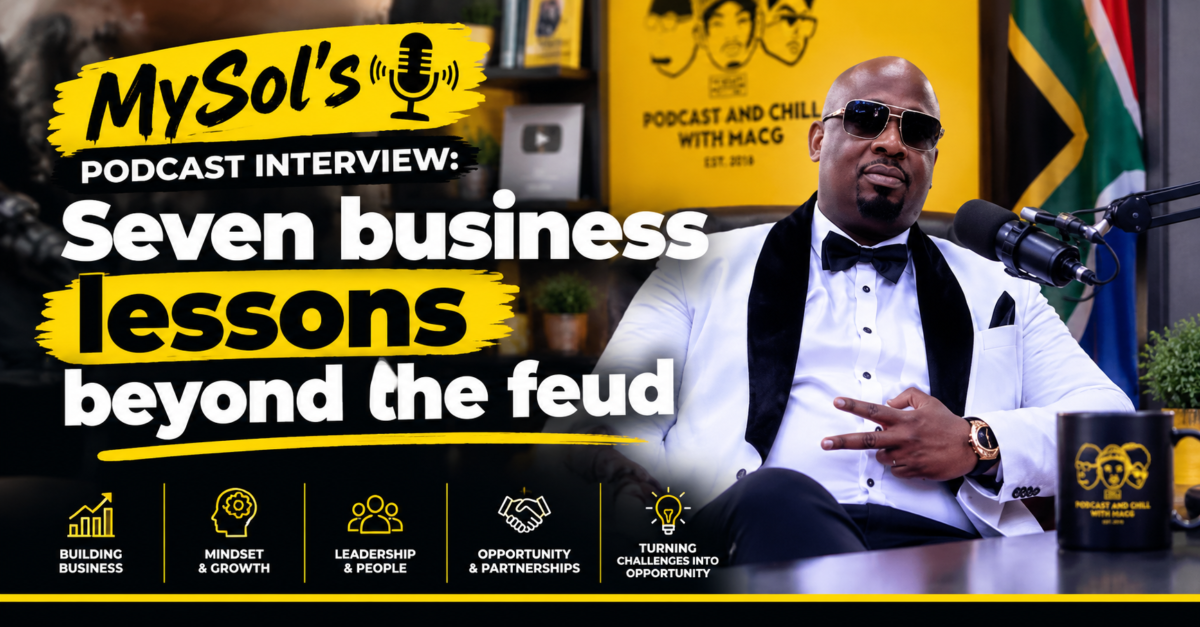
Chrome mining contractor Solly Madibela, known as MySol, spent more than three hours on the Podcast and Chill network’s channel this week, answering claims made on the same show a week earlier by his former associate Benjy Maponya. The two men’s accounts of how their arrangement ended conflict, and we do not adjudicate them here. What is left, once the feud is set aside, is an unusually candid account of how a contract miner thinks about tenders, cash and risk. Each lesson below separates what he said from what can be checked.
Who is speaking
According to a Volvo Construction Equipment customer profile published in March 2025, Madibela founded MYSOL in 2018, started with hired machinery and aimed to extract 200,000 tonnes of chrome a month with his own fleet by 2025. The profile says he took delivery of 18 articulated haulers and several excavators in September 2024. “In this industry performance is everything,” he is quoted as saying. In the interview he said he worked about 15 years in mining before starting his own company. His claims of more than 2,500 employees and 181 small community contractors are his own, and we could not verify them.
1. Community tenders reward locals, but capacity decides who wins
Madibela said mine tenders are advertised to the surrounding community and that the evaluation includes a section on how a bidder will develop local businesses. A firm that qualifies as local but cannot fund the work, he said, finds a technical partner, and he described joining a partner for one project only, with a 50% split.
The regulatory background is real. The 2018 Mining Charter, summarised by the Department of Mineral Resources when it was gazetted on 27 September 2018, requires mining right holders to prove local content and to contribute meaningfully to mine community development. It also provides for a 5% equity-equivalent benefit for host communities and keeps social and labour plan commitments separate. The terms that apply to a given tender depend on the mine and its mining right, so read the actual bid conditions. His own advice on the paperwork is sound: he said he told his local partner to have lawyers read the contract before signing, and scoping a joint venture to a single project limits what can go wrong.
2. Cash flow decides who can play
“You get paid in 90 days,” Madibela said of mining contracts, which means the contractor carries diesel, salaries and machines in the meantime. He put the price of a single large excavator at about R14 million.
Late payment is a wider problem than mining. Business Partners, a financier of small businesses, cited National Treasury data showing that 95,399 invoices older than 30 days, worth R12.4 billion, were unpaid at the end of the second quarter of 2025. That is government payment data, not mining. Its recommendation applies to any contractor: short-term funding matched to your invoicing cycle. Before you bid, model the full payment delay, and keep our late payment and debt recovery toolkit to hand for the invoices that run over.
3. Development spending works best when it is structured
Madibela described buying machines worth R2 million to R3 million for small contractors, giving them a three-year contract and deducting part of each invoice until the machine is paid off, after which they own it. His example was R300,000 to R500,000 taken from a R2 million invoice. He said the same approach covers 181 businesses. He also said he pays full tertiary costs for 20 learners a year and had trained 200 excavator operators for about R5 million.
The structure is the lesson: repayment comes from the work itself, ownership is defined from the start, and the supplier base grows with you. The risk is concentration, since every borrower depends on one client’s contracts. On training, employers with a payroll above R500,000 a year pay a skills development levy of 1% of salaries. Check with your sector education and training authority how much of it you can recover through grants before you fund training from scratch.
4. Check your partner’s solvency before you sign
Madibela said his joint venture partner was liquidated three months into the contract and that the client’s rules do not allow it to rely on a liquidated supplier, so the contract was terminated and put out to tender again. That is his account, and we have not seen the documents.
The risk is common. Stats SA recorded 753 insolvencies in the first half of 2026, as we reported from the release. Before a joint venture, check the partner’s finances and compliance record, and write an exit clause that says what happens to the contract if either side becomes insolvent.
5. Visibility attracts audits and security costs
Madibela said SARS had audited his company three times in the past year, that he hired a former SARS auditor, and that his office team is always working through the next audit. He also said extortion and kidnapping are real risks for visible business owners and that he travels with security.
Section 40 of the Tax Administration Act lets SARS select a person for audit on any consideration relevant to the proper administration of a tax Act, including a random or risk assessment basis, so an audit is not proof of wrongdoing, and the practical answer is clean, retrievable records. On crime, police recorded 519 extortion cases and 4,638 kidnappings in the first quarter of 2026/27, the latter up 172 on a year earlier, The Post reported. Budget for security as a running cost once you are growing and visible.
6. Policy risk sits inside your supply chain
Madibela argued that chrome should be washed and smelted in South Africa instead of being exported raw. The trade numbers show how large the issue is. China took a record of nearly 12.5 million tonnes of South African chrome ore in 2025, up 23.8%, and high-carbon ferrochrome exports in May 2026 were 48.76% below May 2025, according to Shanghai Metals Market analysis. The same analysis says South Africa plans an export permit for chrome ore and has discussed a tax of up to 25% on unprocessed ore, with the timing uncertain. If you supply miners, test what a change like that would do to their volumes, and to your invoices.
7. Reputation problems need a plan, not a hope
Briefly News reported on 8 October that Madibela had obtained a court interdict against the Podcast and Chill network and Maponya, barring publication of the contested statements and any allegations linking him to criminal activity. The report did not name the court or give the date of the order, and we found no second source. Stopping a publication in advance is hard in principle: in a 2007 case about a broadcaster and a pending criminal trial, the Supreme Court of Appeal held that an order of that kind needs a real risk of demonstrable and substantial prejudice and that “mere conjecture or speculation” will not be enough. The practical point for any owner is to keep an evidence file, know your lawyer before you need one, and answer public claims with documents, not heat.
This piece covers the business content only. The episode includes serious allegations about private individuals that we have not repeated and have not verified.