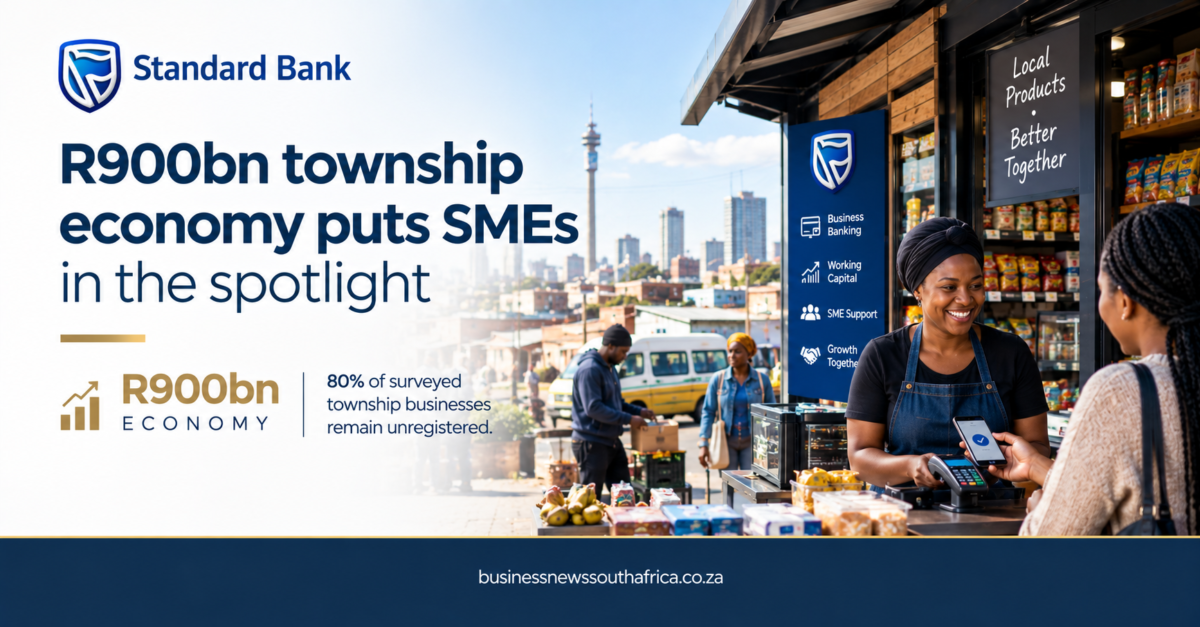
Standard Bank puts the township economy at about R900 billion a year, and some estimates go above R1 trillion, according to its 2025 Township Informal Economy Insights Report. Naledzani Mosomane, head of enterprise and supplier development for business and commercial banking at the bank, discussed the findings on a Moneyweb Mzansi Business podcast published on 21 September 2026.
What the report found
The report was compiled for Standard Bank by the market research consultancy Foshizi. It is based on interviews with more than 250 businesses in five provinces (Gauteng, KwaZulu-Natal, the Western Cape, Limpopo and North West), with annual turnovers ranging from R100 000 to R50 million. Those businesses employ more than 7 500 people between them.
Nearly 80% of the businesses surveyed are not registered. Fewer than 9% have access to a bank loan, and more than half (57%, according to the bank) rely on personal savings to keep going. About 49% operate from a home or garage, while only 11% work from commercial premises.
The most common sectors were retail (15%), transport and logistics (13.8%), tourism and hospitality (13%) and hair and beauty salons (8.5%), according to coverage of the report by Forbes Africa.
Cash still runs township trade
BusinessTech reported that the R900 billion estimate represents about 12.3% of gross national product, and that the informal economy accounts for 19.5% of total employment, using Stats SA data. The report found that cash remains the main way customers pay, driven by customer preference and limited digital literacy. Business owners cited high fees, a lack of transparency and safety worries about tap-and-go payments as reasons they hold back from digital options.
Many owners also keep more than one account, usually a personal one and a business one, though the second is not always a formal business account. The report also found that entrepreneurs can face as many as 20 similar businesses competing for the same customers in a single community.
Cash dominates, but the same survey found that more than 56% of owners prefer to be paid by EFT or bank transfer, according to FAnews. In other words, the appetite for digital payment is there even though customers still pay in notes and coins. FAnews also quoted Simone Cooper, head of business and commercial banking at Standard Bank: “This report shows the structural challenges facing township entrepreneurs and what it will take to overcome them.” The bank points to its MyMoBiz entry-level transactional account and its SimplyBLU merchant platform as products aimed at this market.
Forbes Africa, citing the report, says the township economy contributes about 6% of South Africa’s GDP, a different measure from the 12.3% of gross national product quoted by BusinessTech, so the two percentages should not be compared directly. The 19.5% employment share refers to the fourth quarter of 2024.
Four areas Standard Bank says must improve
Mosomane told the podcast that unlocking the sector depends on four things: access to markets, funding, infrastructure and knowledge. On registration, he said: “If you want to scale your business, you can’t operate informally because that ultimately leads to a lack of opportunities.”
In practice, that means a formally registered business can bid for corporate supply contracts and apply for conventional finance, which an unregistered one generally cannot. Standard Bank’s own material on the report makes a related point in Mosomane’s words: “Funding without development doesn’t deliver sustainable change.” The bank says programmes that pair skills development with access to capital are what the sector needs, and it describes the township economy as “rich with enterprise, ingenuity, and potential.”
Where this leaves township business owners
The figures show a wide gap between the size of the sector and the finance reaching it. A business turning over between R100 000 and R50 million a year that has no registration, no business account and no bank history has few options beyond savings and family loans, and that is the position of most firms in the sample.
Owners who want to move towards formal funding have a concrete first step in registering the business and opening a dedicated business account. Our SME and entrepreneurship coverage follows funding programmes aimed at small firms, and the regulatory and policy desk tracks changes to registration and compliance rules. Readers following the wider consumer picture can also look at retail and consumer news.