Speaking on the Mindset Profits podcast, entrepreneur Teboho Nthoana gave the host a long, personal account of what he says South African founders get wrong: selling township-born products only to the township, spending early profit on show, and writing off corporate careers. This article covers the business parts of the conversation. What follows is Nthoana’s own opinion and experience, in his words, and the figures are his recollection, not audited numbers.
The township market, and why he calls its size unverifiable
Nthoana said he won a research essay competition run by PSG, which he described as an annual contest for South Africans who think big. He wrote about the township economy, although he told the host he has no economics qualification. He said the winning paper placed him ahead of an economics research professor, who came second, and a professor from another Johannesburg university, who came third.
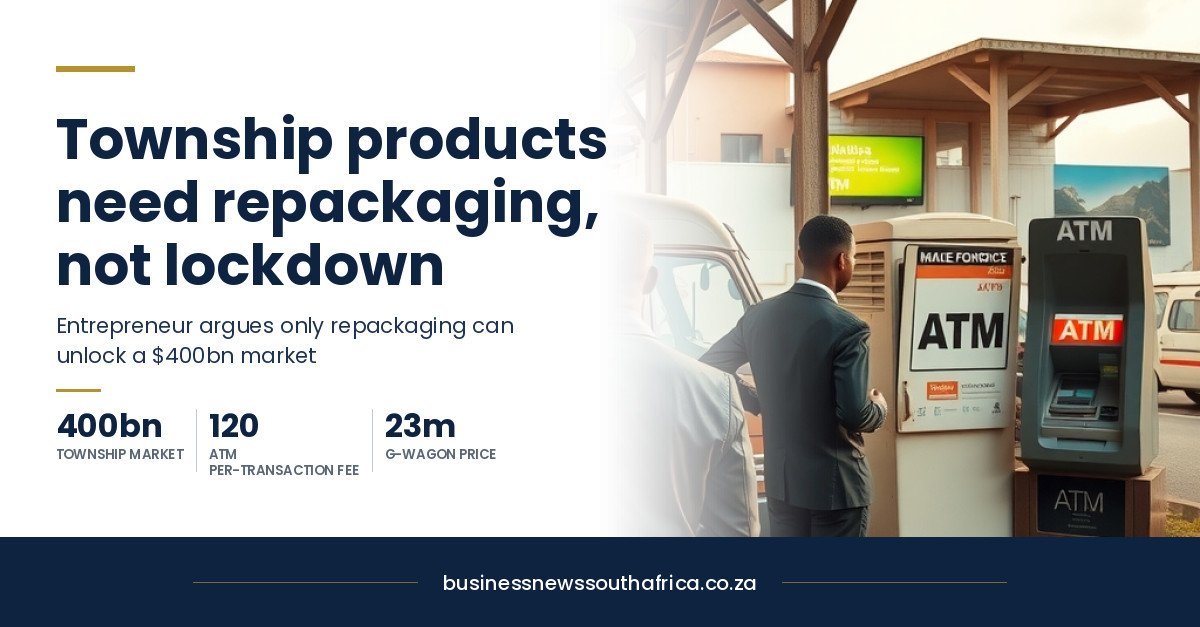
One finding was a market size. In his words, there is “arguably close to about 400 billion” sitting in the township economy. He was careful to add that the number is “unverifiable”, and said it shows how big the sector is because nobody can quantify it properly. Treat the figure as his estimate. He did not name a source for it, and we have not found one.
He argued that retailers already behave as if the market is real. In his view, the arrival of shopping malls in townships is itself the evidence. He also said townships differ from one another in culture and in the businesses that operate there.
Know your market, then repackage for it
The most practical idea in the interview is repackaging. Nthoana said “it’s important for you to know the kind of business you’re running and where you’re running it.” His example was magwinya (fat cakes). A seller who pitches the product from a bucket in a suburban business area, he said, will meet customers who worry about hygiene and where the oil came from, and many of them will not buy. The same seller at a busy taxi rank, he said, “chances are he gets sold out.”
His wider point was that product quality is not always the problem. In his words, “sometimes these businesses don’t become as amazing because they’re selling to the wrong market.”
He then pointed to two brands as proof of what packaging can do. He said Fat Cake City took the township fat cake, added fillings and turned it into a franchise. He credited Kota Joe with doing the same for the kota, and called it a multi-million franchise. He also said the name “Spios” is a registered trademark that the township community does not own. We could not verify his franchise or trademark claims, and the Kota Joe website we checked describes a roadhouse chain selling burgers, kotas and milkshakes, so treat the rest as his account.
He gave a smaller example from his own work. For a team-building event, he said, he skipped the usual catering and booked township food sellers. He said guests enjoyed it and he was paid well and invited back.
The ATM story: counting your own foot traffic
Nthoana said his team once launched a township business that took in millions, which made him decide to put ATMs on the site. He approached several banks. One carried out a visibility study, and he said it found transaction volumes “in the thousands” across banks. He could not recall whether the number was 40,000 or 400,000.
Because one bank had approved the idea, he said he used its numbers to approach another, and then negotiated how he would be paid: a fee per transaction or a monthly rental. He chose the per-transaction route. He recalled the fee only as a figure of about 120 and did not say whether he meant cents or rand, so we are not stating a rand amount. His summary was that it “looks like small money”, but with the volume involved it was “good money.”
The business lesson he drew is that a busy site can be monetised in ways the owner does not first see, and that a third party’s study can become negotiating evidence. Owners weighing the cost of card payments and terminals can compare the options in our business bank accounts guide.
His season of showing off
Nthoana, who said he won a Future 100 top entrepreneurs award in 2011, was frank about his own mistakes. “My season of showing off it was it was stupid,” he said, because he spent what he could have used to build on show. He said he later learned from people with more substantial wealth.
His advice is built on observation, not data. He said some of the wealthiest people he has met dress simply and avoid big logos, and that “wealth whispers.” He pointed to well-known South African families and said they tend to buy businesses, not flashy brands. He also said such families could afford a six-wheeled G-Wagon (he put it at 23 million) but would rather drive something like a Maybach (about 12 million) and keep building for the long term. He did not name the currency, and the prices are rough. His yardstick was how many properties he holds, which shares he owns and what dividends they pay.
He also described a robbery at a mentor’s home in which, he said, the thieves ignored valuable items such as Montblanc items and took cheap ones, because they did not recognise real value. He used the story to argue that status symbols attract attention without protecting anyone.
This is general information about one speaker’s views, not financial advice. Decisions about property, shares or dividends depend on your own circumstances and are worth discussing with a licensed adviser.
“There’s millionaires that are sitting in corporates”
Nthoana pushed back on the idea that entrepreneurship is the only route to wealth. “Do you know how many millions millionaires are sitting in corporates?” he asked, adding: “There’s millionaires that are sitting in corporates.” He blamed American content for the message that you cannot build wealth from a salary, and said some people who believe it resign without a plan and fail.
To make his case he cited pay and bonus figures from memory, and they were not consistent. He mentioned a Capitec chief executive package of about 109 million a year, an Eskom figure of about 15 million, and an average of about 23 million for JSE-listed companies. We have not checked any of them, and you should not rely on them. He also said a friend was unhappy with a 2.8 million performance bonus because he expected 3.5 million, and that he knew someone whose sign-on bonus was 3 million.
His conclusion was that a person whose strength is working inside a “protected” corporate environment should stay and grow there, while street-level trading suits others. Those who lean the other way may find our guide to scaling a business in South Africa useful, because it covers the gap between a small operation and a mid-sized one.
Hiring beyond your own limits
On growth, Nthoana said the best entrepreneurs are often those who have worked in corporates and understand how they operate. He respects owners who can say they have taken a business to a certain level and need other people to take it higher. As an example, he described a friend, a black woman entrepreneur whose staff are about 90% white. According to him, her salary bill is high, but so is the revenue she brings in.
The failure problem
He said a business trip to Israel around 2014 or 2015 left a lasting impression. As he told it, the investors he met gave more money to founders who had failed, because they saw failure as getting closer to a breakthrough, and they were surprised that South Africa treats it differently. In his words: “you fail we blacklist you we liquidate you we do all of these things to make sure that you do not come back.” That is his characterisation of local attitudes.
Where the guidance fits for South African owners
He also prefers mentoring in small circles of about ten people to one-on-one sessions. Several parts of the interview move into politics, race and personal relationships, and we have left those out because they are the speaker’s opinions and are not business guidance.
For owners looking at funding for a township business, our explainers on Gauteng Enterprise Propeller funding and SEFA funding set out what each programme asks for.
- Match the product to the buyer: Nthoana says the same item can fail in one setting and sell out in another.
- Look for income hiding in your foot traffic, and get third-party data before you negotiate.
- Spend early profit on the business first: his own showing-off phase, he says, cost him.
- Do not dismiss corporate careers or corporate hires: he says both can unlock growth.