The relaunch of the Township and Rural Entrepreneurship Programme (TREP) was scheduled for Tuesday 27 October 2026, and the agency that runs it now shows the enhanced programme on its own pages. As at 29 October, the Small Enterprise Development and Finance Agency (SEDFA) shows TREP as enhanced, with loans of up to R3 million and an Apply now button. The Department of Small Business Development (DSBD) has not yet posted a report on the event. This is what each official page says today, what they disagree on, and what we could not confirm.
The relaunch went ahead on 27 October, according to SEDFA’s own posts
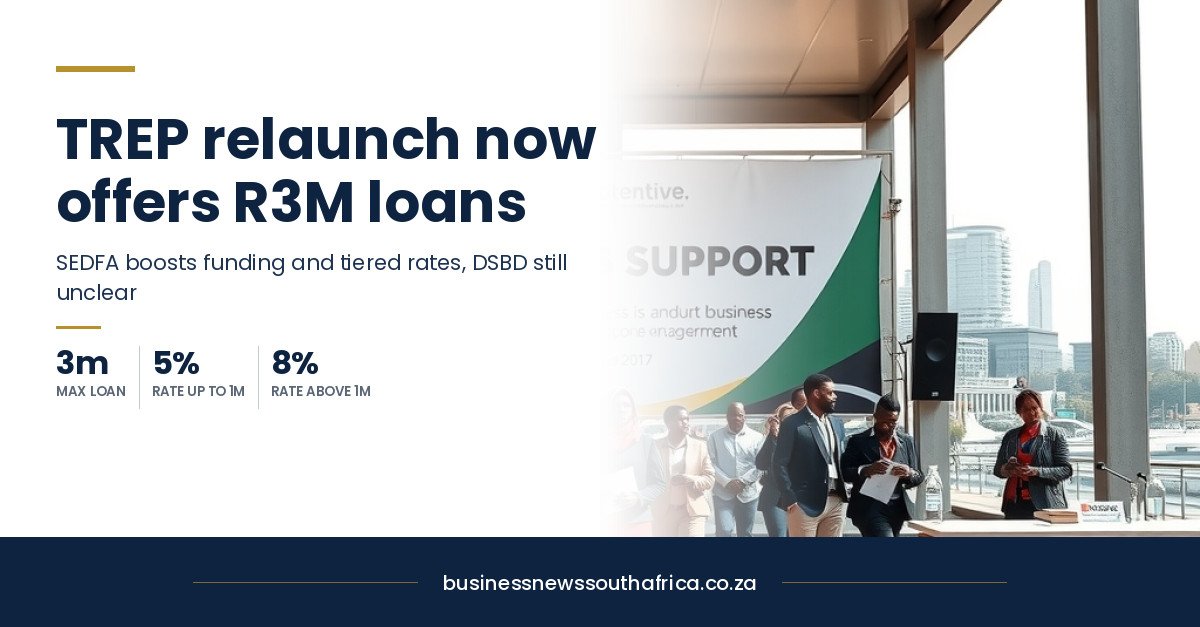
DSBD’s media advisory, dated 22 October, said Minister Stella Tembisa Ndabeni would relaunch the programme at Seshego Stadium in Polokwane, Limpopo, at 09:00 on 27 October. The advisory listed the changes: the maximum funding rising from R1 million to R3 million, an interest rate of 5%, repayment terms of up to 60 months, a repayment moratorium of up to six months, blended finance, and stronger business support. It is on the DSBD media release page.
DSBD’s media releases list had no post-event statement when we read it today. The latest entries were the 22 October advisory and a 26 August item on the Spaza Shop Support Fund. The evidence that the event took place comes from SEDFA’s social posts. The Spaza Shop Fund website carries a live feed of SEDFA’s X account, and two of those posts are dated 27 October. One says the relaunch in Seshego highlighted the importance of connecting small businesses with support opportunities. The other shows businesses exhibiting at the relaunch, “held earlier today at Seshego Stadium, Ground B”. That is a feed on a partner site, not a statement on SEDFA’s own pages, so we treat it as confirmation that the event happened, not as a full account of what was announced.
SEDFA’s TREP page carries rates and terms that differ from the advisory
The SEDFA TREP page and the agency’s TREP brochure (a PDF whose file data shows it was created on 13 October 2026) set out the programme in more detail than the advisory does. The pages carry no date, so we cannot say when the wording was last changed. They state:
- Funding of up to R3 million per business.
- A fixed interest rate of 5% on facilities up to R1 million, and 8% fixed on facilities above R1 million up to the R3 million ceiling.
- Repayment terms of up to 60 months, with a moratorium of up to six months on capital and interest, based on cash flow.
- Blended finance of 60% loan and a grant of up to 40%, with the grant portion decided by SEDFA’s Grant Scorecard. A stronger business case, inclusion profile and job creation earn a larger grant, according to the brochure.
- Eligibility for all sectors, with digital, green economy, creative and tourism named.
The difference matters. DSBD’s advisory says the department will maintain a 5% rate, with no mention of a second tier. SEDFA’s two documents say 5% applies only to facilities up to R1 million and 8% applies above that. A business asking for R2 million should therefore work from SEDFA’s figures, which are the ones attached to the application, and confirm the rate in writing before signing anything. We have not seen a DSBD correction or a reconciling statement.
Who qualifies, according to SEDFA
SEDFA lists these requirements for TREP applicants: registration with the Companies and Intellectual Property Commission (CIPC), a category that includes co-operatives and sole proprietors; 100% South African ownership; operation in a township or rural area; SARS registration; a valid business bank account; and at least one owner actively involved in running the business. Priority goes to businesses owned by women, youth and persons with disabilities.
The brochure adds conditions that are easy to miss. Applicants must be willing to complete SEDFA’s Business Development Services programme, which runs for three to six months. Funds may be paid straight to suppliers or service providers instead of to the applicant. People under debt review or insolvency, businesses in business rescue or liquidation, labour brokers, and entities on development finance institution delinquency registers are not eligible.
DSBD’s own TREP programme page still describes an older version. It lists target sectors such as clothing and textiles, bakeries, retail, automotive and personal care, and asks for 70% South African employees and a municipal business licence. Those conditions do not appear in SEDFA’s current list. The DSBD page is undated and has not been updated for the relaunch, so applicants should follow SEDFA’s version.
Applications go through SEDFA’s online portal, with documents ready
SEDFA’s route is five steps: check eligibility, prepare documents, apply online at sedfa.org.za by selecting TREP, wait for assessment and approval by SEDFA, then contracting and disbursement. The documents named are CIPC registration papers, SARS documents, proof of address and six months of bank statements. SEDFA says its offices, municipal local economic development offices and Business Regulation Officers can help with an application. The brochure lists 012 748 9600 for financial enquiries and 0860 103 703 for non-financial ones.
The Apply now button on SEDFA’s TREP page leads to SEDFA’s online application. We did not create an account and did not test an application. Neither DSBD nor SEDFA publishes a closing date, a total budget for the programme, or a turnaround time, and DSBD’s promise of faster turnaround comes with no figure. We cannot say how many businesses will be funded, and nothing here should be read as a promise of approval.
The Youth Challenge Fund shows an apply route but no dated call
The SEDFA page for the Youth Challenge Fund describes a loan-and-grant programme for businesses owned by people aged 18 to 35, run with the European Union’s EDSE programme. It gives funding of up to R2 million for start-ups and up to R15 million for growth enterprises, split into a Technology and Innovation channel and an Other Products and Services channel. Applications are made online, and incomplete ones get a 20-day window to be completed. Exclusions include debt repayment, activities already funded by another government body, and applicants with a record of fraud or an unrehabilitated insolvency.
The page is undated and shows no opening or closing date. DSBD’s own page for the fund is also undated and frames it as a response to Covid-19. Status: listed with an apply button, no public call date, and we could not confirm whether new applications are being accepted. Business owners should ask SEDFA before spending time on a submission.
The Spaza Shop Support Fund shows an apply button while earlier applications are still being processed
DSBD’s Spaza Shop Support Fund page lists three parts: a stock grant of up to R40 000, a blended grant and loan of up to R50 000 for infrastructure such as refrigeration and shelving, and up to R10 000 of non-financial support. The fund’s own website puts the total at up to R100 000, with a 50% grant and 50% loan split for funding above R50 000. Owners must be South African citizens (or naturalised before 1994), operate in a township or rural area, and hold municipal registration. CIPC registration becomes compulsory within six months for funding above R80 000, and SARS registration or a six-month transition is required.
The fund’s site still shows how to apply through a portal and carries no closing date. DSBD’s 26 August release said a press briefing would update the public on the fund. Status: an apply route is shown, and we could not confirm whether the portal is still taking new applications. Our guide to the Spaza Shop Support Fund covers the background.
What we could not confirm
The SEFA website, sefa.org.za, would not load securely when we checked, and we did not bypass the warning. The remaining gaps are the date of the latest edits to SEDFA’s TREP and Youth Challenge Fund pages, whether DSBD will correct its 5% rate wording, how many businesses TREP will fund, and whether the Youth Challenge Fund and spaza portals are open to new applicants. Anyone planning an application should read the pages themselves and phone SEDFA first.
For a wider view of what else is open, see our funding open this week roundup and the list of government funding programmes. Younger founders can also compare the NYDA grant programme, and our report on the UIF and NEF R1 billion fund covers a separate government-backed fund.