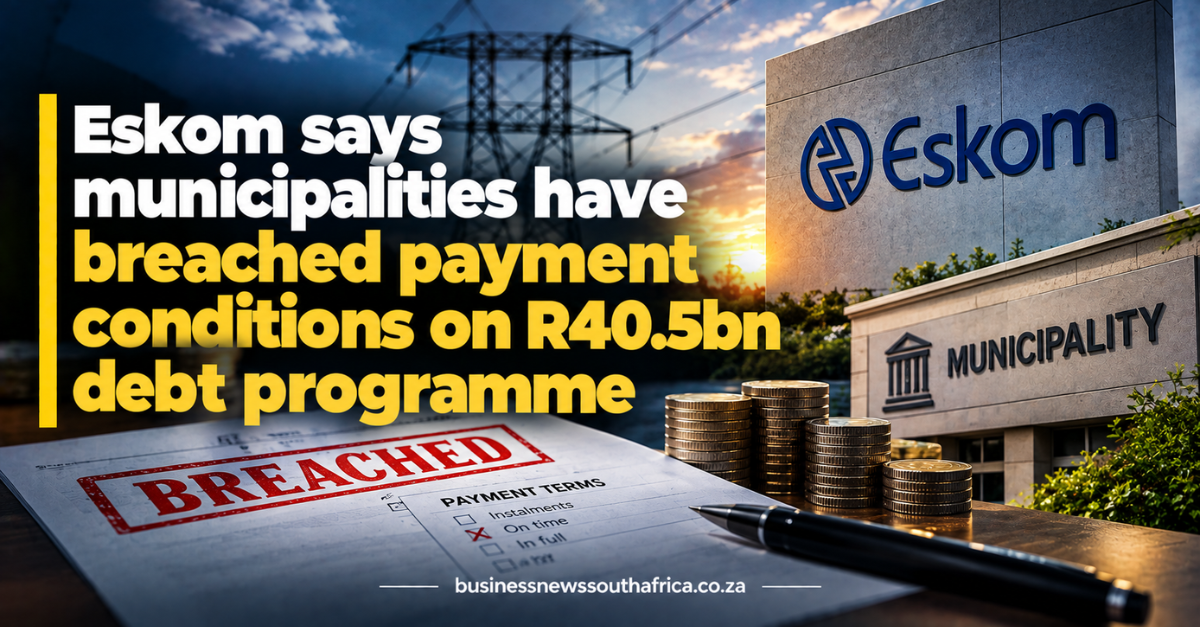
Eskom announced on Monday that a number of South African municipalities have not complied with the payment conditions attached to a R40.5bn (forty-point-five billion rand) debt relief programme. The utility said the breaches were identified during its routine monitoring of the programme, which was designed to help municipalities manage overdue electricity bills while keeping the power grid stable.
The programme, launched in 2022, allows municipalities to spread large arrears over several years, provided they meet quarterly payment milestones. A payment milestone is a pre-agreed amount that must be paid by a set date; missing a milestone triggers a breach of conditions. Eskom’s statement noted that the missed payments were not isolated incidents but involved several municipalities across different provinces.
For small-business owners, the immediate question is whether this will affect the reliability of electricity supply. Eskom warned that continued non-payment could force it to reassess the credit terms it offers to municipalities, potentially leading to tighter cash-flow constraints for local authorities. In practice, tighter terms could mean delayed or reduced electricity allocations to municipal customers, which may translate into more frequent load-shedding periods for businesses that rely on a steady power supply.
Load-shedding, the controlled rolling blackouts used to balance supply and demand, has already been a cost factor for many SMEs. When municipalities struggle to pay Eskom, the utility’s ability to invest in maintenance and new generation is compromised, which can exacerbate supply shortfalls. The breach therefore adds another layer of uncertainty for entrepreneurs who already factor in power interruptions when budgeting for operating costs.
From a broader perspective, the debt programme is part of Eskom’s effort to stabilise its own balance sheet, which has been under pressure for years due to high operating costs, ageing infrastructure and a history of unpaid municipal bills. The utility’s total debt exceeds R400bn (four hundred billion rand), and municipal arrears account for a significant slice of that amount. By enforcing payment conditions, Eskom aims to protect its cash flow and avoid further deterioration of its financial position.
Industry analysts have noted that municipal debt has been a persistent challenge for Eskom, with many local authorities citing cash-flow problems of their own. The current breach does not automatically trigger legal action, but Eskom said it will consider a range of responses, including renegotiating terms or, in extreme cases, suspending supply to non-compliant municipalities. The utility stopped short of detailing which municipalities were involved, citing confidentiality and the need to focus on the broader issue.
What remains unclear is how the breach will influence future negotiations between Eskom and the National Treasury, which oversees the allocation of state funds to the utility. The Treasury has previously stepped in to provide emergency financing when Eskom’s cash position became critical. If the breach leads to a wider funding shortfall, the Treasury may need to reassess its support, which could have knock-on effects for the entire energy sector.
For SME owners, the practical takeaway is to keep a close eye on any changes to municipal electricity tariffs or supply schedules. Some municipalities may pass on the cost of tighter credit terms to end-users through higher rates. Others might implement demand-side management programmes, encouraging businesses to shift consumption to off-peak hours. Both scenarios affect cash flow and operational planning.
In the meantime, Eskom said it will continue to monitor the situation and work with municipalities to bring them back into compliance. The utility emphasised that the debt programme remains a key tool for managing arrears, but it relies on the good-faith participation of all parties.