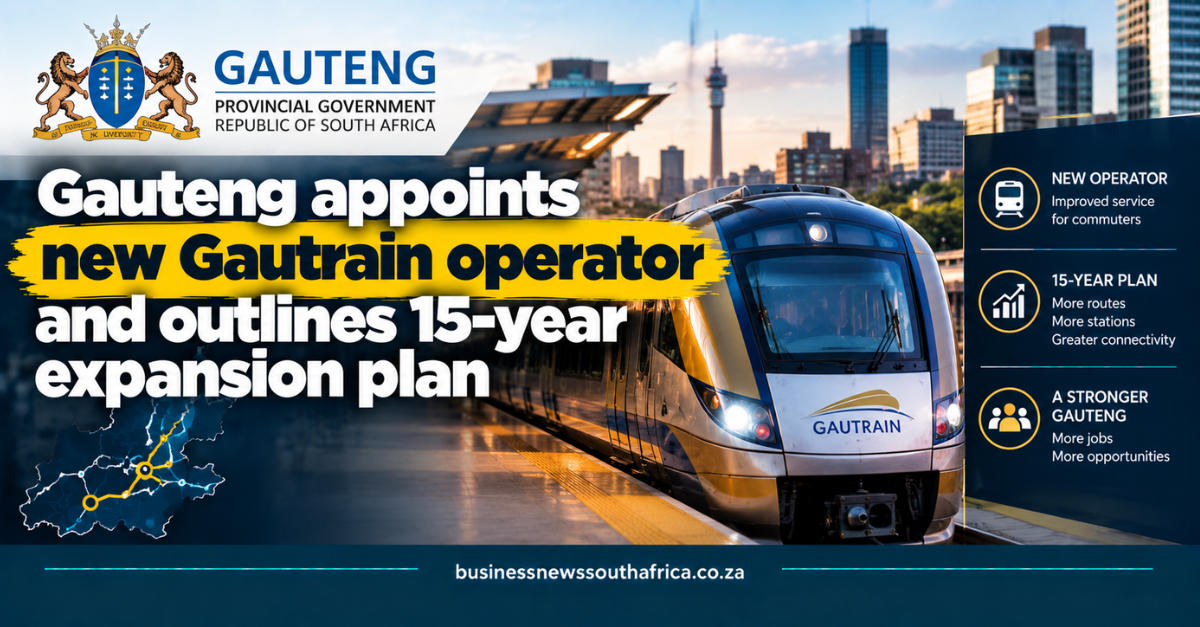
The Gauteng Provincial Government announced that it has completed the appointment process for a new operator of the Gautrain for the next fifteen years, although the operator’s name has not yet been disclosed. The government said the appointment provides certainty for the service and creates an opportunity to unlock further value from the rail system.
The plan calls for the fleet (the collection of trains) to grow from twenty-four four-car trains to thirty-two, a thirty-three point three percent increase in total capacity. In addition, the service will run more frequently, operate for longer hours each day and upgrade existing trains to improve passenger amenities.
For businesses that rely on commuter traffic, the changes could mean more footfall at stations and greater reliability for employees travelling between Johannesburg and Pretoria. Retail outlets, food vendors and logistics firms that serve the stations may see higher demand as trains run more often and for longer periods.
New stations and routes
The Gautrain also intends to expand its rail network as part of the Gauteng Rapid Rail Integrated Network (GRRIN). Routes gazetted in March 2026 will link the existing line to areas such as Randburg and Lanseria airport, adding new stations that could stimulate economic activity in those suburbs.
Beyond rail, the service plans to grow its bus routes that feed stations and to improve integration between buses and trains. Stations will receive upgraded digital services and full backup power to make the system more resilient during load-shedding events.
The agency previously floated an e-hailing service called Gau-Express to address “last-mile” travel. Senior executive manager for communication and marketing Albi Modise told MyBroadband in May 2026 that the project is still at a conceptual stage and will be finalised before being presented to stakeholders.
All of these interventions are slated to be implemented progressively over the fifteen-year period. The Gauteng Provincial Government said it will work with the Gautrain Management Agency and relevant stakeholders to manage the transition into the new operating phase effectively.
The Gautrain’s history stretches back to 2010, when the high-speed link first connected Johannesburg and Pretoria, and over the ensuing sixteen years it has logged more than 216 million passenger trips, underscoring its role in daily commuting patterns across the province. This long-standing usage base forms the backdrop for the upcoming expansion, as the new operator will inherit a system that already serves a substantial share of inter-city travel demand, providing a solid platform for the planned capacity boost and service enhancements.
With the appointment now sealed, the Gauteng Provincial Government will move to formalise the operator’s responsibilities through a concession agreement that outlines performance targets, investment obligations and reporting requirements. The agreement will stipulate milestones for fleet enlargement, timetable adjustments and station upgrades, and will be monitored by the Gautrain Management Agency to ensure compliance throughout the fifteen-year horizon.
The fleet growth from twenty-four to thirty-two four-car trains translates into a thirty-three point three percent rise in overall capacity, a figure that will be reflected in the scheduling software as additional train sets are commissioned. As each new set enters service, the timetable will be recalibrated to shorten headways, allowing passengers to benefit from more frequent departures during peak periods.
Extending operating hours will involve revising crew rosters and securing additional staff contracts, a process that the new operator will initiate once the concession is signed. The expanded timetable will be aligned with the bus network’s feed-in times, ensuring that connecting services are available throughout the longer service window and reducing waiting times for commuters transferring between modes.
Digital upgrades at stations will see the rollout of enhanced passenger information displays, contactless payment integration and real-time service alerts, all powered by the planned full backup power systems. These technological improvements are slated to be phased in alongside the physical infrastructure works, with priority given to high-traffic hubs to maximise early benefits for users.
The e-hailing concept, Gau-Express, remains in an embryonic stage, and the operator will be tasked with delivering a detailed business case before any pilot can commence. Once the proposal is finalised and presented to stakeholders, a tender may be issued to select a partner, after which the service could be integrated with the existing bus routes to offer a seamless last-mile solution for passengers.