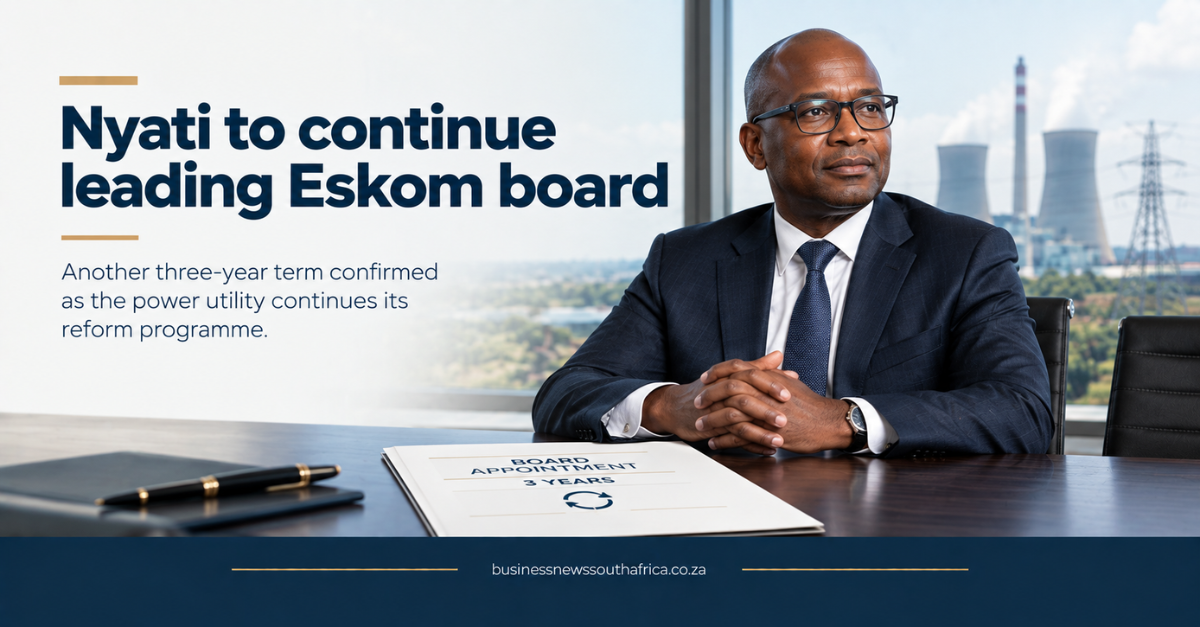
Electricity and Energy Minister Kgosientsho Ramokgopa announced on Friday that Mteto Nyati will remain chairman of Eskom, ending speculation that the board might be reshuffled after the utility released its annual results.
Nyati, a former chief executive of MTN South Africa and Altron, joined the Eskom board when it was reconstituted in October 2022, a period when load shedding had reached record levels. He became chairman a year later after Mpho Makwana stepped down. His three-year term was due to end in October, but the minister’s statement confirmed his continuation.
Ramokgopa used the announcement to outline what he called “Eskom 2.0”. The next phase, he said, will be judged on three criteria: sustained energy security, a financially sound utility and better service to South Africans. The board is now tasked with producing a single road map that covers the next three, five and ten years, defining public obligations, the future generation mix, commercial position and required investment.
According to the minister’s statement, Eskom must achieve those goals without relying on repeated fiscal support or sustained double-digit tariff increases. Nyati echoed that view at last month’s results presentation, saying tariff hikes alone are not the strategy.
The utility’s latest financials show a turnaround. Net profit after tax more than doubled to R30.3-billion for the year to 31 March 2026, its second consecutive profit after eight years of losses. Net debt fell by R45.3-billion to R313.3-billion. The figures are confirmed in Eskom’s audited statements, although Deloitte issued a qualified audit opinion because the utility had not fully recorded irregular expenditure.
For small and medium-sized enterprises, the continuity of leadership matters because Eskom’s performance directly affects electricity reliability and cost. The minister highlighted data centres as a sector that needs “a deliberate approach to reliable supply, suitable locations, network capacity and long-term contracts”. Mining and industry also remain key demand drivers, while municipal arrears, which rose 17.9% to R111.6-billion, continue to pressure supply and network investment.
Ramokgopa said the utility’s renewable arm, Eskom Green, must turn its approved strategy into a credible pipeline of projects, with an early step being engagement on about 2 GW of renewable capacity. The board is also expected to expand into Southern Africa through cross-border interconnectors and electricity trade, working with partners such as the Development Bank of Southern Africa, the Industrial Development Corporation and the African Development Bank.
Beyond the strategic roadmap, the minister called for a stronger commercial and customer strategy, smarter use of artificial intelligence for technical losses, forecasting and grid management, and tighter financial controls. Reducing system losses, improving procurement value and achieving an unqualified audit opinion are also on the agenda.
For entrepreneurs and SME owners, the key takeaway is that the board’s continuity could provide stability while Eskom attempts to implement its roadmap. However, the success of “Eskom 2.0” will depend on how quickly the utility can curb debt, avoid steep tariff hikes and deliver reliable power, factors that directly influence operating costs and growth prospects for businesses across the economy.
What to watch next
The board has not been given a deadline for the road map, so the timeline for concrete actions remains unclear. Stakeholders will be watching for the first set of concrete projects from Eskom Green, progress on the independent transmission projects programme and any signals of reduced reliance on fiscal bail-outs.
Read more about the energy sector in our Tech & Telco coverage.
TechCentral reported that the minister’s announcement settled a question that had hung over the utility since it reported its annual results last month, confirming that Nyati’s three-year term was due to end in October. The statement also highlighted that Nyati joined the board when it was reconstituted in October 2022, after load-shedding had reached record levels that year, and that he succeeded Mpho Makwana a year later. By thanking Dr Nyati for his leadership during a demanding period, the minister underscored that the board’s continuity will help carry the work into Eskom’s next phase, where success will be measured against sustained energy security, financial soundness and better service.
TechCentral reported that the Integrated Resource Plan 2025 requires Eskom to undertake technical and financial work for board decisions on the future of its fleet, including cutting emissions at existing coal stations, assessing coal-abatement technologies, repurposing and repowering power-station sites, and establishing a role in gas and nuclear. The minister also noted that the independent transmission projects programme will see private companies finance and build transmission lines, with spending aimed at supporting South African manufacturers, suppliers and skills development. These steps are intended to feed the “deliverable grid programme” that underpins the broader growth strategy.
The road-map that the board must produce will outline public obligations, the generation mix and required investment for the next three, five and ten years. For a South African business owner this matters because it signals the stability of supply, the likely trajectory of tariffs and the timing of new capacity that could affect operating costs. Stakeholders should watch for the first concrete projects from Eskom Green, the rollout of the independent transmission projects and any formal statements on how the utility will limit reliance on fiscal support.
Expanding the use of artificial intelligence to manage technical losses, forecasting and grid operations, together with smart-metering to improve revenue collection, are key components of the commercial strategy. Achieving an unqualified audit opinion, after Deloitte’s qualified view due to unrecorded irregular expenditure, will require tighter financial controls and reduced system losses. Business leaders should monitor progress on AI deployment, smart-meter roll-out and procurement value, as these factors directly influence cost predictability and the reliability of power for industry, mining and data-centre customers.