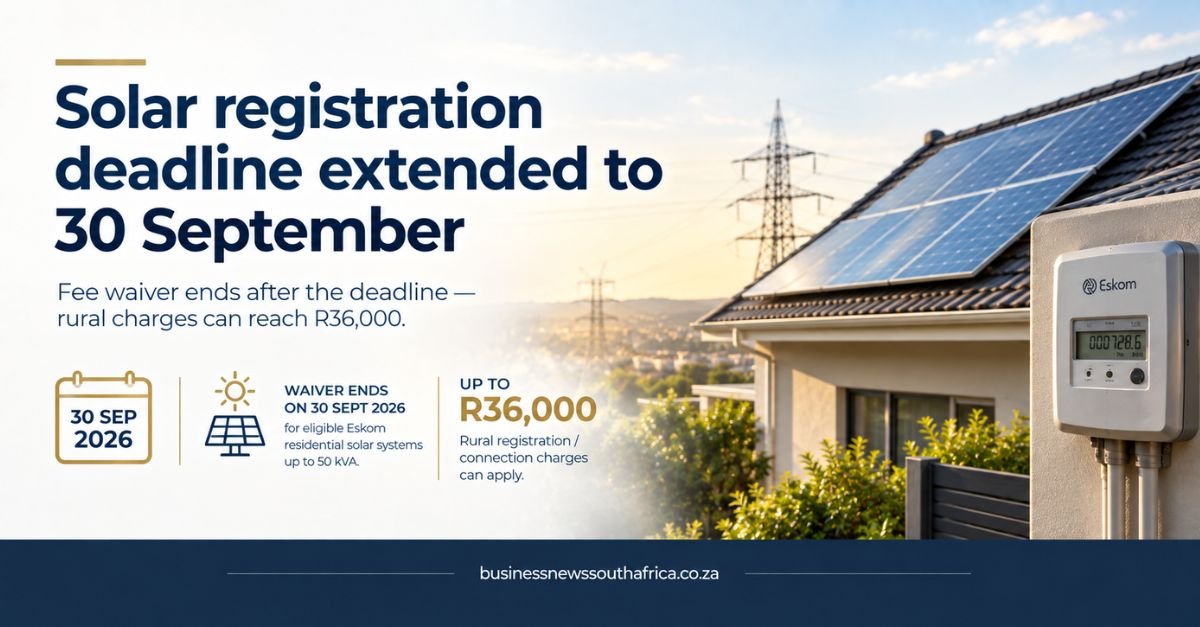
Eskom has scrapped the 30 September 2026 cut-off for its rooftop solar registration fee waiver. On Wednesday 30 September, the utility said the waiver of registration-related charges for eligible customer-owned generation systems of up to 50 kVA connected directly to its distribution network would continue “beyond 30 September 2026”, with no new compliance deadline set, as reported by TechCentral and News24. Until then, registration and connection costs of up to R10,000 for urban and residential customers and up to R36,000 for rural customers were waived only until 30 September, according to BusinessTech, which is why owners had been warned to register before that date.
How the deadline moved
Eskom first set 31 March 2026 as the cut-off. In a statement released on 26 March, its Acting Group Executive for Distribution, Agnes Mlambo, said that “all registration and connection fees including a free smart meter (up to R10k for urban/residential customers and R36k for rural customers), are waived until 30 September 2026”, as the utility’s announcement of the six-month extension shows. The waiver covers systems up to 50 kW (or 50 kVA).
The same statement said Eskom was advancing a prepaid residential option, so that customers could install rooftop solar and keep prepaid metering. It was, Eskom said, being tested, with the intention of a broader rollout once initial requirements were confirmed.
On 30 September, as the second deadline arrived, Eskom extended the waiver until further notice. Registration is still required: Eskom said the extension “does not change the underlying regulatory requirement for qualifying grid-connected generation facilities to be registered”, a requirement it says rests on the Electricity Regulation Act of 2006. Systems of 100 kW or less must register with Eskom or the relevant municipality, larger ones with the National Energy Regulator of South Africa (Nersa), and systems with no grid connection are exempt, according to TechCentral’s account of Eskom’s statement.
Documents and who can sign off
The rules apply to low-voltage solar photovoltaic (PV) and battery energy storage systems connected behind the meter at homes. Owners need three documents: a Certificate of Compliance (CoC), an inverter test certificate and an installation test report.
Eskom no longer requires the installation to be signed off by a professional registered with the Engineering Council of South Africa (ECSA). It now accepts a CoC from an installation electrician or electrical contractor registered with the Department of Employment and Labour. It has also withdrawn earlier threats to fine or disconnect customers only because they had not registered by the deadline, as Briefly reported.
The dispute over disconnection
One point remains open. Eskom maintains that it can disconnect any rooftop solar or battery system it considers unsafe. The Organisation Undoing Tax Abuse (OUTA) disagrees. It argues that a valid CoC is legal proof of technical compliance under the Occupational Health and Safety Act, that Eskom would have to show in court that a certificate was fraudulent before a disconnection could be lawful, and that low-voltage systems fall outside the National Energy Regulator’s jurisdiction and are governed by the SANS 10142-1 wiring standard.
Behind that is a wider disagreement. According to the Financial Mail, Eskom’s position is that every grid-connected system must register, whether or not it exports power. OUTA’s is that a valid safety certificate should be enough for systems that do not export. OUTA energy adviser Chris Yelland has also argued that Eskom’s R10,000 and R36,000 figures understate the value of the waiver. After the extension, OUTA chief executive Wayne Duvenage called it “good progress” but said Eskom had still not explained why registration should be compulsory for a safe, compliant system that does not feed power back into the grid.
What insurers are asking
Insurers are treating solar as more than an electrical upgrade. Marius Kemp, Head of Personal Underwriting at Santam, told FAnews that “insurers are no longer covering electrical upgrades. They are underwriting decentralised power plants.” The questions now put to homeowners include whether the system is registered, whether it was installed to grid standards, who signed off the commissioning, whether the protection systems are adequate and whether the building can carry the load.
Most insurers want a CoC and a detailed invoice showing the brand, type and size of the panels, inverters and batteries, the number of panels and the installation cost. Some also ask for a structural engineer’s certificate confirming the roof’s capacity, since, according to Kemp, panels can weigh up to 40 kg each. Kemp advises owners to tell their insurer at the point they confirm the purchase, before the system is installed, so the equipment is reflected in the insured value and the owner is not underinsured. He also says installation should be done by a professional, reputable installer, and that owners should check references and insist on a warranty and a CoC.
Santam’s guidance on solar installations adds that fire is a real risk when a system is not installed in line with regulations, and that policyholders must keep their installation maintained.
Where to check
Kemp notes that registration requirements can differ depending on the type of installation, how it connects to the network and which distributor’s rules apply, so owners on a municipal network should ask their municipality as well as Eskom. Related reporting is filed under energy and infrastructure, regulatory and policy news and property.