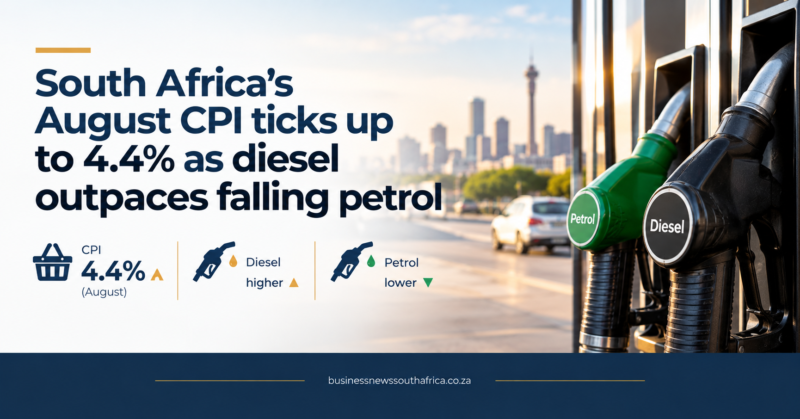
For a small business owner who drives a delivery van, the cost of filling an 80-litre tank has jumped from about R165 in 1996 to more than R2,140 today. That increase, roughly 1,199% in nominal terms, is not just a headline number; it directly erodes profit margins on every kilometre driven.
Statistics South Africa (Stats SA) reports that inland 93-octane petrol was R2.06 per litre in 1996 and rose to R26.76 per litre in September 2026. Multiplying the current price by an 80-litre tank gives the R2,140.80 figure. The agency’s historical analysis tracks how quickly fuel prices have moved over three decades.
Historical price spikes
Stats SA notes that the R1 per litre mark was first reached in November 1985. Two decades later the price hit R5, then doubled to R10 within three years, breaching that level in 2008 when crude oil climbed above $145 a barrel. A rapid decline followed the global financial crisis, with petrol falling to R5.82 per litre in January 2009 before returning to R10 two years later.
The next major jump came after the Covid-19 pandemic. In December 2021 motorists paid more than R20 per litre, and a record of R26.31 was set in July 2022. Prices eased to R19.99 in February 2026 before climbing again to R28.06 in June 2026, the highest inland price on record at that point.
These swings are driven by international oil prices, exchange-rate movements and major global events. Stats SA also points out that fuel costs feed through to other household expenses because transport accounts for a large share of inflation. In the 2022 fuel-price shock, transport made up 44% of the July headline inflation rate.
The latest projection from the Central Energy Fund (CEF) suggests another sharp rise in October. If the forecast materialises, inland 95-unleaded petrol could rise by about R2.80 a litre to around R29.80, and wholesale diesel could climb above R33 a litre. If 93-octane rises by the projected R2.71, the same 80-litre tank would cost about R2,358. We looked at what the October increase will cost a small business.
For SMEs that rely on road transport, each additional rand per litre translates into higher operating costs, tighter cash flow and the need to reassess pricing or delivery frequencies. While the government’s fuel-price monitoring mechanisms remain in place, businesses may need to explore fuel-efficiency measures, alternative transport modes or hedging strategies to cushion the impact.
Understanding the long-term trend helps owners plan ahead rather than react to each headline spike. The data from Stats SA and the CEF forecast provide a factual basis for budgeting, rather than speculation.
BusinessTech reported that the Central Energy Fund’s latest figures show a projected rise of almost R3 per litre for diesel, which would push wholesale diesel prices above R33 per litre. The forecast also notes that the previous May record for diesel stood at R31.88, meaning the anticipated increase would eclipse that benchmark by more than a rand. This potential jump follows the same pattern that saw inland 95-unleaded petrol expected to climb by almost R2.80 per litre, taking the price to around R29 per litre. For operators of diesel-powered fleets, the extra cost per litre translates directly into higher per-kilometre expenses and tighter budgeting pressures.
Fuel-price forecasting in South Africa relies on a combination of international crude-oil benchmarks, the rand-to-dollar exchange rate, and domestic tax and levy structures. Agencies such as the Central Energy Fund model these inputs to produce monthly outlooks that inform both policy and commercial decisions. For a business owner, understanding that a projected increase is based on these variables helps differentiate between short-term spikes and longer-term trends, allowing more accurate cash-flow planning and inventory management for fuel-dependent operations.
How much room a business has to manage fuel costs depends on the fuel. Petrol pump prices are regulated, so every filling station charges the same set price in a given zone and there is no discount to negotiate at the forecourt. Diesel is different: only the wholesale price is regulated, so fleet operators buying in bulk can negotiate supply deals, and fuel cards make it easier to track consumption per vehicle and spot waste.
Looking ahead, business owners should monitor the monthly releases from the Central Energy Fund and any updates from Statistics South Africa, as these sources will signal whether the October projection materialises or if market dynamics shift. Keeping an eye on the rand’s performance against the dollar and global crude-oil trends will also provide early warnings of potential price movements. By staying informed, companies can time any adjustments to pricing, route optimisation, or fleet upgrades to minimise the financial strain of future fuel-price volatility.