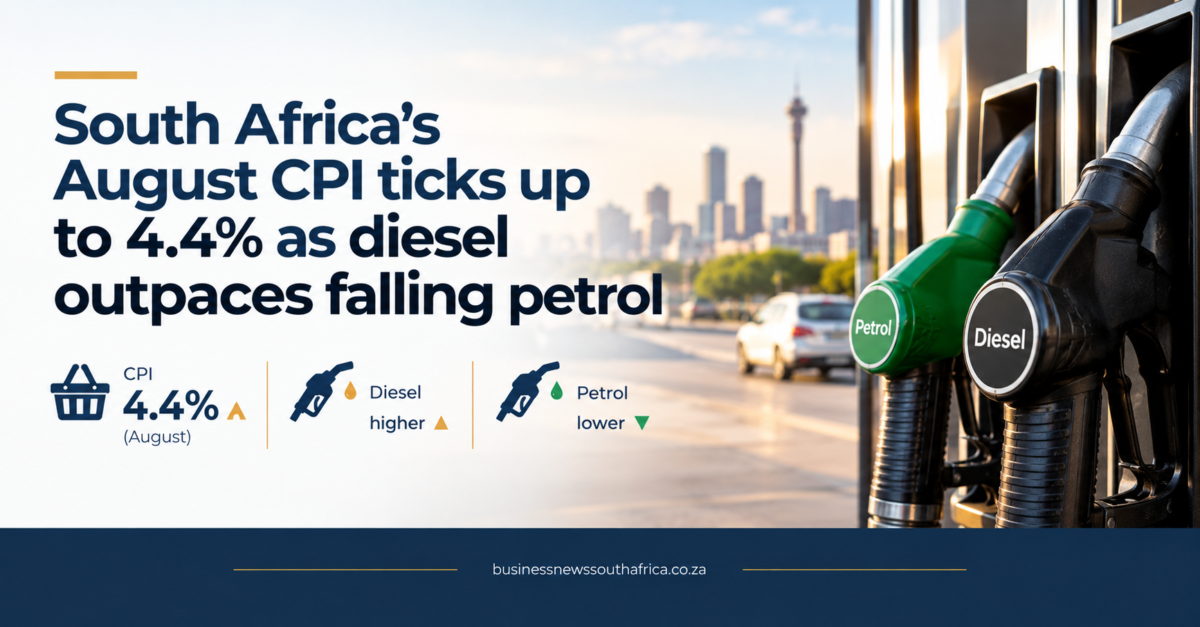
When Thabo, who runs a small delivery service in Durban, opened his fuel receipt on 15 August, he was surprised to see the price of petrol 52 cents a litre lower than the previous month. The same receipt, however, showed diesel, the fuel his vans need for heavy loads, up by R1.23 a litre. That split in fuel costs mirrors the latest consumer price data released by Statistics South Africa.
According to Stats SA, the consumer price index (CPI), the headline measure of inflation that tracks the price change of a basket of goods and services, edged up to 4.4% in August 2026, a 0.1 percentage point rise from July’s 4.3%. The reading came in below the 4.5% median forecast in a Bloomberg survey of economists.
The CPI is a weighted average: each component, such as housing, transport or food, contributes a share of the total. In August, the biggest contributors were housing and utilities, which added 1.3 percentage points, and transport, which added 1.2 points. Insurance and financial services added a smaller 0.6 points. When food, non-alcoholic beverages, fuel and energy are stripped out, core CPI slowed to 4.1%, comfortably inside the South African Reserve Bank’s (SARB) 3% to 6% target range.
Standard Bank’s head of South Africa macroeconomic research, Dr Elna Moolman, said the softer-than-expected headline number owed a lot to the drop in petrol prices in August, but warned that fuel prices rose again in September and were expected to rise further in October, pointing to a harder few months ahead for households and the businesses that serve them.
The rate decision has already happened
Moolman’s own forecast, made before the CPI print, was that the SARB could move on the rate at either its 23 September or 19 November meeting given the fuel-price pressure. The Reserve Bank chose to act at the earlier date: on 23 September the Monetary Policy Committee raised the repo rate by 25 basis points to 7.25%, taking prime to 10.75%, as we reported at the time. The move was unanimous, and Governor Lesetja Kganyago cited the same upside risk from fuel prices that shows up in this CPI print.
For small businesses, the mixed fuel picture is a double-edged sword regardless of the rate decision. Lower petrol prices ease the cost of employee travel and small-scale deliveries, but higher diesel raises the operating expense of any business that relies on heavy vehicles. The net effect on margins depends on how much of a firm’s cost base sits in each fuel type.
Investec’s economics team has separately flagged that fuel-price inflation within the CPI basket remains high at 20.6% year on year, even after easing from 23.3% in July. Food and non-alcoholic beverage prices showed only modest movement in August, with deflation still present in some agricultural outputs.
What small businesses should watch
With the September rate decision now behind us, the practical questions for the fourth quarter are about fuel and the next inflation print, not about whether a hike is coming.
- Fuel price trends: keep an eye on both petrol and diesel, since they affect different parts of the cost chain differently.
- Loan repayments: the 25-basis-point hike to prime has already raised the cost of any facility linked to it, so factor that into financing plans now rather than waiting.
- Consumer sentiment: a CPI under 5% suggests price pressure is easing overall, but the fuel-inflation figure of 20.6% shows real volatility remains underneath the headline number.
For more analysis on how inflation and monetary policy affect small enterprises, see our Markets & Finance coverage.
The Reserve Bank’s own updated forecasts, published alongside the 23 September decision, suggest the fuel-driven pressure will persist for longer than earlier expected. The SARB raised its 2026 headline inflation forecast to 4.4%, from 4.0% previously, and now projects inflation peaking at 5.4% in the fourth quarter, up from a 4.3% forecast in July. For a business owner planning cash flow into year end, that revision matters more than the August print itself: it signals that the central bank expects the current pressure to build before it eases, not fade away on its own.
The rand’s muted reaction to both the CPI data and the rate decision is itself informative. Currency moves around the announcement were driven mainly by a stronger US dollar rather than by the SARB’s decision, which had been widely expected by the market. That suggests investors had already priced in the hike, and that South African businesses hedging import costs or foreign-currency debt should watch broader dollar strength as much as domestic policy news when timing currency decisions.