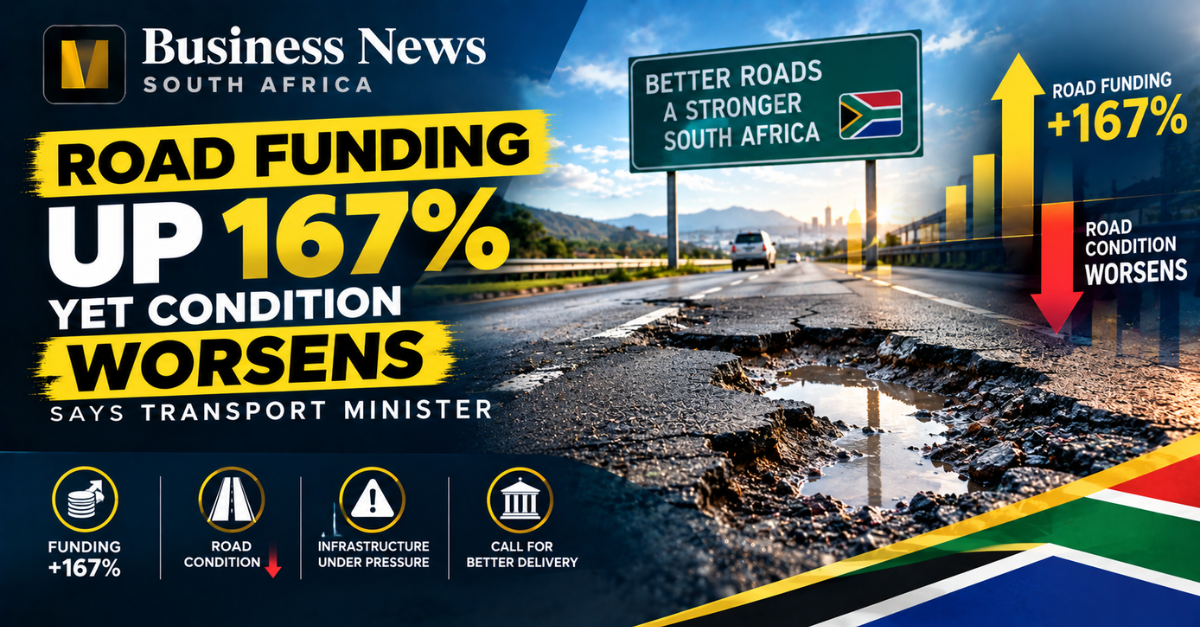
Transport Minister Barbara Creecy told parliament that the national budget for road maintenance and infrastructure has risen from R6.5 billion in the 2012 financial year to R17.2 billion for 2025/26, a 167 percent increase. The same minister also warned that, despite the extra cash, the overall condition of South Africa’s roads has gotten worse.
The comment came after National Assembly member Glynnis Breytenbach asked for a province-by-province breakdown of road-maintenance spending since 1994. Creecy said the only consistent data start in 2011, when the Provincial Road Maintenance Grant (PRMG), a fund that tracks how much each province receives for road upkeep, was created. She directed anyone needing earlier figures to the provincial treasuries or road authorities.
What does this mean for the everyday road user and for small businesses that rely on transport? Higher spending should translate into smoother rides, lower vehicle wear and fewer delays. Instead, the opposite is happening. The South African Institution of Civil Engineering (SAICE) publishes an Infrastructure Report Card every five years. Its latest edition, compiled with input from the South African National Roads Agency (SANRAL) and the Council for Scientific and Industrial Research (CSIR), shows a steady decline in road quality over the past 15 years.
Grades that matter
SAICE grades paved provincial roads as D, “at risk of failure”, and municipal paved roads as D-. Unpaved roads, which make up about 80 percent of the network, are rated E, meaning they are “unfit for purpose”. The report points to a reactive approach by provincial and local authorities: they tend to wait for a road to break down before fixing it, rather than carrying out regular preventive maintenance.
For a delivery driver in Gauteng, for example, a D-grade municipal road can mean more frequent tyre replacements and longer travel times. For a small retailer that ships goods across provinces, deteriorating secondary roads raise fuel costs and increase the risk of damage to stock.
Provincial funding patterns add another layer of complexity. Gauteng, the country’s economic hub, saw its PRMG allocation grow from R566.9 million in 2011/12 to R1.27 billion in 2025/26, still the lowest per-capita grant among the nine provinces. By contrast, KwaZulu-Natal’s allocation rose from R1.24 billion to R3.15 billion in the same period, and the Western Cape’s funding jumped more than fivefold, from R411.1 million to R2.18 billion.
The Western Cape is the only province where SAICE rates paved roads as satisfactory. The province attributes its performance to an up-to-date Pavement Management System, a software tool that identifies which sections need work before they reach a critical breaking point. Mpumalanga also uses a similar system, but its coal-haul roads are deteriorating fast because the province receives R862 million less each year than the amount required to keep those roads in acceptable condition. The Medium Term Expenditure Framework (MTEF) allocates an average of R328 million to those roads, while R1.19 billion would be needed.
These figures illustrate a mismatch between money poured into the sector and the outcomes on the ground. The increase from R6.5 billion to R17.2 billion represents an extra R10.8 billion, yet the SAICE grades have slipped further into the D and E ranges. The minister’s statement is a claim based on the PRMG data; the SAICE report provides an independent assessment of road quality.
Why should a small business owner care? Poor road conditions raise operating costs in three ways: higher vehicle maintenance, increased fuel consumption and longer delivery times. All three erode profit margins, especially for firms that operate on thin margins. Moreover, unreliable roads can deter customers, affect inventory turnover and limit expansion plans that depend on efficient logistics.
What can be done? The SAICE report suggests that provinces adopt proactive maintenance regimes, using tools like Pavement Management Systems to schedule work before roads fail. The Western Cape’s experience shows that such an approach can protect road quality even with limited budgets. For provinces that lag behind, reallocating existing funds toward preventive work could stretch each rand further.
In short, the headline number, a 167 percent rise in road-maintenance funding, tells only part of the story. The real stake is the daily cost that deteriorating roads impose on commuters, freight operators and small enterprises across the country. Until the spending translates into measurable improvements on the road surface, the extra billions will continue to feel like a tax on every kilometre driven.