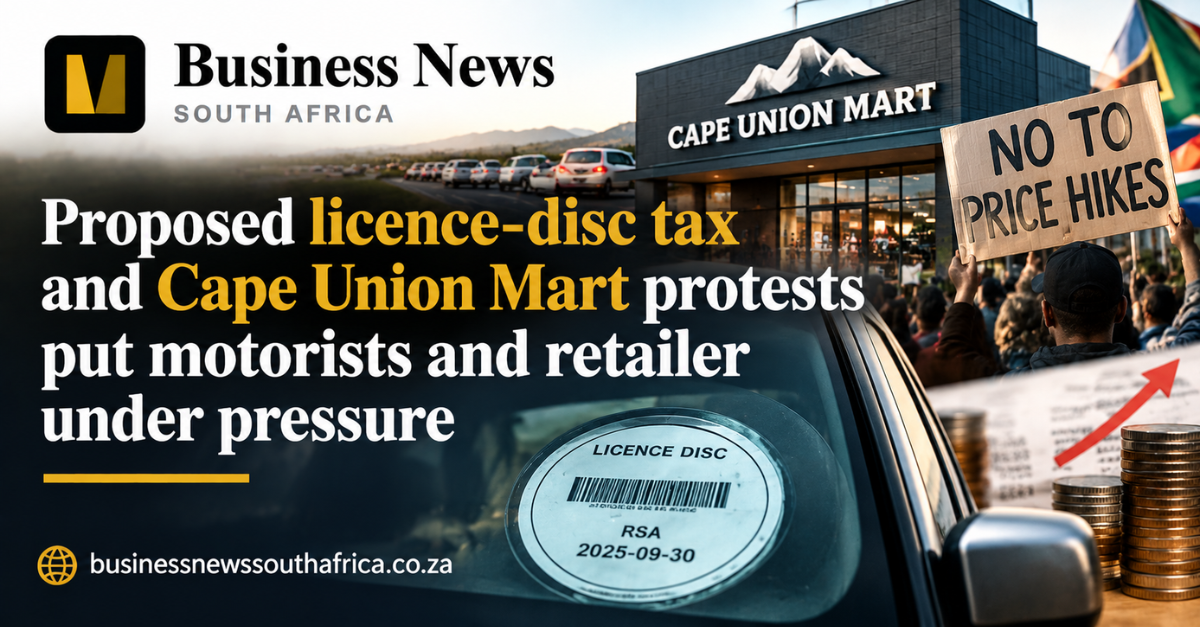
On a sunny Saturday at Canal Walk, a small crowd gathered outside the entrance of Cape Union Mart. They carried placards that read “Stop the oppression” and shouted slogans supporting the Palestinian cause, even though a court order bars them from linking the retailer to violence. The protest, organised by the Palestine Solidarity Campaign, is a reminder that retail outlets can become flashpoints for political disputes, regardless of whether the shop itself is directly involved.
Owner Phillip Krawitz, who recently won a defamation case that cleared his name, watched the demonstration from a distance. While the court ruling protects him from legal claims, it does not shield the store from public scrutiny or potential loss of foot traffic. For a retailer that relies on tourists and local shoppers at high-traffic locations such as Canal Walk and the V&A Waterfront, any disruption can dent sales, especially in a climate where consumer confidence is already fragile.
At the same time, the Department of Transport is quietly drafting a new funding model for the Road Accident Fund (RAF). Minister Barbara Creecy told reporters that the department is considering a temporary tax on licence disc renewals. A licence disc is the small sticker displayed on a vehicle’s windscreen that proves registration and payment of road tax. The proposed levy would be short-term, aimed at shoring up the RAF’s finances as more motorists switch to electric vehicles (EVs), which currently contribute less to the fund through fuel levies.
The RAF is the state body that compensates victims of road accidents. Its funding has been under pressure for years, and the shift to EVs threatens to reduce the revenue stream that traditionally came from fuel taxes. By adding a licence-disc tax, the government hopes to maintain the fund’s ability to pay claims without over-burdening the national budget.
What the licence-disc tax could mean for motorists
For small business owners who depend on a fleet of vehicles, even a modest increase in renewal costs can affect operating expenses. A typical passenger car licence disc renewal costs around R500. If the temporary tax adds, say, 10 % to that fee, a business with ten vehicles could see an extra R500 in annual costs. While the department has not released exact figures, the impact will be felt most by those who already feel the squeeze from rising fuel prices, oil is currently trading above $96 a barrel, feeding inflation concerns.
Consumers may also feel the ripple effect. Higher vehicle operating costs can translate into higher prices for goods delivered to shops, especially in remote areas where transport costs are a larger share of the final price. Retailers like Cape Union Mart, which stock outdoor and travel gear, could see a subtle shift in demand if customers cut back on discretionary spending to cover higher vehicle fees.
Both issues, the licence-disc tax and the protests, intersect with a broader economic backdrop. The rand has shown modest strength against the dollar, moving from R16.14/$ on 31 August to about R15.99/$ by early September, buoyed by corporate earnings such as Eskom’s first profit in years. Yet the outlook remains uncertain, with the upcoming release of Q2 2026 GDP figures expected to show a 0.2 % contraction, driven by weaker mining and manufacturing. A disappointing GDP report could erode the rand’s gains, potentially raising the cost of imported goods and further tightening household budgets.
For retailers, the combination of a volatile currency, inflationary pressure from oil, and the spectre of a new vehicle levy creates a challenging environment. Store managers must balance inventory decisions with the risk that customers may tighten belts. Meanwhile, the protests at Cape Union Mart highlight how quickly a retail outlet can become a stage for broader political debates, drawing attention away from product offerings and onto the store’s perceived stance on international issues.
Minister Creecy emphasised that the tax proposal is still under development and that details will be shared once finalised. She assured that the aim is to ensure the RAF’s sustainability during the transition to electric mobility, without imposing a permanent burden on motorists. Until then, businesses and drivers alike will have to watch for official announcements and assess how any new levy fits into their budgeting.
For Cape Union Mart, the immediate concern is managing the protest’s impact on brand perception. The retailer has not issued a public statement on the demonstrations, but its legal victory may provide some shield against defamation claims. Still, the company will need to engage with local authorities and possibly communicate its position to customers to mitigate any lasting reputational damage.
In a market where consumer sentiment can swing on both macro-economic signals and localised events, the dual developments of a potential licence-disc tax and a high-profile protest serve as a reminder that retailers must stay agile. Monitoring policy changes, understanding the cost pressures on their customers, and navigating the social landscape are now part of the daily calculus for South African retail managers.