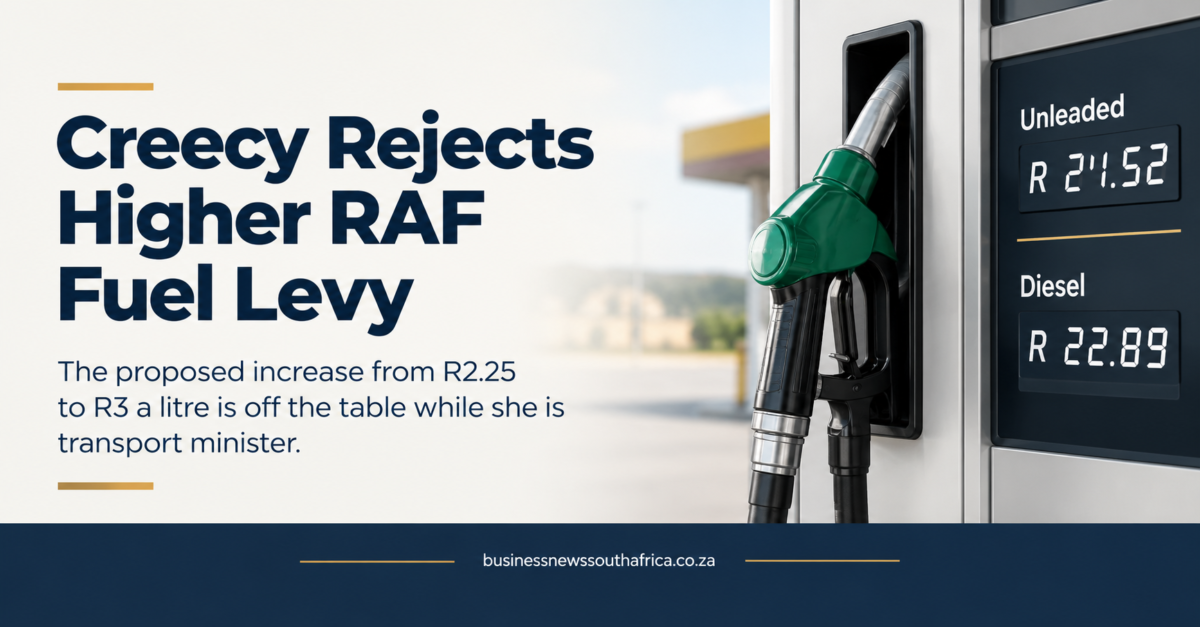
Transport Minister Barbara Creecy has ruled out asking National Treasury to raise the Road Accident Fund (RAF) levy to R3.00 a litre, which means no RAF-driven rise in the price of petrol and diesel for now. BusinessTech reported on 12 October 2026 that Creecy told ENCA she will not apply for an increase to the RAF fuel levy, the part of the fuel price that goes to the fund, for as long as she heads the department.
The decision matters to anyone who buys fuel in bulk or runs vehicles, because the levy is charged on every litre sold. It does not end the fund’s money problems, and the minister has said other ways of funding it are being looked at.
What the RAF asked for
The proposal for a higher levy sits in the RAF’s 2025/26 annual report. The fund said it has made a proposal to National Treasury through the Medium Term Expenditure Framework, the multi-year budget plan that guides government spending, for a levy of “up to R3.00 per litre”, in addition to Treasury capital support.
The levy is currently R2.25 a litre. Treasury raised it by 7 cents from R2.18 in 2026, the first increase in five years, according to BusinessTech. Cape Town Etc reported that the increase took effect on 1 April 2026.
The RAF welcomed the 7 cents but said it was not enough. In its annual report it said: “The RAF has not received an increase in the fuel levy over the past five years. During the same period, inflation continued to erode the Fund’s real income.” Collections were also hurt by lower fuel sales, which the report links to fuel price rises driven by the war in the Middle East and other inflationary pressures. The fund calls itself historically insolvent and says it faces an “unlimited claims trajectory”.
The money going in and out
Cape Town Etc reported that Parliament’s Portfolio Committee on Transport heard on 7 October that the RAF pays out about R25 billion a month and receives around R4 billion. The committee was told the fund’s finances are contributing to lengthy delays in settling claims. The RAF’s revenue fell 5% to R48.1 billion in 2025/26 from R50.8 billion, according to a separate BusinessTech report on 7 October.
What Creecy said
“As long as I am in this job, we will not apply to National Treasury for an increase in the fuel levy,” Creecy said. She added: “I think consumers are under enough pressure; what we have to do is sort out the mismanagement that has happened at the Road Accident Fund for a long time.”
She said the Department of Transport has already taken steps to address the RAF’s management crisis and that more will follow. “We have to sort out the finances and management, so we stop wasting money, and we stop doing dramatic things that grab headlines and generate a lot of heat,” she said. The minister also said the laws and regulations governing the RAF need to change so the fund stops wasting large sums on endless legal cases. She called it “outrageous” for a fund paid for by taxpayers to be tapped for “exorbitant amounts of money”.
Other ways to pay for the fund
A fuel levy increase is off the table, but Creecy has not ruled out other charges. BusinessTech reported that the department is investigating applying a levy to foreign-registered vehicles entering South Africa and attaching one to vehicle registration or licence renewals. Creecy confirmed in July that the government is working on a new RAF funding model and said there was merit in a separate mandatory RAF fee tied to registrations and licence disc renewals.
The Department of Transport argues that a new vehicle-linked transitional levy is needed to capture revenue from all road users. BusinessTech said the RAF says electric and hybrid vehicles pay no fuel levy despite using the same benefits, and that a renewal-based charge would help cover them. No amount has been published for such a fee, and Cape Town Etc reported that no new RAF licence-renewal fee has been finalised.
Pressure from motorists
The Automobile Association (AA) has gone the other way and wants the RAF levy scrapped. In a statement reported by Business Day on 8 October, it called the RAF’s request “beyond concerning”. The AA also wants a further R3 a litre cut in fuel taxes before the November price adjustment. It noted that Treasury cut fuel levies by R3 a litre in April at a cost of about R17 billion, and said taxes make up about 25% of the current fuel price.
Business Day reported that petrol and diesel prices reached record levels on 7 October, and that Central Energy Fund data points to a petrol increase of up to R4.58 a litre in November. The AA said diesel has roughly doubled this year, from R17 a litre in January to more than R34.
Source: BusinessTech.