The influencer disclosure rules in South Africa come down to one principle: your followers should never have to guess whether a post is an advert. This guide sets out what the Advertising Regulatory Board (ARB) expects, what has to be disclosed, where the label goes, and how to write a brief or contract that keeps you protected.
The rule in one line
The ARB’s Code of Advertising Practice requires advertising to be clearly identifiable as advertising, and that includes influencer content. MJ Kotze Inc points to the ARB’s Social Media Code, which asks for disclosure of any “material connection” between a creator and a brand.
It is not only about cash
The most common mistake is thinking a post is not an advert because no money changed hands. The ARB has ruled otherwise. In a July 2019 ruling on a complaint about an influencer’s Instagram post and YouTube video featuring a Volvo, the board said influencers must disclose if they were given goods or services, permanently or on loan, in return for media coverage, whether or not that is stated openly. BusinessTech reported that Volvo argued the arrangement was a trade exchange rather than a payment, and the ARB rejected that distinction. Gifted products, loaned products, free trips and affiliate commission all count as a material connection.
Where the label goes
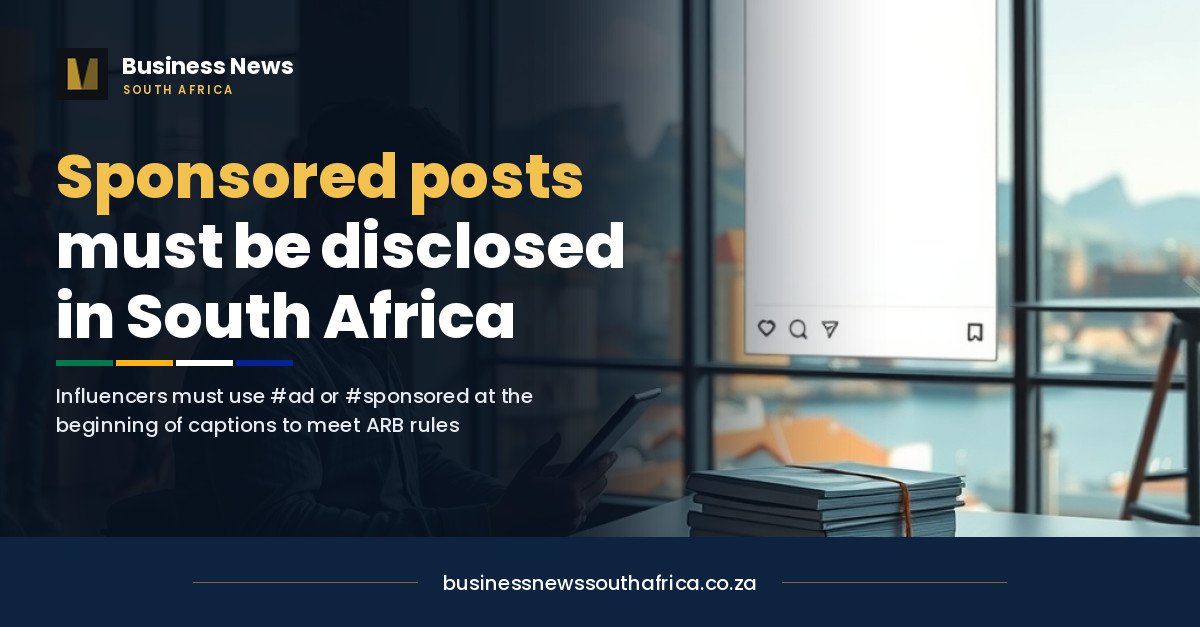
A label that nobody sees does not meet the standard. Polity reports that disclosures buried at the end of a caption or in the comments may not satisfy the ARB’s transparency requirements, and MJ Kotze advises placing #ad or #sponsored at the start of the caption, where followers see it. The ARB’s recognised identifiers in the 2019 ruling were #AD, #Advertisement and #Sponsored. Use the platform’s own paid-partnership tool as well where it exists. For video, make sure the label is visible before a viewer has committed to watching.
Say only what is true
Disclosure is half the rule. The other half is honesty. Polity reports that endorsements should be genuine and fact-based, resting on your own experience or on facts the brand has substantiated. Under section 41 of the Consumer Protection Act, false, misleading or deceptive representations are prohibited, and MJ Kotze notes that a brand will usually ask you to warrant that your claims are truthful. If a brief asks you to say something you cannot back, ask the brand for the evidence, or decline that line.
Competitions and sign-ups
If a campaign collects personal information, such as a giveaway that asks followers to enter their details, the Protection of Personal Information Act applies too. MJ Kotze flags section 69, which governs consent for electronic direct marketing. Our guide on handling personal information and a data breach explains your duties when you hold other people’s data.
Who is responsible when something goes wrong
Both sides can be answerable, which is why the contract should say who carries the risk. MJ Kotze notes that a brand will typically ask the influencer to warrant compliance with the ARB Code, the Consumer Protection Act and POPIA, and to indemnify the brand for the influencer’s breaches, while the brand warrants that the product information it supplies is accurate. Read those clauses before you sign. Our guide to influencer contracts, rates and invoicing shows what else belongs in the agreement.
A checklist for every sponsored post
- Is there a material connection: payment, a free or loaned product, a trip, or commission? If yes, label it.
- Is the label at the start of the caption, or clearly visible before the viewer engages?
- Have you used a recognised label, such as #Ad, #Advertisement or #Sponsored, plus the platform’s paid-partnership tag?
- Can you back every claim you make about the product?
- If the post collects details from followers, do you have a lawful basis and consent?
- Have you kept the brief and the brand’s supporting information on file?
Disclosure also has a tax side: whatever you were given is income. See influencer tax in South Africa. And if you are about to take on a brand campaign through TikTok, start with our guide to TikTok One.