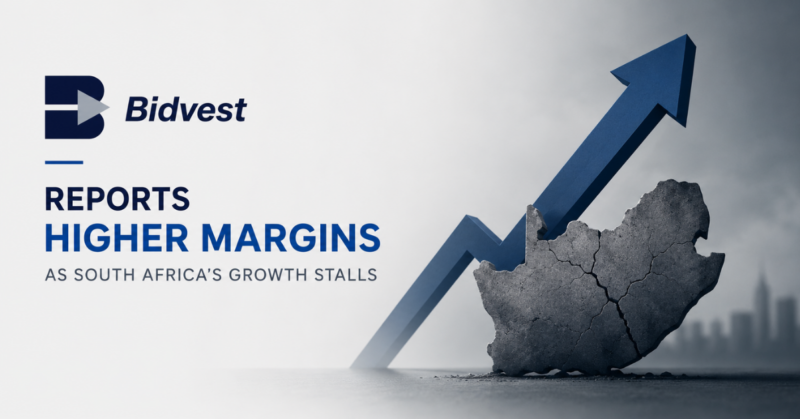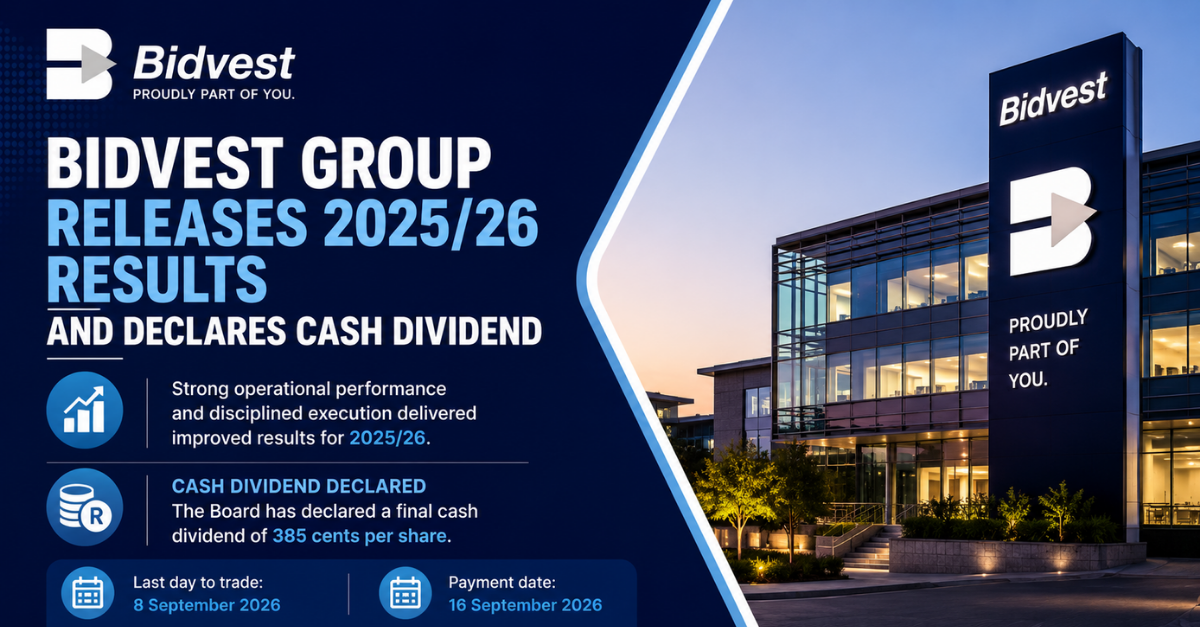
Bidvest has told the market its books are closed for the year and there is cash coming shareholders’ way, the kind of routine annual update that carries real weight precisely because of how large and diversified the company behind it actually is. Bidvest Group Limited said on 30 June 2026 that it had finalised its consolidated financial results for the year ended that date and would pay a cash dividend to shareholders, published via Moneyweb.
A cash dividend is a distribution of profit paid in money rather than additional shares, a way for a listed company to return cash to owners, with the amount per share usually set by the board once the year-end accounts are approved. Bidvest itself is a large, diversified industrial conglomerate with interests spanning services, distribution, automotive and other sectors, closely watched precisely because its performance reflects broader trends in South Africa’s manufacturing and services landscape, an economy that has been under real pressure from high electricity costs, inflation and a tight labour market.
What is missing, and why it matters
The brief release did not include headline earnings per share, revenue growth rates or the exact dividend per share, and without those numbers, it is genuinely difficult for investors, and for small business owners who may hold Bidvest shares themselves, to gauge either the strength of the underlying business or how generous the payout actually is relative to the company’s own history.
Analysts typically compare a company’s dividend yield, the payout divided by the share price, against other firms in the same sector to judge whether it is attractive, but in the absence of a disclosed figure, the market simply has to wait for the fuller results package, usually released a few weeks after an initial announcement like this one. Bidvest’s own diversification across services, distribution and automotive makes this wait more interesting than it would be for a single-sector company, since a genuinely strong result here would say something meaningful about the broader industrial economy rather than just one narrow niche within it.
For SMEs holding Bidvest shares, the immediate takeaway is that a dividend is confirmed to be on the agenda, even if size and timing remain unconfirmed. The broader signal is that Bidvest believes its own numbers are strong enough to justify returning cash rather than hoarding it defensively, a genuinely reassuring data point in a climate where plenty of South African companies have been doing the opposite and tightening cash flow instead.
Bidvest’s own conglomerate structure makes this particular result worth reading more carefully than a single-sector company’s equivalent announcement, since strength or weakness in one division, automotive, say, can be masked or amplified by performance in another entirely unrelated one like distribution or services. That blending effect is precisely why analysts tend to wait for the segment-level detail in the fuller results rather than reacting to the group-level dividend confirmation alone, since the headline number rarely tells the whole story for a business this diversified. That conglomerate structure is also part of why Bidvest gets watched as a proxy for the broader economy rather than for any one sector specifically, since a business this spread across services, distribution and automotive alike effectively holds a small, diversified slice of South African commercial activity within a single set of accounts. That is precisely why the dividend confirmation, thin on detail as it is, still functions as a genuinely useful early signal ahead of the fuller results, worth noting even before the actual numbers arrive to confirm or complicate it. Suppliers and lenders reading tea leaves this early would do well to treat the confirmed dividend as directional rather than definitive, a real signal of board confidence rather than a substitute for the audited numbers still to come.