Moneyweb‘s podcast on 20 August 2026 featured Viv Govender of Rand Swiss, who said Bidvest‘s latest earnings show a lift in margins. A margin is the profit left after a company pays its operating costs, and an improvement signals that the business is keeping more of each rand it earns.
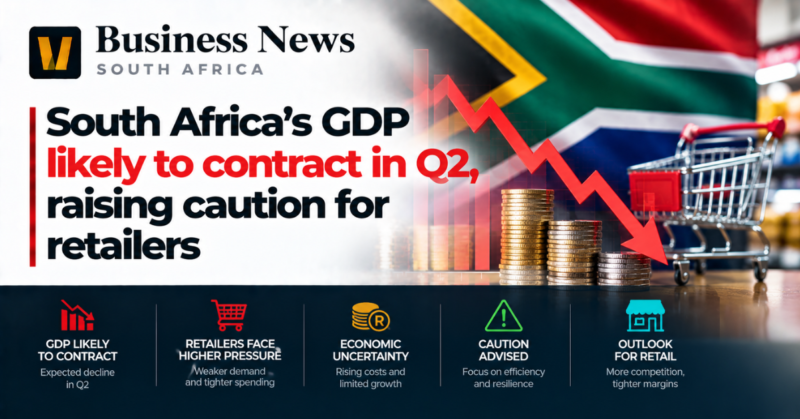
Govender explained that the margin gain comes from tighter cost control and a shift toward higher-margin services. The company did not disclose exact percentages, but the comment was framed as a positive step in an environment where South Africa’s gross domestic product has been flat for several quarters.
For a mid-size conglomerate like Bidvest, which operates in logistics, services and distribution, a stronger margin can mean more cash to reinvest or return to shareholders. In a low-growth economy, that extra cash can be the difference between expanding a fleet of delivery trucks and postponing the purchase.
Why margin expansion matters more than revenue growth in a stalled economy
When an economy is barely growing, a company generally has two ways to grow its profit: sell more, or keep more of what it already sells. With consumer and business spending both constrained, the first option is largely closed off to most South African firms right now, which is exactly why analysts on the Moneyweb panel focused on margin rather than revenue. A conglomerate that can widen its margins without relying on volume growth is, in effect, proving it can generate shareholder returns even while the broader economy stands still, a more difficult and more telling achievement than growing profit purely by selling more into an expanding market.
The podcast also noted that Old Mutual‘s trading update earned market approval, suggesting that investors are rewarding firms that can show resilience despite weak demand. While the update was not detailed, the approval hints that clear communication and steady earnings still matter to shareholders.
RCL Foods, another guest on the show, warned that its results were hit by pressure in the sugar and dry pet-food segments. Those pressures illustrate how commodity-linked businesses can feel the squeeze when consumer spending stalls, since raw-material costs for sugar and animal feed do not necessarily fall just because household budgets are under pressure.
Finally, Capital Legacy‘s Craig Baker introduced the new Estate Readiness Index survey, which measures how prepared South Africans are for wills and estate planning. The survey’s findings are relevant for any business owner, as a clear succession plan can protect a company’s continuity when the broader economy is uncertain, particularly for family-owned businesses where a founder’s death or incapacity without a documented plan can trigger disputes that outlast the original crisis by years.
In practical terms, the take-away for small-to-medium enterprises is that managing costs and focusing on higher-margin activities can help weather a sluggish macro-environment. While large firms like Bidvest have the scale to absorb short-term shocks and the balance sheet to fund a multi-year cost-control programme, the same underlying principle, protect the margin when you cannot grow the top line, applies just as directly to a family-run manufacturing outfit or a regional distribution business trying to survive the same flat economy with a fraction of the resources.
None of the four businesses discussed on the panel described a dramatic turnaround. What they described, collectively, was a set of ordinary operating disciplines, tighter cost control, clearer client communication, succession documentation, that matter more in a low-growth year than they would in a boom, precisely because there is no rising tide to cover for a weak balance sheet or an unresolved ownership dispute. Whether an SME operator can borrow any of those lessons directly, tighter cost discipline, clearer client communication, formal succession planning, is a fair test of how much a large-company earnings call actually has to say to a business a fraction of Bidvest’s size.