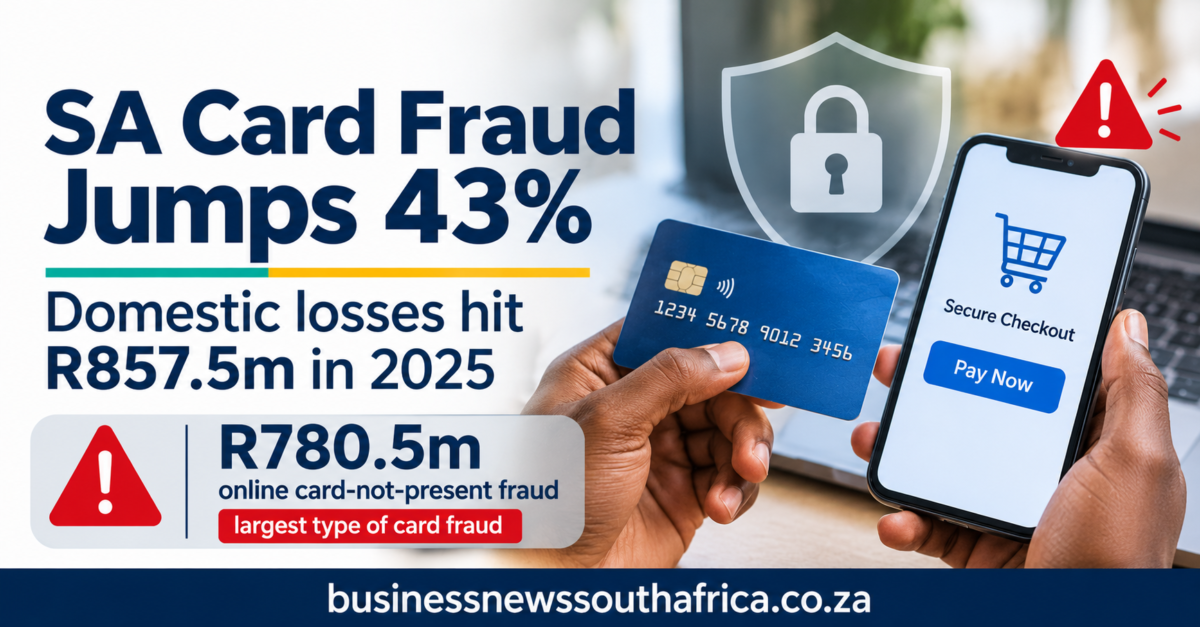
Fraud on South African credit and debit cards cost R1.75 billion in 2025, up 18% from R1.48 billion in 2024, according to the South African Banking Risk Information Centre (SABRIC). Losses on transactions inside South Africa grew faster, rising 43.3% from R598.0 million to R857.5 million. With Black Friday today, the tables in SABRIC’s 2025 Annual Crime Statistics report show where card losses sit and which parts affect local sellers.
SABRIC’s report covers 2025, not Black Friday itself, and it does not break losses down by day or shopping event. It is the most recent full-year picture from the banking industry.
The card fraud numbers
- Gross card fraud losses: R1.745 billion in 2025, up 18.0%. Credit cards lost R739.2 million (up 29.3%) and debit cards R1.006 billion (up 10.9%).
- Domestic card fraud: losses on transactions within South Africa rose 43.3% to R857.5 million. Credit card losses rose 45.8% to R301.4 million and debit card losses rose 42.0% to R556.0 million. Debit cards were 64.8% of the domestic total.
- Abroad: in 2025, transactions outside South Africa accounted for 59.2% of credit card fraud losses and 44.7% of debit card fraud losses.
SABRIC says the rise in domestic losses is likely linked to growing use of cards for online payments, together with a shift towards locally executed card-not-present and social-engineering fraud.
Card-not-present fraud: still the biggest loss, but falling
Card-not-present fraud, where card details are used online or by phone without the card, was the largest single loss category at R780.5 million. It fell during the year, which SABRIC highlights: credit card losses dropped 5.3% to R402.1 million and debit card losses dropped 35.1% to R378.4 million. Even so, it made up 54.4% of credit card losses and 37.6% of debit card losses.
Most of it happened abroad. International transactions made up 67.5% of credit card and 63.5% of debit card losses in this category. For credit cards, advertising services, travel agencies and betting accounted for more than half of reported losses, and for debit cards, digital goods, advertising services and computer software accounted for 43%.
SABRIC says card-not-present fraud is commonly carried out with card details obtained through phishing, vishing and other social-engineering methods. Criminals may impersonate bank officials by call or message and persuade customers to disclose card details and one-time passwords.
Lost and stolen cards matter for debit cards
Lost and stolen card fraud was the second-largest category at R287.2 million, and R253.0 million of it was on debit cards, which SABRIC calls particularly prominent for debit. Most of it happened inside South Africa. For credit cards, supermarkets and ATMs together accounted for 40% of losses, and for debit cards, ATM withdrawals alone accounted for 49.3%. SABRIC says this underlines the importance of protecting cards and PINs and reporting missing cards immediately.
What SABRIC says about the wider fraud picture
Digital banking crime reached 110,074 incidents and R2.41 billion in 2025, up from 97,547 incidents and R1.86 billion in 2024, with an average loss of R21,865 per incident. We covered those figures in our report on South Africans losing R2.4 billion to digital banking fraud. SABRIC says the banking app was the channel in about 89% of cases and 70.5% of the claim amount, but that does not mean the app was compromised: in many cases the fraud began outside the bank, when criminals impersonated trusted organisations, created urgency or guided customers through transactions in real time.
What this means on Black Friday
- Shoppers: SABRIC’s findings point to the same habit: never give a card number or a one-time password to someone who contacted you, whoever they say they are, and report a lost card at once.
- Sellers: the domestic increase means local transactions are part of the fraud picture, not only foreign ones. Our payments checklist from Ecentric for retailers covers what to check with a payment provider before the tills get busy.
- Everyone: be slow when a message creates urgency. SABRIC identifies urgency as a common tool in digital banking crime.
This article reports SABRIC’s published statistics and is general information, not financial or security advice.