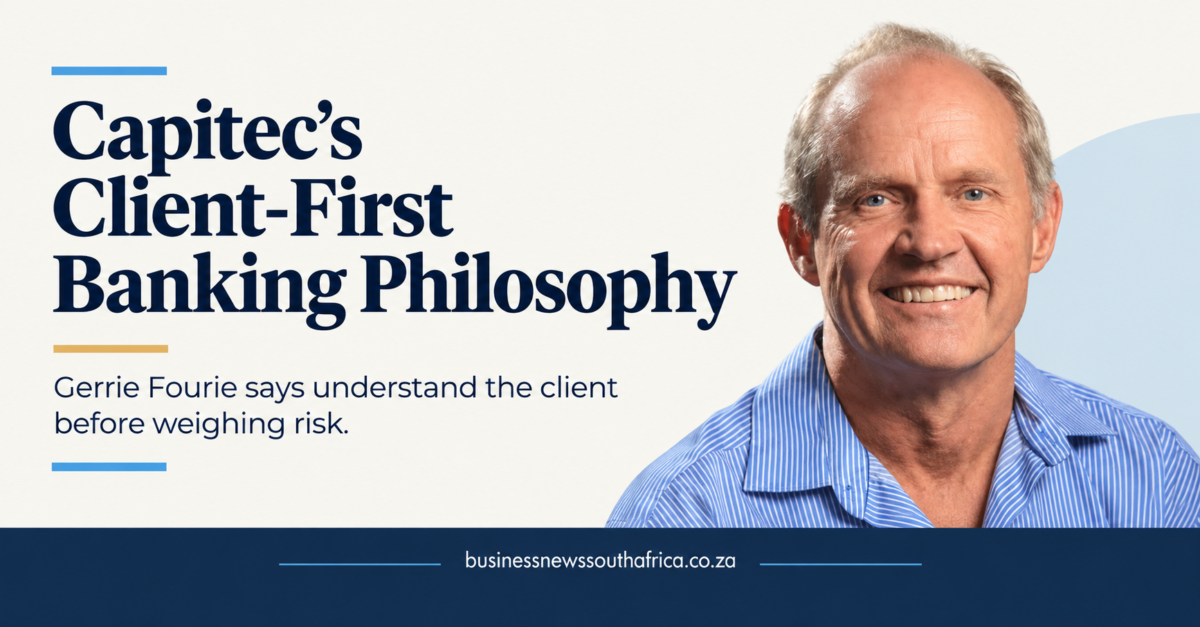
Gerrie Fourie, Capitec’s former chief executive, says the bank was built on a simple order of thinking: “We’re retailers, we think client and then risk.” He made the point in the third episode of Building Conviction, the podcast of Peregrine Capital, in conversation with Peregrine chief executive Jacques Conradie. “Bankers look at risk, risk, risk, and then client,” he adds. Everything below is Fourie’s own account as set out in Peregrine’s write-up of the episode, which we have not checked against the audio, and not an audited statement.
The episode is produced by Peregrine Capital, an authorised financial services provider whose funds may hold positions in companies discussed. It is not investment advice.
Who Fourie is
Fourie was part of the founding team when Capitec launched in 2001, ran operations for the bank’s first decade and became chief executive in 2014. He retired in July 2025, when Capitec served more than 24 million people and had become the country’s largest bank by market capitalisation, according to Peregrine. Before that he worked at Stellenbosch Farmers Winery, and Michiel le Roux phoned to ask whether he wanted to help build a bank. Graham Lee is the current chief executive.
Fourie’s account of the client-first approach
Fourie says the founding team knew little about banking, and that was part of the point. The ambition was to bank 95% of South Africans, which he says the market misread as a microlender or a bank only for low-income clients, and it took roughly twelve years before the market understood the business. He describes expansion as guerrilla warfare: rather than start in the cities, Capitec opened 20 branches in the Transkei, more than four times the handful run by the only local incumbent, and pushed into urban areas from the outside in.
He describes a deliberately plain offer. Every client received the same gold card regardless of income: “Why do you have to classify clients? All clients are the same, they need to be treated the same.” The fee structure was a handful of flat charges, and branches opened from 7am to 10pm because, as he puts it, “you do what your client wants.”
He applied the same discipline to products. When Capitec acquired Mercantile Bank it inherited 64 products, and Fourie says he gave the team three weeks to cut the list to ten. They landed on twelve. “Do one or two products exceptionally well, penetrate deeply, and focus on it,” he says.
Capital discipline and the 2018 short-seller attack
Fourie says everything was priced to a 25% return on equity, no higher and no lower, and that he refused pressure to hand capital back to shareholders because that buffer carried the bank through the 2018 attack by short seller Viceroy Research and later through Covid-19. When returns ran above target, he says, the excess was given back to clients rather than banked.
Viceroy accused Capitec of concealing bad debts, and the share price fell around 30% in a single trading day. The allegations were Viceroy’s, and Fourie’s account is his recollection. “The hardest part wasn’t the process,” he says. “It’s the fact that you’ve built a business and they’re actually attacking your integrity, what you stand for.” He says he and the finance director pulled the finance team back from a conference, assigned each allegation to someone to answer, and by late afternoon had briefed roughly 700 analysts and investors.
Culture, AI and what comes next
Fourie says Capitec’s culture, which he wrote down with the executive team in thirty minutes, is Client, People, Delivery, and that “all leaders will be replaced, but culture won’t be replaced.” He says artificial intelligence has changed internal work: a valuation that took him three or four days now takes about an hour, and credit committee reviews that ran to forty pages and two weeks are done in half an hour. On life after the chief executive role, he says: “You can strategically challenge things, but on detail, stay away.”
He puts Capitec at roughly 26 million clients and close to 900 branches, with about 40% of personal banking, and a share in business banking, insurance and value-added services that is in the low single digits. He names international expansion as the long-term prize beyond that. These are his estimates, not figures from Capitec’s results.
His closing advice
Fourie ends the episode with his “Conviction Card”: “If you believe in something, go and do it and execute on it. Too many people talk and don’t deliver. It’s not ideas that count, it’s the people that go execute and do them.”
For more on how South African banks compare, see our comparison of the biggest banks, our report on Capitec’s record first-half profit and dividend, and on a rival’s push into Africa, Nedbank’s purchase of 66% of Kenya’s NCBA.
Correction, 29 October 2026: an earlier version of this article misquoted Mr Fourie’s opening line, relied on a Moneyweb write-up of the podcast, and included figures from Capitec’s half-year results that we have removed because we could not confirm them from Capitec’s own announcement. It has been corrected.