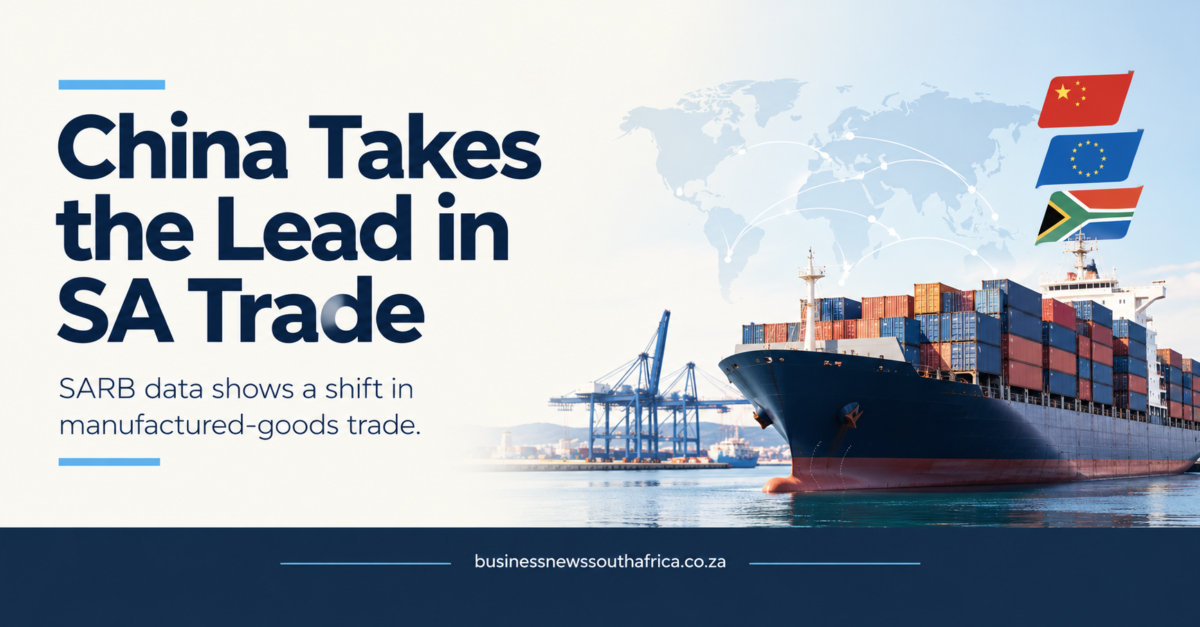
China has overtaken the euro area as South Africa’s largest trading partner in manufactured goods, according to the South African Reserve Bank (SARB). The central bank’s trade-weight update, reported by BusinessTech, ends more than 23 years in which Europe held the top spot.
The ranking matters to any business that buys or sells across borders, because it feeds into how the Reserve Bank measures the strength of the rand. The detail sits in a SARB data story dated 8 October 2026, published alongside its September 2026 Quarterly Bulletin.
What the SARB changed
The SARB periodically revises its effective exchange rate (EER) indices. An EER measures the rand against a weighted basket of the currencies of South Africa’s main trading partners, so it shows how the rand is doing against the countries the economy actually trades with, rather than against the dollar alone. Each partner’s weight reflects how competitive it is in trade with South Africa.
In the latest revision, China’s trade weight is 28.6% in 2026, up from 3.1% in 1999. China sat in sixth place in 2003 and now ranks first. The euro area’s weight fell from 35.7% to 26.01%, which puts it second.
The SARB’s own wording is specific: China is the largest trading partner in manufactured goods. The BusinessTech report adds that Europe remains South Africa’s main export destination, so the change should not be read as China having become the biggest buyer of South African goods overall.
A lopsided relationship
The central bank describes the trade as uneven. China supplied 35.7% of South Africa’s manufactured imports in the 2026 revision, but received only about 5.9% of South Africa’s manufactured exports. South Africa therefore buys far more manufactured goods from China than it sells there.
The SARB also says China’s growing presence in export markets where South African producers compete has pushed up its overall weight in the indices. In other words, the weight reflects both the goods that flow between the two countries and the competition South African firms face from Chinese exporters elsewhere.
The SARB data story does not name the rankings of South Africa’s other major partners, and refers readers to the September 2026 Quarterly Bulletin for them. BusinessTech’s report names India, Japan and the United Kingdom among the other major partners.
Where the pressure shows: vehicles
Vehicles are one place where the shift is visible. When vehicle parts maker Metair reported interim results for the six months to 30 June 2026, as covered by BusinessTech on 26 August 2026, it said new-vehicle sales rose 12.9% year on year in the first half. The company said “Most of the increase in vehicle sales was attributable to imports from Chinese and Indian automotive brands”.
Metair’s group revenue rose about 1% to R8.54 billion, and headline earnings per share (profit per share, adjusted to strip out one-off items) rose 11% to 72c. Local vehicle exports from original equipment manufacturers fell 7.8% to 181 731 units, while light and passenger vehicle manufacturing rose 1% to 285 917 units.
Metair makes parts such as shock absorbers and spring systems for locally built vehicles. BusinessTech’s report does not give a figure for the import share of sales.
Chery moves into a local plant
Part of the Chinese presence is shifting from imports to local assembly. According to Cars.co.za, Chery took over Nissan’s Rosslyn plant, near Pretoria, at a ceremony on 3 July 2026 attended by Deputy President Paul Mashatile. Nissan had announced the sale in January 2026. Chery bought the land, buildings and associated assets, including the nearby stamping plant.
Cars.co.za reports that Jetour T1 and T2 crossovers are due to start production there by mid-2027, and that the Jaecoo J5 will form part of the core line-up. The plant is planned to have capacity of 50 000 vehicles a year in its first phase, with a local content target of 40% under a localisation programme. Chery says the project will create nearly 3 000 direct and indirect jobs and that it has kept the majority of the factory’s existing Nissan workforce.
These are Chery’s own targets, announced at the handover, and none of the production numbers has yet been tested.
What is not yet known
The SARB data story gives no breakdown of which Chinese products drive the change, and BusinessTech’s report refers to a Q2 bulletin while the SARB’s page refers to the September 2026 edition. The Reserve Bank’s page is the primary source for the figures above.
Source: South African Reserve Bank, with reporting from BusinessTech.