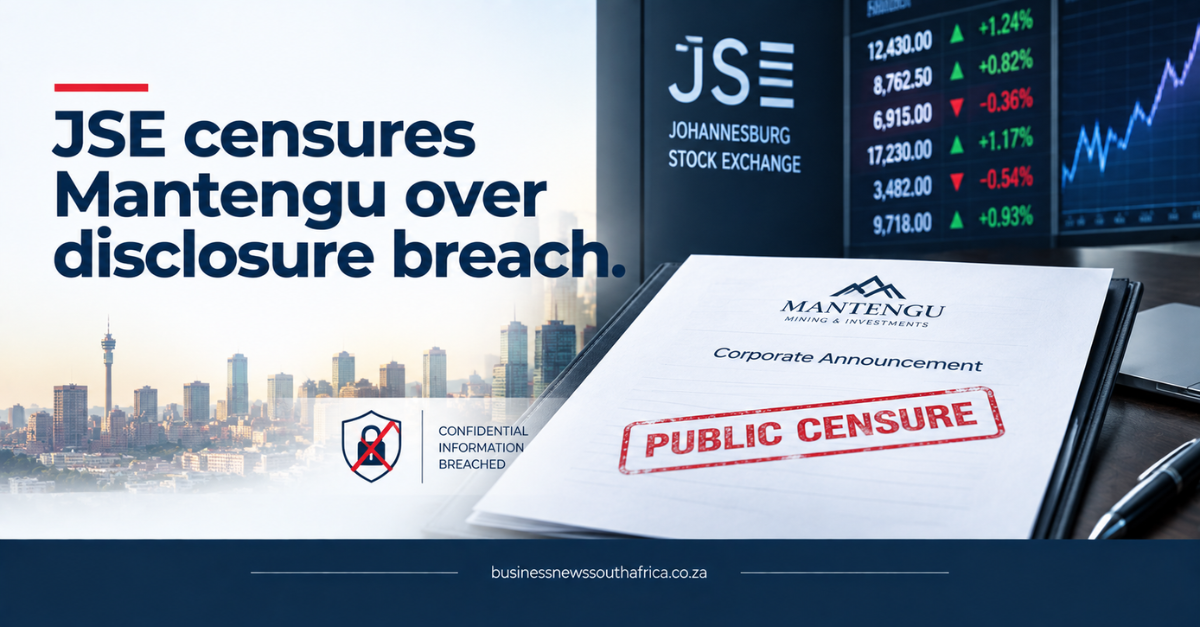
On 21 September 2026 the Johannesburg Stock Exchange confirmed that its public censure of Mantengu Limited was now enforceable. The censure follows the exchange’s finding that Mantengu failed to publish a cautionary statement when it discovered a breach of price-sensitive information linked to a proposed acquisition.
Public censure is a formal, public rebuke that appears on the JSE’s website and in its daily market bulletins. It is not a fine, but it signals to investors, banks and other counterparties that the company has violated the exchange’s listings rules. In practice, a censure can make lenders more cautious, raise the cost of borrowing and deter potential investors who rely on the exchange’s governance standards.
Mantengu, which rebranded from Mantengu Mining Limited after shedding its environmental-services business, had already been fined R100 000 in May 2026 for alleging, without evidence, that its share price was being manipulated. That fine was suspended for three years on the condition that the company does not breach any further JSE rules. The new censure adds another layer of scrutiny.
The breach in question dates back to May 2023 when Mantengu made a binding offer to acquire 100% of the shares in Blue Ridge Platinum, a subsidiary of a larger mining group. In June 2023 the company discovered that confidential, price-sensitive details of the deal had been leaked. Under the JSE’s Listings Requirements, a company must publish a cautionary statement as soon as it becomes aware of such a breach. Mantengu did not do so, and the exchange uncovered the omission during an investigation that began in early 2026.
After the JSE’s investigation, Mantengu applied to the Financial Services Tribunal in April 2026, seeking to have the censure overturned and to suspend its effect pending a review. The tribunal rejected the request for suspension in May 2026 and later dismissed Mantengu’s reconsideration application, leaving the censure in place.
For small-to-medium enterprises that rely on capital markets for funding, the Mantengu episode is a reminder of the importance of timely disclosure. A breach of market rules can quickly erode trust, and the resulting censure can limit access to credit lines or equity financing. Companies that are already navigating operational challenges, such as Mantengu’s shift from environmental services to chrome and platinum mining, may find the reputational hit especially damaging.
While Mantengu’s case is relatively rare, only a handful of listed firms have received a public censure in recent years, it underscores the JSE’s willingness to enforce its rules. The exchange’s actions align with broader regulatory trends in South Africa that aim to improve market transparency and protect investors.
Stakeholders should watch how Mantengu responds. If the company can demonstrate compliance going forward, the censure may become a footnote. If further breaches occur, the suspended fine could be reinstated, and additional penalties could follow. For lenders and investors, the prudent step is to review Mantengu’s compliance track record and consider the potential impact on credit terms.
SME owners and entrepreneurs can use this episode as a case study in corporate governance. The Markets & Finance section offers tools such as the Compliance Document Generator to help companies draft timely disclosures and avoid similar pitfalls.