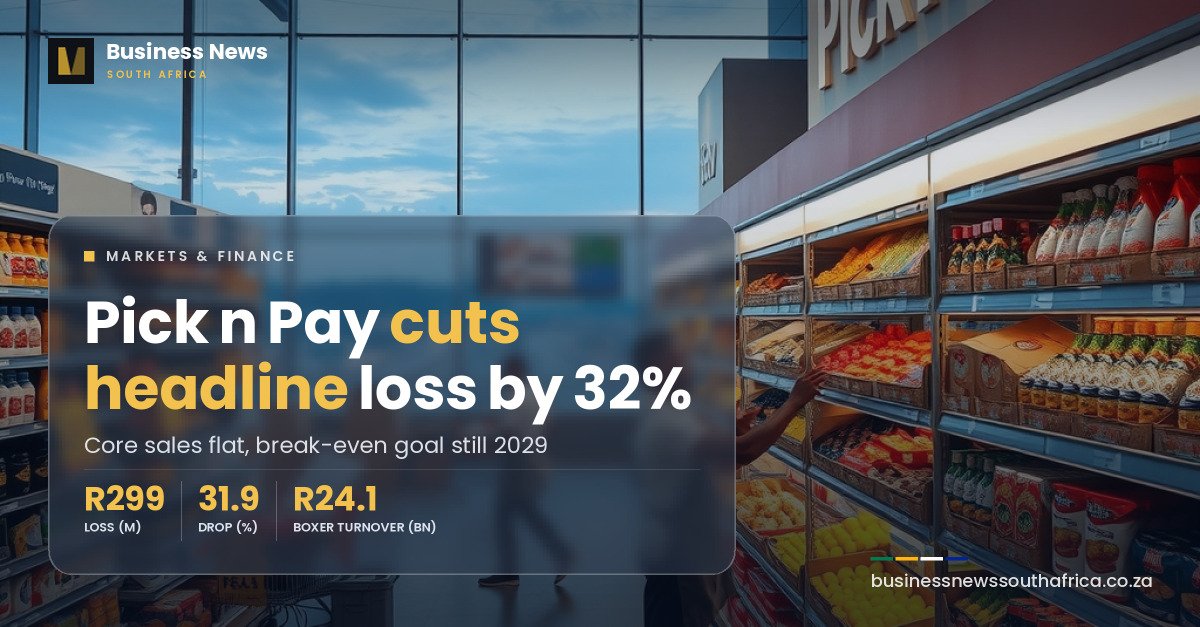
Pick n Pay has cut its headline loss by almost a third for the first half of its 2027 financial year, but sales at its own supermarkets are going nowhere and the retailer says the road back to profit is still long. According to its interim financial statements for the 26 weeks to 30 August 2026, the group’s headline loss narrowed 31.9% to R299m from R439m a year earlier, while group trading profit rose R180m to R490m.
The group is improving, but the Pick n Pay business is still losing money
The improvement at group level leans heavily on Boxer, the discount chain in which Pick n Pay now holds 53.1% after selling a further 12.5% in May. Boxer’s turnover grew 6.3% to R24.1bn and its trading profit rose 8.1% to R1.0bn. It opened its 600th store in the period.
The Pick n Pay segment itself, which covers the supermarkets, clothing and liquor businesses, cut its trading loss by 16.9% to R516m, from R621m. Turnover there was R36.4bn, down 0.1%. Within that, South African turnover slipped 0.5%, while the rest of Africa grew 10.8%, which Pick n Pay attributed to currency translation gains from a stronger Zambian kwacha. The company said the net closure of 19 company-owned and franchise supermarkets over twelve months, taking the estate to 520 stores, is still dragging on sales, although less than before.
Group turnover rose 2.4% to R60.5bn. The group’s loss before tax and capital items shrank 56.2% to R139m, from R317m. Headline loss per share improved to 40.71 cents from 59.77 cents.
The booklet is blunt about how far there is to go. Measured after lease interest, the Pick n Pay segment still lost R1.1bn in the half (R1.076bn, against R1.164bn a year before). The company says “substantial further profitability improvement must still be delivered”, and its FY29 break-even target is set at the trading profit after lease interest level, which is a tougher yardstick than the R516m headline trading loss.
Margins and cost control did the work, not sales growth
The segment’s gross profit margin rose 0.7 percentage points to 17.5%, which Pick n Pay credited to better category and margin management and the move of its Botswana stores to company ownership. Trading expenses rose only 1.7% to R8.1bn, compared with like-for-like expense growth of 6.7% in the whole of FY26.
Not every cost line behaved. Operations costs climbed 5.0% to R2.2bn because of higher diesel, electricity and utility costs, and the credit loss allowance rose by R22m to R93m. Employee costs were up 2.7% to R3.4bn, held down by support office savings that Pick n Pay said involved selective retrenchments.
At company-owned South African supermarkets, like-for-like sales grew 2.4%, ahead of internal selling price inflation of 1.5%, which Pick n Pay says means volumes grew. Franchise supermarkets managed 1.0%. CEO Sean Summers described the company-owned performance in a results release carried by Bizcommunity as “ahead of competitors”. The booklet itself is more measured, calling the outcome “satisfactory” given pressure on consumers since the May 2026 fuel price increases and similar like-for-like figures reported recently by competitors, and adding that stronger growth is required.
Online is the one fast-growing line
Pick n Pay Online turnover grew 35.4% in the half, which the company called another standout performance. Two launches featured: clothing inside the asap! app, which it says delivered turnover well ahead of budget, and Penny, an AI-powered shopping assistant that lets customers build a grocery basket by talking, typing or photographing a recipe, list or empty shelf. Pick n Pay says Penny has improved order conversion and average order value but gave no figures.
As TechCentral pointed out, the company disclosed no rand value for online sales, so it is impossible to tell how large the business has become or whether it makes money. Shoprite’s Sixty60, by comparison, grew 34.5% to R25.5bn in its year to June, according to the same report.
The labour dispute is settled and the balance sheet is stronger
Pick n Pay has withdrawn the Section 189A retrenchment process it opened on 4 May 2026 after agreeing a new store labour model with labour partners, which starts on 1 November. Its results presentation names SACCAWU as the party to the collective agreement and says no operational-requirements dismissals were needed. We covered the withdrawal when it was announced in our earlier report on the withdrawn retrenchment process.
Group net cash stood at R10.0bn, of which R7.7bn sits in the Pick n Pay segment. Most of the rise since the FY26 year-end came from the R4.7bn in gross proceeds from placing the Boxer shares. Excluding that, the Pick n Pay segment’s net cash rose by R0.6bn, which included a R232m Boxer dividend. With the group still making a headline loss, the board has declared no dividend and does not expect to until the group is on a sustainable footing.
What the outlook says, and what it does not
Pick n Pay is targeting break-even in FY29, and the booklet says significant further benefits are expected over the next two and a half years. Daily Investor reported that the target for the core segment has already moved from FY27 to FY28 and now FY29. On the near term, the company says visibility for the rest of FY27 is low because elevated oil prices are hitting food inflation, logistics costs and consumer spending. Summers said in the Bizcommunity report that trading conditions will stay challenging for the remainder of the year. In the four weeks after the period ended, like-for-like sales growth at the Pick n Pay segment’s South African supermarkets was slightly ahead of the half-year figure.
Leadership is also changing. Spencer Sonn, previously at Woolworths, has been named CEO-designate and is due to join next year; we reported on the appointment in our report on the CEO-designate appointment.
For suppliers, landlords and investors, the numbers show a retailer cutting its losses through margin and cost discipline while its core sales are flat and the estate shrinks. Whether that can turn into profit by FY29 depends on like-for-like growth accelerating in a weak consumer market, and the company has not published figures that show how quickly. More retail coverage is in our Retail & Consumer section.