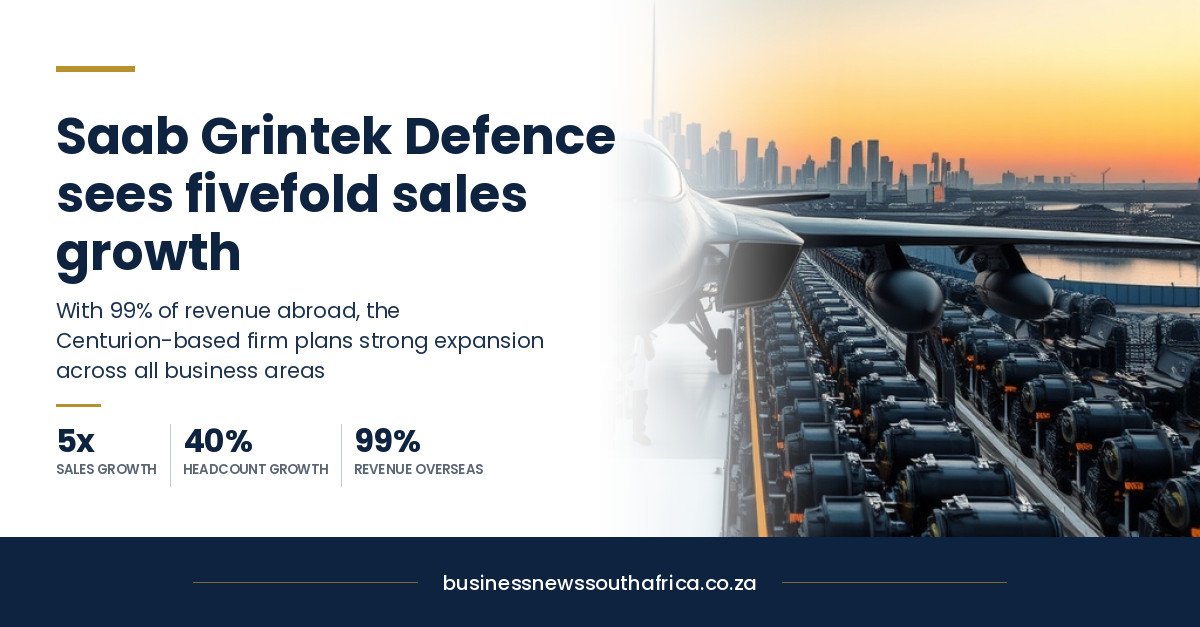
Sara Radu took over as President and Managing Director of Saab Grintek Defence in July. Three months later, at the Africa Aerospace and Defence show at Air Force Base Waterkloof, she stood up and said the company expects strong growth in every part of its business. That kind of line gets said at every defence trade show by every company with a stand to fill. What makes it worth a second look here is what the company’s own numbers over the past five years already say before she arrived: sales up fivefold, headcount up 40%, and more than 99% of revenue coming from outside South Africa.
Saab Grintek Defence, usually shortened to SGD, is the wholly owned South African subsidiary of Sweden’s Saab AB, based in Centurion. It builds electronic warfare systems: the self-protection suites that warn a military aircraft, land vehicle or ship it is being targeted and then jam or spoof whatever is coming for it, plus the avionics that sit around them. Its flagship product, the Integrated Defence Aids Suite, flies on the South African Air Force’s Rooivalk attack helicopter and Oryx transport helicopter, among other aircraft worldwide, and integrates radar, missile and laser warning with the countermeasures that respond to them.
The export number is the real story. A South African defence manufacturer earning 99% of its revenue abroad is not a company riding local defence budgets, which have been a source of complaint rather than growth for most of the sector for years. SGD sells to roughly 25 countries, and SGD’s VP and Head of Strategy, Dr Nivan Moodley, named India as its largest customer base, where it supplies components for the light combat aircraft programme. That is an unusual position for a South African manufacturer to be in: competing for a slot in another country’s domestic fighter jet supply chain, rather than selling finished equipment to it.
Radu’s own career path says something about why a company like this can win that kind of business. She is an engineer who spent years at Business Sweden, the joint government and private-sector body that promotes Swedish exports, working as a trade commissioner developing business for Swedish companies across southern Africa, the wider continent and the Middle East. Before that she held senior roles at Atlas Copco, Epiroc and Polarium, three very different Swedish industrial companies spanning compressors, mining equipment and battery storage. She is not a defence specialist parachuted in to run a defence company. She is a Swedish-industry generalist whose job, for most of her career, was finding foreign markets for Swedish-made things. Putting that person in charge of the local subsidiary reads less like a defence appointment and more like an export appointment that happens to be in defence.
Moodley’s explanation of SGD’s competitive edge runs in the same direction: strength in radio frequency and microwave component production, feeding into larger platforms that Saab’s global presence then has room to scale. The company would not disclose sales figures or breakdowns, which is standard for defence manufacturers and makes Radu’s “fivefold” claim unverifiable against hard numbers from outside the company. What can be checked independently is the hiring pattern she described: SGD received about 500 job applications from South African engineering students earlier this year, put 38 through coding tests, and hired nine. A roughly 2% conversion rate from application to hire is tight even by competitive-graduate-programme standards, and it points to a company treating local engineering talent as a resource worth being selective about rather than one it is struggling to find.
The number worth watching going forward is the 85% of SGD’s parts that Radu said are currently locally sourced, with a stated intention to keep developing that supplier base. For a South African component manufacturer, that figure is the difference between selling into a foreign-owned assembly operation and selling into a foreign-owned company that is actually building its supply chain here. If SGD’s order book genuinely grows the way Radu expects, that local-sourcing share is the number that determines how much of the benefit stays in South Africa, as opposed to flowing straight back to an export order filled mostly with imported components.