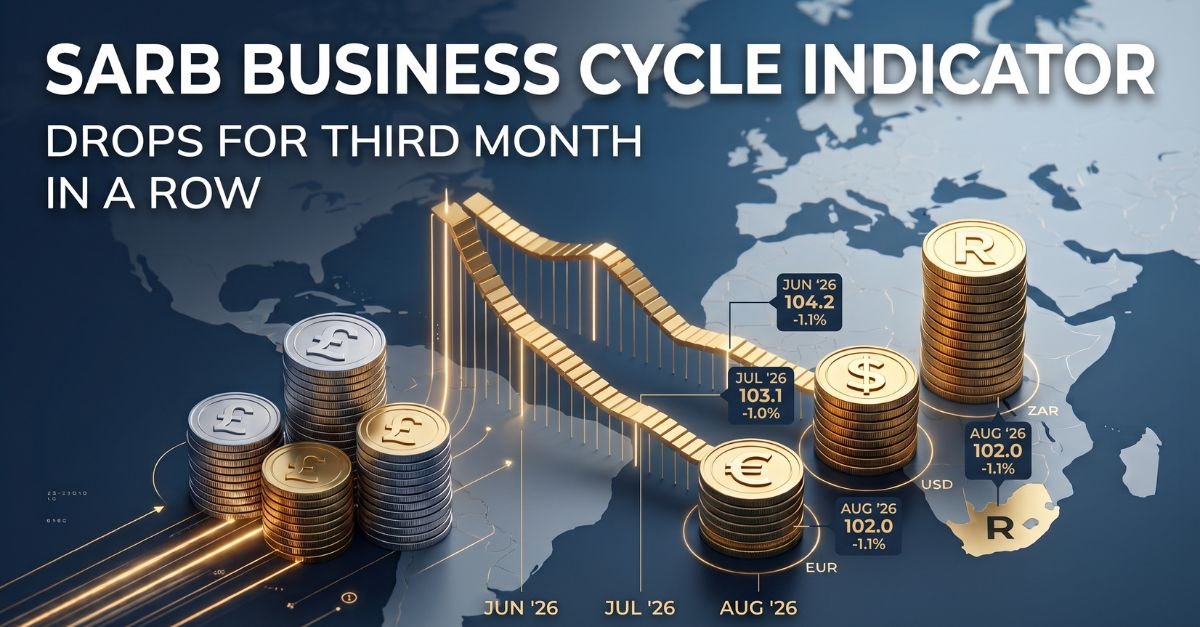
A line on the South African Reserve Bank’s monthly chart has been heading the wrong way for three months running, and business owners with an eye on the broader economy would do well to notice. The bank released the data on Tuesday, confirming its composite business cycle index, which aggregates surveys of manufacturers, retailers and service providers, moved lower again for the third consecutive month.
The composite index exists specifically to flag shifts in economic activity before they show up in official statistics. Readings above 50 suggest expansion; figures below point to contraction, and the latest release placed the index beneath that threshold, meaning the Reserve Bank’s own data now reads as the economy tilting into contractionary territory rather than merely slowing.
What the bank did not say, and why that matters
SARB’s statement did not provide the exact number for the latest reading, nor did it break down which component surveys, new orders, inventory levels, employment expectations, were responsible for the dip. That omission leaves the precise drivers of the slowdown genuinely unclear from the source material alone, a real gap for anyone trying to plan around the trend rather than simply react to the headline.
For small and medium enterprises, a falling business cycle indicator has traditionally forewarned weaker demand, tighter credit conditions, and a higher likelihood of load-shedding disruptions returning alongside a softer economy generally. While the Reserve Bank did not tie this specific trend to any policy decision, the pattern aligns with broader concerns already circulating in economic commentary about consumer confidence and export pressure, suggesting this is not an isolated data point so much as one more confirmation of a story already being told elsewhere.
Without the more granular data, firms are left to monitor upcoming releases for sharper insight, especially if the index keeps trending downward into a fourth or fifth month. In the meantime, the indicator’s sustained decline serves as a genuine, if unglamorous, reminder that the economic environment remains fragile for any business depending on steady consumer spending and reliable power supply, the two conditions South African SMEs have learned, the hard way, never to simply assume.
Composite business cycle indicators like this one are deliberately built to lead rather than confirm, aggregating soft, forward-looking survey responses precisely because hard data such as GDP or retail sales figures only arrive weeks or months after the fact, by which point a business has already lived through whatever shift the indicator was trying to flag. Three consecutive months of decline is exactly the kind of sustained signal these indices are designed to catch early, which is precisely why a business owner tracking cash flow and hiring plans should treat this SARB release as more actionable than its dry, technical framing might suggest.
South Africa’s business cycle has, for years, tracked a fairly consistent set of drags: load shedding’s operational cost, elevated interest rates raising the price of every rand borrowed, and a consumer base whose real spending power keeps getting eroded by inflation running ahead of wage growth. A third straight month of decline does not confirm any one of those specific causes over the others, but it does confirm the combined weight of whatever is happening has not yet found a floor, which is itself useful information for a business trying to decide whether now is the moment to expand or the moment to conserve cash instead. Business owners who have weathered a South African downturn before will recognise the pattern this data is describing before the official recession label, if one ever gets applied, catches up to what the composite index is already showing today.