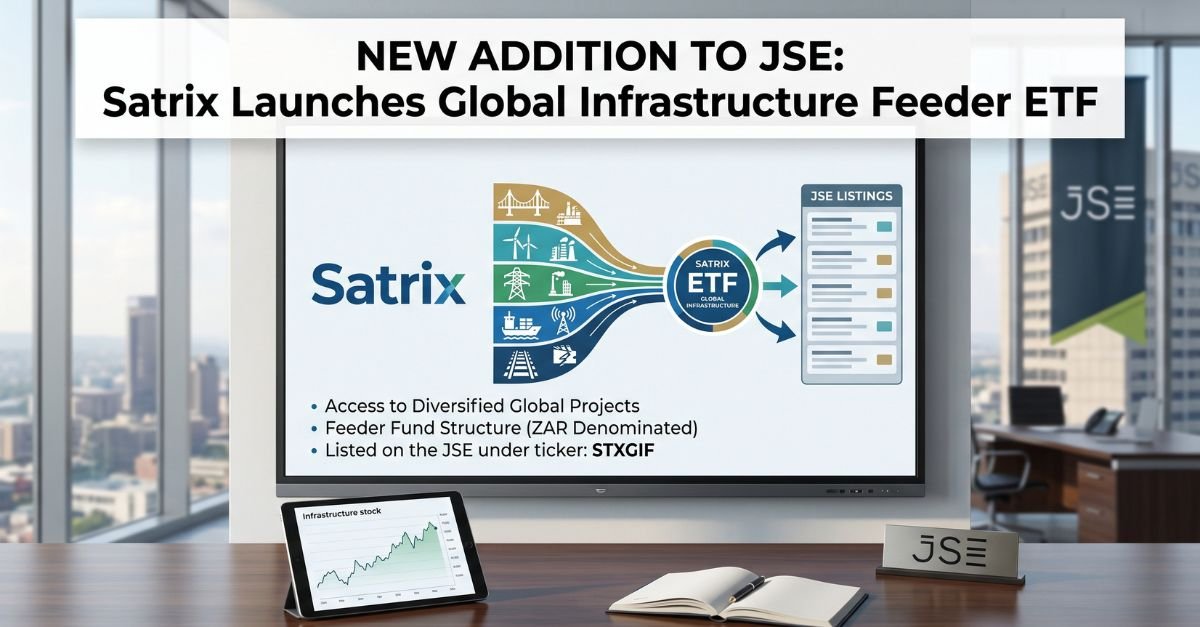
Satrix has added another local doorway into a global asset class, listing a feeder exchange-traded fund tracking the Satrix Global Infrastructure index on the JSE, according to Moneyweb. The new product gives South African investors a rand-denominated route into infrastructure assets, toll roads, airports, renewable-energy projects, without needing to hold foreign currency or deal with an overseas custodian directly.
A feeder ETF mirrors the performance of a master fund, here the Satrix Global Infrastructure ETF, while trading and settling entirely in the local market. Infrastructure assets have attracted real investor attention over the years precisely because they tend to generate steady cash flows and act as something of a hedge against inflation, the kind of defensive characteristic that looks especially appealing when domestic markets feel unpredictable.
Why a local wrapper on a global asset class matters
For owners of small and medium enterprises, this listing offers a genuinely convenient way to diversify earnings otherwise tied entirely to the domestic economy. The feeder structure passes through whatever fees the master fund charges, which can keep total costs lower than directly managing an equivalent overseas fund would, a meaningful difference for anyone investing surplus business cash rather than institutional capital.
The announcement did not disclose launch date, expense ratio or minimum investment amount, details investors genuinely need before committing, which means the sensible next step is reading the prospectus once it becomes available rather than acting on the headline alone. South African retirement savers and retail investors have increasingly leaned on products exactly like this one to access global infrastructure without the administrative friction of an offshore account, and the JSE’s listing framework gives that access a level of regulatory oversight and transparency that a fully offshore alternative would not necessarily match.
Whether this particular fund fits a given portfolio still comes down to the same basic questions every investment does: risk tolerance, time horizon, and how much of an existing portfolio already sits in South African rand-denominated assets. A feeder fund like this one lowers the barrier to global infrastructure exposure considerably, but it does not remove the need to actually think through whether that exposure belongs in a specific investor’s mix before buying in.
Infrastructure as an asset class has grown considerably in appeal globally since interest rates began climbing worldwide, precisely because assets like toll roads and utilities often have contracted, inflation-linked revenue built into how they’re regulated or financed, insulating them somewhat from the same rate pressure squeezing more conventional equities. That is a genuinely different risk profile from a typical growth stock, which is worth understanding before treating this fund as simply another way to buy shares rather than a deliberately defensive addition to a portfolio.
South African investors weighing this against holding infrastructure-adjacent JSE shares directly, listed toll operators or utility-linked companies, should note the diversification the global version genuinely offers: a single country’s regulatory or political risk, load shedding included, cannot sink a globally diversified infrastructure basket the way it can a purely domestic equivalent. That international spread is arguably the whole point of a fund like this one existing in a local-currency wrapper in the first place. Financial advisers increasingly recommend a modest infrastructure allocation as a portfolio stabiliser precisely for this reason, a small, steady counterweight to the more volatile growth positions most South African portfolios already carry through JSE equities and offshore tech exposure alike. For an SME owner who has spent years managing the operational side of infrastructure risk, generator fuel, backup water, the same category showing up as an investable, income-generating asset class rather than purely a cost centre is a small but genuine reframe worth sitting with.