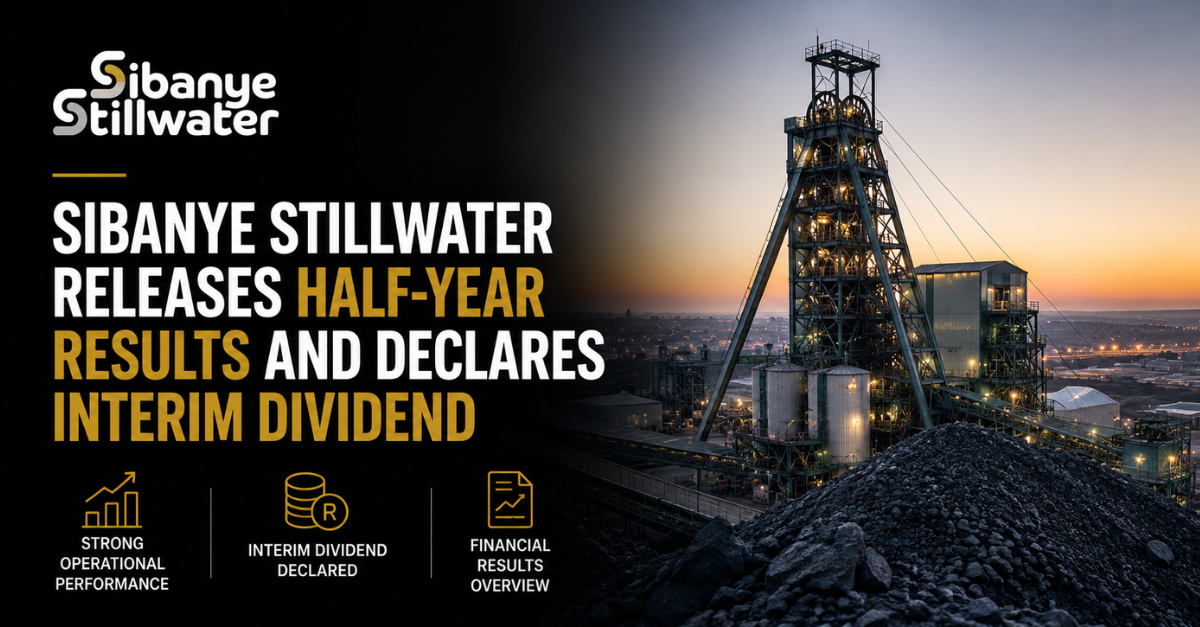
According to a statement released by Sibanye Stillwater Limited, the company posted its financial results for the six months ended 30 June 2026 and announced an interim dividend. The announcement was published on Moneyweb, a South African financial news platform.
The numbers, since confirmed in the fuller results release, are the strongest the group has posted in years. Revenue reached a record R90 billion for the half-year, adjusted EBITDA (earnings before interest, tax, depreciation and amortisation, a standard measure of operating profit) jumped 111% to R31.8 billion, and profit surged to R18.8 billion. Net cash generated from operations hit a record R19.6 billion.
The board declared an interim dividend of R5.7 billion, or 201 South African cents per share, roughly 49.7 US cents per ADR for the group’s American depositary receipt holders. That payout sits at the upper end of Sibanye Stillwater’s own dividend policy, which targets a distribution of between 25% and 35% of normalised earnings.
What actually drove the turnaround
The half-year covered a period in which gold and platinum-group-metal prices have been volatile, and South Africa continues to grapple with load-shedding and logistics bottlenecks, conditions that would ordinarily squeeze a miner’s margins rather than expand them. The scale of the swing here says the tailwind from commodity prices outran those cost pressures by a wide margin. Alongside the earnings jump, the group used its improved cash generation to cut gross debt to R32.1 billion from R39.3 billion at the end of the second half of 2025, an 18% reduction in six months. A miner that pays down debt aggressively in a strong period is buying itself flexibility for the next weak one, which in a cyclical, commodity-price-driven business is not a matter of if but when.
For small-business owners who hold shares in mining stocks, the announcement provides a concrete, near-term cash-flow event: a 201-cent-per-share interim dividend is a meaningful payout by recent standards for the group, not the token gesture that a smaller distribution might have signalled about management’s confidence in sustaining the improvement.
The broader mining sector in South Africa has been under pressure from higher energy costs and a tightening of environmental regulations. Companies that can maintain profitability while navigating these constraints tend to attract more stable investment. Sibanye Stillwater’s half-year performance will therefore be scrutinised not only for the headline numbers but also for the narrative it tells about cost control and operational resilience, and for what management commits to next: the group used the same results to back further investment in new mine developments, a signal that it is treating the current price strength as an opportunity to extend the operation’s life rather than simply banking the windfall.
With the headline figures now public and audited, the debate shifts from whether the turnaround happened to whether it can be sustained once commodity prices normalise, and whether the debt reduction achieved this half becomes a durable feature of the balance sheet rather than a one-off cleanup funded by an unusually strong six months.
Sibanye Stillwater’s operations span gold and platinum-group-metal mining in South Africa alongside platinum operations in the United States, a geographic spread the group has built deliberately over the past decade specifically to reduce its dependence on any single country’s regulatory and power-supply risk. This half-year’s results are the clearest evidence yet that the strategy is paying off in a period when commodity prices cooperated; the sterner test will be whether the diversification still cushions the group the next time prices, rather than local operating conditions, are the source of the pressure. Investors holding the stock through the last several difficult years, when the same geographic spread did comparatively little to offset weak platinum-group-metal pricing, have reason to treat this half’s strength as vindication of the strategy rather than a stroke of unrelated luck.