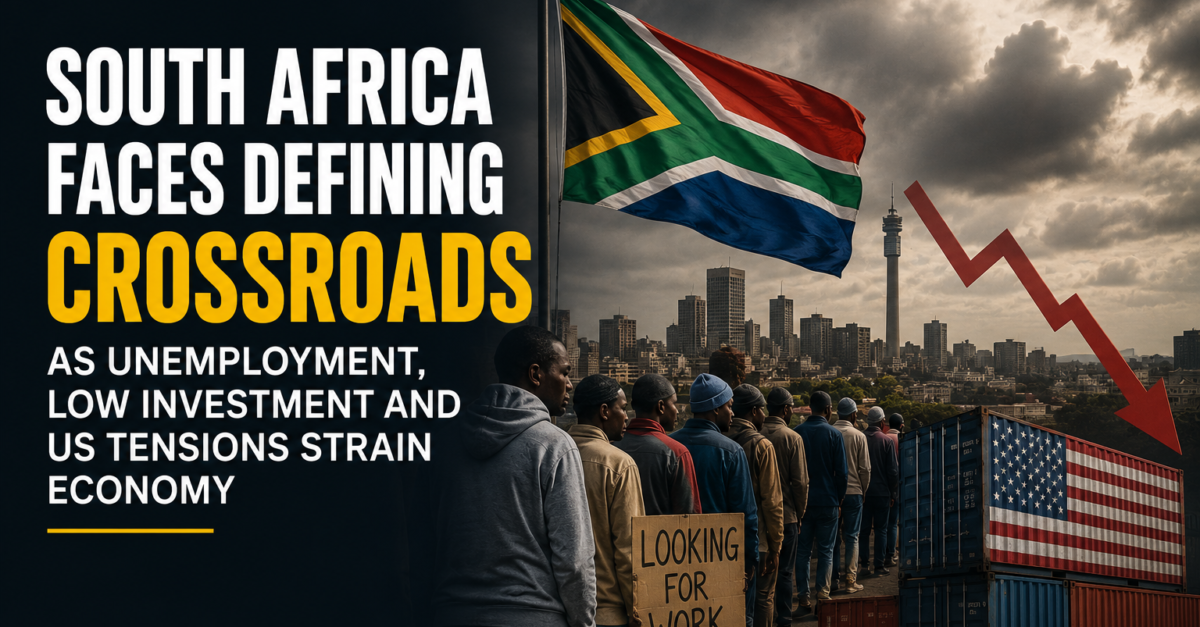
According to African Insider, South Africa is at a defining crossroads because unemployment, weak investment and tensions involving the United States are weighing on the economy. For owners of small and medium enterprises, commonly known as SMEs, this combination of structural pressures signals tighter consumer spending, reduced access to commercial financing, and persistent uncertainty across international export markets.
Unemployment remains above 30 percent, with Statistics South Africa, the official national statistical service responsible for tracking national economic indicators, reporting an unemployment rate of 34 percent in the second quarter of 2026. High joblessness severely restricts household disposable income. Disposable income is the net amount of money that households have left to spend or save after paying personal income taxes and mandatory obligations. When national disposable income falls, consumer spending power contracts across the board. This direct decline in purchasing capacity reduces overall market demand for consumer goods, retail products, and commercial services provided by local SMEs.
Investment flows have also stalled, placing further constraints on broader market liquidity. Official data show that total foreign direct investment, defined as net financial capital originating from foreign enterprise investors seeking long term operational interests in domestic assets, fell to roughly R30 billion in 2025. This marks a sharp contraction from a peak of R45 billion recorded a few years earlier. Capital inflows serve as essential funding engines for large scale infrastructure, commercial expansion, and industrial production projects. When foreign direct investment drops, large corporate capital expenditure contracts, reducing downstream supplier contracts for smaller businesses.
This drop in foreign capital also influences commercial banking behavior across the domestic market. Lower incoming foreign capital reduces overall market liquidity, leading commercial lenders to reassess systemic credit risk. In banking, credit standards refer to the specific financial guidelines, credit rating thresholds, and collateral criteria that financial institutions use to approve business loan applications. When aggregate macroeconomic trends weaken, commercial financial institutions tighten these standards. Banks become far more cautious, raising debt service coverage requirements and restricting liquidity, which makes business loans, credit lines, and asset finance harder to secure for smaller businesses.
External pressure from the United States adds another layer of commercial risk to domestic industry stability. Recent US sanctions on Russia and ongoing international trade disputes have pushed up key global commodity prices and disrupted international supply chains. A supply chain represents the complex network of production, transportation, and distribution channels required to bring raw materials and finished goods to market. For South Africa’s mining and manufacturing sectors, these disruptions increase input costs for machinery, fuel, and raw materials. Because mining and manufacturing operations act as major anchor customers for local business networks, cost pressures in these primary sectors trickle down to local specialized suppliers, logistics providers, and maintenance contractors.
What this means for your business
For SME owners and business professionals, these broad macroeconomic trends translate into direct operational challenges that demand careful balance sheet management. SME executives should expect slower sales growth as households manage tight personal budgets. Managing operating margins becomes critical when customer order volumes soften. Business leadership must evaluate pricing strategies carefully, audit vendor agreements, and eliminate non-essential operating overhead to protect business profit margins.
Securing traditional bank loans will become increasingly challenging as commercial institutions enforce stricter credit standards in response to lower foreign direct investment. Small enterprise owners may need to look beyond standard bank overdraft facilities and explore alternative financing arrangements. These alternative capital options include invoice discounting, where a business accesses working capital by selling unpaid invoices, trade credit arrangements extended directly by suppliers, asset-backed lending, or private debt funding providers.
Companies that participate directly in export markets or supply export focused industries must closely track international trade policies. Changes in US trade regulations, tariff structures, or international cross-border compliance standards can rapidly alter foreign demand for South African products. Export oriented SMEs should monitor global policy adjustments proactively to realign inventory commitments, review target export markets, and shield cash flows from sudden international demand shocks.
The government has signalled a need for policy reforms to boost investment and create jobs, but concrete measures have yet to be announced. Policy reforms refer to targeted economic updates, legislative alterations, or regulatory relief designed to improve business conditions and encourage capital formation. Until formal measures take effect, local business professionals must prioritize strict cash flow management. Cash flow management involves tracking, analyzing, and optimizing the cash coming into the enterprise against mandatory operational outlays. Maintaining disciplined control over working capital, cash reserves, and operating expenses remains the primary defense for business owners navigating these challenging economic conditions.