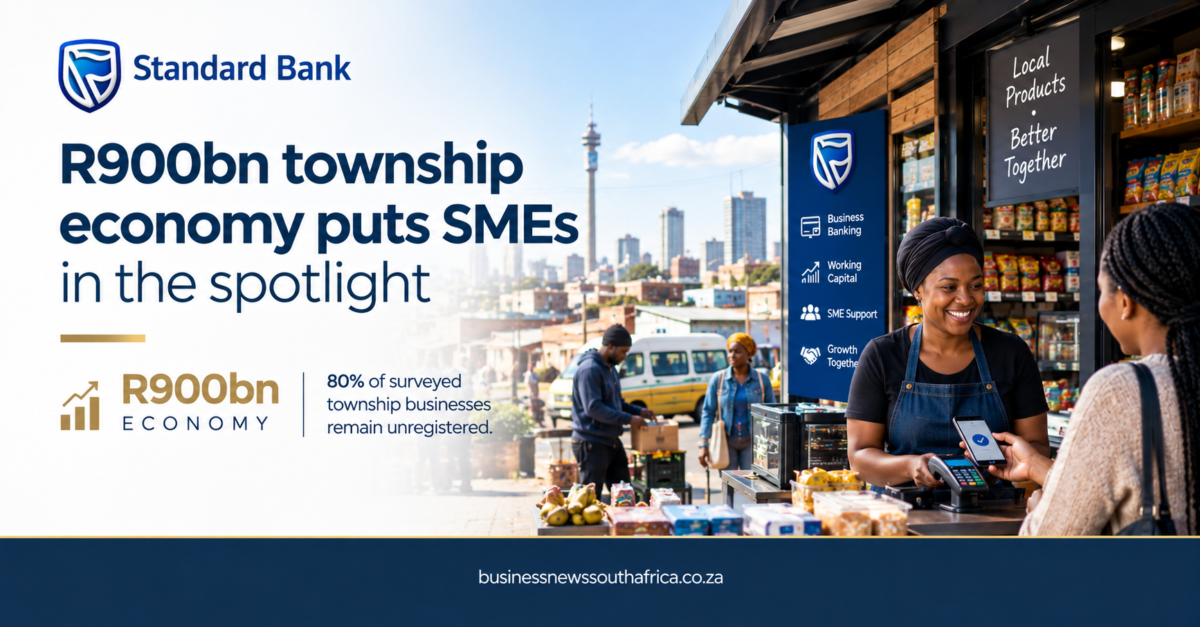
In a bustling township market, vendors shout over the clatter of metal trays while customers haggle over fresh produce, a scene that hides a $50 billion-plus business ecosystem. The description comes from a Moneyweb podcast that featured Standard Bank’s head of enterprise and supplier development, Naledzani Mosomane, discussing the bank’s 2025 Township Informal Economy Insights Report.
The report labels the township sector as an informal economy, meaning that many of the enterprises operate without formal registration, tax identification or statutory labour contracts. It puts the sector’s contribution at roughly R900 billion, with some estimates pushing the figure above R1 trillion. Those numbers are based on surveys of more than 1 000 township enterprises.
Four in five of the surveyed businesses are unregistered, fewer than nine per cent have accessed a bank loan and more than half rely on personal savings to keep the lights on. Almost half operate out of homes or garages, while only about one in ten work from commercial premises. The data points to a clear financing gap and a regulatory hurdle that keeps many entrepreneurs stuck in survival mode.
Why the informal sector matters for South Africa’s economy
The informal sector has long been recognised as a vital source of employment and income for a large share of the population. In South Africa, the majority of small enterprises are located in townships, where the proximity to a dense consumer base creates a natural market for everyday goods and services. Because these businesses are often started with little capital, they tend to be highly adaptable, responding quickly to changes in demand and to the preferences of local shoppers. This agility can translate into resilience during economic downturns, but it also means that the sector is vulnerable when formal support mechanisms such as credit facilities, insurance or legal protection are unavailable.
Informal enterprises typically rely on cash transactions, which limits their ability to build credit histories. Without a documented track record, banks are reluctant to extend loans, and the cost of borrowing from alternative lenders can be prohibitive. The result is a cycle in which entrepreneurs fund growth with personal savings, family contributions or informal lenders, and then struggle to expand beyond a modest scale. The report’s finding that fewer than nine per cent of township businesses have accessed a bank loan underscores how entrenched this cycle has become.
The four pillars of growth identified by Standard Bank
According to Mosomane, the key to unlocking the sector’s full potential lies in four pillars: access to markets, funding, infrastructure and knowledge. Each pillar addresses a specific barrier that prevents informal enterprises from scaling up.
- Access to markets , Formal registration opens doors to corporate procurement processes, supply-chain contracts and larger retail channels. When a business can demonstrate compliance with tax and labour regulations, larger buyers are more willing to engage, knowing that the risk of non-performance is reduced.
- Funding , Formalisation enables entrepreneurs to apply for conventional finance products, from term loans to revolving credit facilities. Banks can assess risk more accurately when they have access to audited financial statements and tax returns.
- Infrastructure , Reliable electricity, water and transport links are essential for consistent production and delivery. Townships often face challenges such as load-shedding and limited road networks, which increase operating costs and reduce competitiveness.
- Knowledge , Business skills, financial literacy and regulatory awareness are critical for sustainable growth. Training programmes that teach entrepreneurs how to manage cash flow, negotiate contracts and comply with labour laws can dramatically improve performance.
These pillars are inter-dependent. For example, improved infrastructure reduces operating costs, which in turn strengthens cash flow and makes a business more attractive to lenders. Likewise, knowledge about procurement processes can help an entrepreneur secure a market that justifies investment in better infrastructure.
Formalisation as a catalyst for change
Formalisation, the process of registering a business and complying with tax and labour rules, can open doors to corporate procurement, supply-chain contracts and conventional finance, but many entrepreneurs view it as costly and disconnected from day-to-day realities. The perception of high registration fees, complex paperwork and ongoing compliance obligations often outweighs the perceived benefits. Yet the report shows that formal businesses typically enjoy lower interest rates and better access to government procurement programmes.
For SME owners, the implication is simple: moving from an informal to a formal structure can broaden the pool of financing options. The Commercial Funding Suite tool on Business News South Africa can help map out suitable loan products once a business is registered. In addition, formal registration provides a legal framework that can protect owners from disputes, improve credibility with suppliers and enable participation in formal sector training initiatives.
How the broader SME landscape informs township policy
South Africa’s broader SME landscape already shows that formally registered firms enjoy lower interest rates and better access to government procurement programmes. The township economy, with its proximity to a concentrated consumer market, could therefore become a powerful growth engine if the formalisation barrier is lowered. National policies that streamline registration, reduce fees and provide one-stop support for compliance can make the transition less daunting.
In practice, many municipalities have introduced business facilitation centres that guide entrepreneurs through the registration process, help them obtain tax numbers and advise on labour compliance. These centres also serve as hubs for information about funding opportunities and market linkages. When combined with targeted infrastructure upgrades, such as reliable electricity supply and improved transport routes, the environment becomes more conducive to business growth.
Implications for township entrepreneurs
The data highlights three immediate actions that township entrepreneurs can consider. First, assess the feasibility of formal registration by weighing the short-term costs against the long-term benefits of access to finance and larger markets. Second, explore partnerships with organisations that provide mentorship, training and market access, as these can accelerate the learning curve and reduce the risk of costly mistakes. Third, leverage digital platforms that facilitate cashless transactions, inventory management and customer outreach, thereby building a digital footprint that can be presented to potential lenders.
Beyond individual actions, collective organisation through cooperatives or business associations can amplify bargaining power. When a group of informal traders presents a unified front, they can negotiate better terms with suppliers, share infrastructure costs and collectively meet the criteria for larger contracts. Such collective approaches also make it easier for banks to assess risk at a group level, potentially unlocking bulk financing arrangements.
Policy recommendations emerging from the report
The next step for policymakers and banks is to translate the data into concrete programmes that bridge the financing and knowledge gaps. Possible interventions include:
- Introducing tiered registration fees that reflect the size and turnover of the business, making it more affordable for micro-enterprises.
- Creating a dedicated credit line for newly formalised township businesses, with interest rates that reflect the reduced risk associated with formal documentation.
- Expanding mentorship schemes that pair experienced entrepreneurs with newcomers, focusing on financial management, regulatory compliance and market development.
- Investing in infrastructure projects that target high-density township areas, ensuring reliable power and transport links that support business operations.
- Launching public awareness campaigns that demystify the formalisation process and highlight success stories from within the township sector.
These measures, taken together, can help shift the narrative from one of survival to one of sustainable growth. By lowering the barriers to formalisation, the government and financial institutions can unlock a substantial amount of economic activity that is currently hidden from formal statistics.
Looking ahead: the potential of a formalised township economy
In the end, the R900 billion figure is not just a snapshot of what exists; it is a benchmark for what could be achieved when township entrepreneurs gain the same support mechanisms that larger firms enjoy. The report’s insight that the sector could contribute more than R1 trillion underscores the magnitude of the opportunity. If the four pillars identified by Standard Bank are addressed in a coordinated manner, the township economy could become a catalyst for job creation, poverty reduction and inclusive growth across the country.
For business owners, the message is clear: formalisation is not merely a bureaucratic exercise, but a strategic move that can open doors to finance, markets and knowledge that are otherwise out of reach. For banks and policymakers, the data provides a roadmap for designing interventions that are both targeted and scalable. The convergence of these efforts could transform the informal landscape into a vibrant, formalised sector that fuels South Africa’s broader economic ambitions.
Listen to the full podcast on iono.fm or on Spotify and Apple Podcasts.