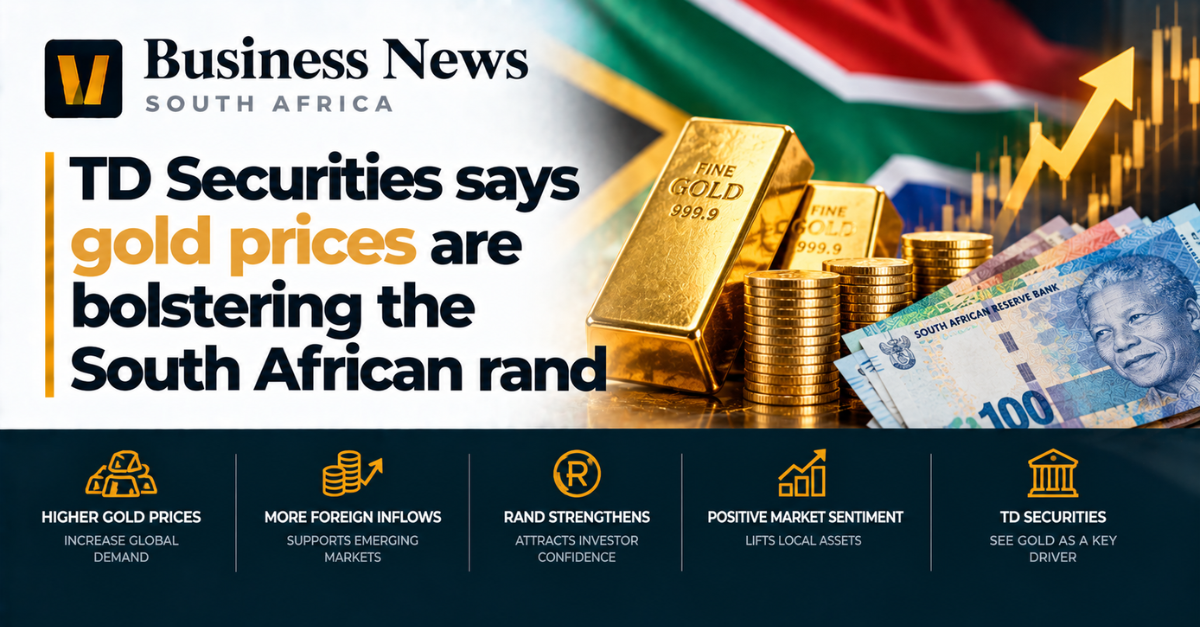
TD Securities told Bitget that the recent rise in gold prices is providing support to the South African rand (ZAR) against the US dollar (USD). The comment was made in a short market note that highlighted the link between the world’s most-traded precious metal and the country’s currency.
For a small-to-medium enterprise that imports raw material or finished goods, a stronger rand means fewer rand are needed to buy the same amount of dollars. That can translate into lower purchase costs, tighter margins and, in some cases, the ability to pass on savings to customers. Conversely, a weaker rand would raise the rand-cost of imports and squeeze profit margins.
South Africa is the world’s second-largest gold producer, and gold exports account for a noticeable share of foreign-exchange earnings. When the price of gold climbs, the mining sector earns more in rand terms, which adds to the supply of foreign currency and can lift the rand’s value. The relationship is not a perfect one-to-one, but it is a recognised driver of short-term currency moves.
TD Securities did not provide a specific price level for gold or a precise forecast for the rand. The note simply said that the metal’s price action is currently acting as a supportive factor. In plain terms, the broker is saying that, all else being equal, the rand is less likely to fall further as long as gold stays firm.
For businesses that rely on the rand’s stability, the message is a reminder to watch two variables: the price of gold and the broader dollar-rand trend. If gold were to retreat, the rand could lose the cushion it currently enjoys, potentially leading to a weaker currency and higher import bills. On the other hand, a continued rally in gold could keep the rand on a steadier footing, which may help companies plan budgets with a bit more certainty.
It is also worth noting that the rand’s movement is influenced by many other factors, such as interest-rate differentials, political developments and global risk sentiment. The gold-rand link is just one piece of a larger puzzle. Companies that track currency exposure often use hedging tools, such as forward contracts, to lock in rates and protect against sudden swings.
In the short term, the TD Securities note suggests that the rand’s recent resilience is not a fluke but is tied to a tangible market driver. For SME owners, the practical takeaway is to monitor gold price headlines alongside their own foreign-exchange risk management practices.
Why the rand tracks commodities at all
Currencies of countries that export a concentrated set of raw materials tend to move with the prices of those materials, and economists group them together as commodity currencies for that reason. The mechanism runs through the terms of trade, the ratio of what a country earns for its exports to what it pays for its imports. When export prices rise faster than import prices, more foreign currency flows in for the same volume of goods shipped out, the current account improves, and the local currency has support it did not have before.
The relationship is real and it is loose. It holds on average and over time, and it breaks routinely over any short window, because a currency is priced against everything else happening at once. Interest rate differentials between South Africa and the major economies usually dominate, since a large share of rand trading is financial rather than trade related. Global risk appetite dominates in a crisis, when investors reduce exposure to emerging markets regardless of what any individual commodity is doing. Domestic politics and fiscal news can override both for weeks at a time.
What this means for a business rather than a trader
The distinction worth holding onto is between forecasting a rate and managing exposure to it. Forecasting requires being right about the direction. Managing exposure requires only knowing what you are exposed to, and it is the one most businesses can actually execute.
The starting point is the size and timing of foreign currency commitments over the coming months. A forward exchange contract fixes a rate for a future date, which removes the uncertainty in both directions: the business gives up the chance of a better rate in exchange for knowing the cost now. An option leaves the upside available and charges a premium for it. Neither is a bet on the currency. Both convert an unknown into a known, which is what a budget requires.
The practical failure in smaller businesses is rarely choosing the wrong instrument. It is pricing a quote at today’s rate, delivering three months later, and discovering the margin was a currency position all along. A commentary note about gold is useful background. Knowing the rate at which a specific order stops being profitable is the thing that actually protects the business.