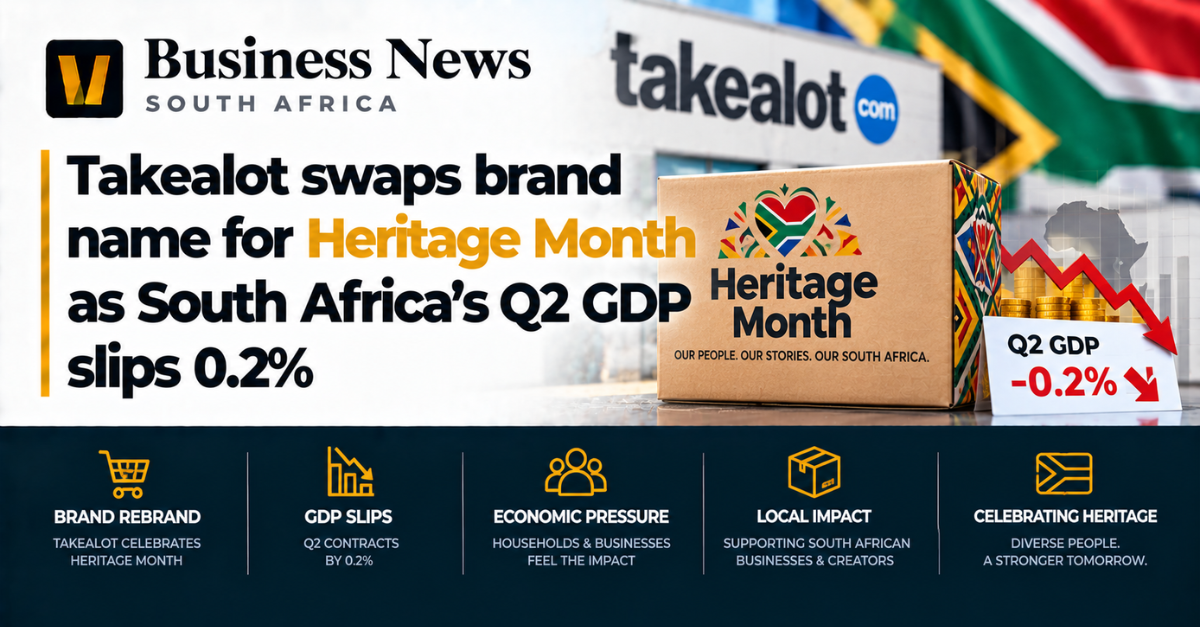
On a Tuesday morning in Johannesburg, a familiar white delivery box arrived at a suburb with a new label: the word “Takealot” rendered in isiXhosa, Afrikaans, or another of the country’s twelve official languages. The e-commerce giant says the change is a one-off celebration of Heritage Month, and the boxes will carry the translated name for the next four weeks.
Takealot’s statement notes that the move is meant to “recognise the linguistic diversity of our customers” and to “show that we are part of the communities we serve”. The company has not disclosed whether the experiment will affect its brand recognition or sales, leaving retailers and marketers to watch the results closely.
Economic backdrop
At the same time, the national economy posted a modest decline. Statistics South Africa released data showing that gross domestic product (GDP), the total value of goods and services produced, fell 0.2% on a seasonally adjusted quarter-on-quarter basis in the second quarter. A seasonally adjusted figure removes the effect of predictable seasonal patterns, such as holiday spending, to give a clearer view of underlying trends.
Investec economist Lara Hodes explained that the contraction reflects “a fragile domestic economy, constrained by high fuel costs”. The war in Iran has pushed energy prices up, raising the cost of transport and manufacturing inputs. Those higher costs have filtered through to consumers, who are now spending less on non-essential items.
The rand, South Africa’s currency, held steady on the day of the release, trading at R15.99 to the dollar. A stable exchange rate can help import-dependent retailers keep costs predictable, but it does not offset the pressure from higher fuel prices.
For small and medium-sized enterprises (SMEs) that rely on Takealot’s marketplace, the name-change experiment may offer a subtle lesson. Localising language on packaging can reinforce brand affinity, especially in a market where consumers value cultural recognition. However, the broader economic slowdown means that any marketing boost must be weighed against tighter household budgets.
Experts caution that the Q2 dip does not necessarily signal a long-term recession. The same Statistics South Africa release noted that the data are “cautiously optimistic” about future growth, pending upcoming figures on the current account, mining, and manufacturing. Those sectors remain key drivers of employment and consumer confidence.
What remains unknown is how Takealot’s temporary rebranding will translate into sales numbers, and whether other retailers will follow suit. The company’s statement is a claim of intent, not a proven outcome. SMEs watching the experiment should monitor footfall on Takealot’s platform, compare it with their own sales data, and consider whether a similar localisation strategy could work for their own brands.
The economics of a temporary rebrand
Swapping a brand name for a month is a cheaper experiment than it looks, and a riskier one than it sounds. Cheaper, because packaging and delivery materials are already reprinted on a rolling cycle and a limited run can be slotted into that cadence without new tooling. Riskier, because brand recognition is built on repetition, and anything that interrupts the repetition spends a little of the asset it is trying to celebrate.
The reason large retailers keep doing it anyway is that a delivery box is media the company already owns. It arrives at a home address, it is handled rather than scrolled past, and it is photographed and shared by customers at no cost to the sender. Measured against buying the same number of impressions, a temporary pack change is one of the least expensive campaigns available to a business that already ships physical goods.
The part that is genuinely hard is attribution. A retailer running a seasonal campaign cannot easily separate its effect from everything else moving at the same time: the calendar, competitor promotions, pay dates, the weather and, in this case, a softening economy. This is why campaigns of this kind are usually assessed on brand tracking measures such as recall and sentiment rather than on sales, and why a company will rarely commit to a sales claim afterwards.
What a smaller retailer can take from it
Localisation is not the same thing as translation, and the distinction decides whether the exercise reads as respect or as decoration. Translating a brand name is a surface gesture that costs little and signals something. Serving customers in their own language across the parts of a business that carry friction, support, returns, delivery instructions and complaints, is more expensive and considerably harder to imitate.
For a smaller operator, the second is usually the better investment, precisely because the first is available to everyone. A campaign is visible for a month. A support channel that works in the language a customer actually complains in is visible every time something goes wrong, which is when a brand is genuinely tested.