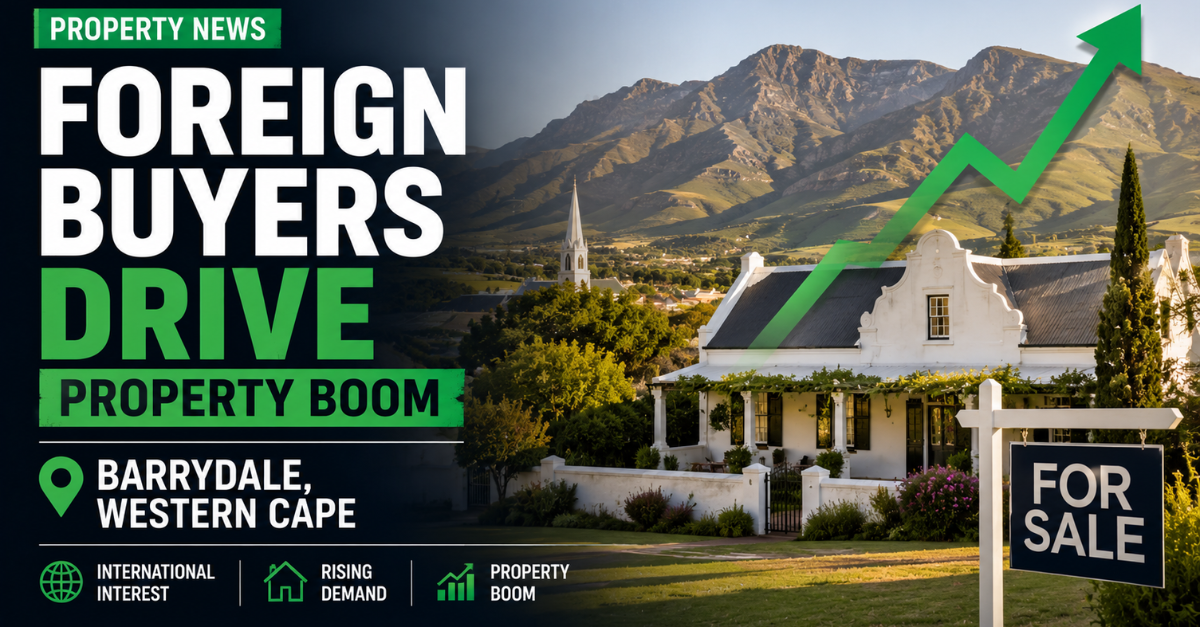
On a quiet street in Barrydale, a newly painted stone cottage sits beside a garden of aloes, its front door opened to a pair of suitcases from abroad. The scene captures a shift that has been quietly reshaping the town ever since the Daily Maverick named it South Africa’s Small Town of the Year in December 2025.
According to Seeff Property Group, an established local real-estate agency, international buyers now make up about 15% of total property sales in Barrydale. Those buyers are typically spending between R2.5 million and R5 million on homes, cottages or smallholdings. The agency’s estimate is a claim by the company and has not been independently verified.
Lightstone, a property data firm, provides a broader picture for the Western Cape. The province accounts for more than 40% of high-value non-resident property transactions in the country, that is, sales to buyers who do not live in South Africa. Lightstone data also shows that foreign buyers represent 7.8% of all property transactions in the province, rising to 11% for homes valued at over R1 million.
The numbers matter for local entrepreneurs. Higher-priced sales tend to lift the average valuation of properties in the area. Lightstone has found that in key lifestyle locations, homes owned by foreign buyers are on average 29% to 39% more valuable than those owned by South African residents. For a town of roughly 4,200 permanent residents, that premium can translate into increased demand for construction, renovation, landscaping and hospitality services, all sectors where small-scale businesses can find new contracts.
The trend is not limited to Barrydale. Buyers are also showing interest in nearby towns such as Greyton, Montagu, Prince Albert, Stanford, McGregor, Riebeek Kasteel and Paternoster. While Cape Town’s Atlantic Seaboard remains the biggest draw for overseas capital, the flow of money into smaller, rural towns suggests a diversification of lifestyle-property demand across the province.
Barrydale’s appeal is rooted in its geography and history. Nestled between the Overberg and Klein Karoo regions at the northern entrance to the Tradouw Pass, the town is surrounded by mountains, vineyards and orchards. Its natural environment, famous for succulents and seasonal flower displays, adds to the lifestyle draw. Historically, the town grew around agriculture, with the Barrydale Koöperatiewe Wynkelder and a distillery established in the 1940s, later earning international recognition when Joseph Barry Brandy was named the world’s best brandy in 2003.
For local SMEs, the influx of foreign capital presents both opportunity and challenge. Builders and renovators may see a surge in projects as buyers look to customise properties to their tastes. Hospitality operators, from boutique guesthouses to cafés, could benefit from increased visitor numbers and longer stays. At the same time, rising property prices can make it harder for local residents to afford homes, potentially tightening the labour market for businesses that rely on a stable local workforce.
Overall, the growing share of overseas buyers in Barrydale reflects a wider shift in the Western Cape’s property market: investors are moving beyond the traditional luxury enclaves of Cape Town to seek quieter, scenic locations. How the town balances this new demand with the needs of its existing community will shape its economic trajectory in the years to come.
Part of a broader semigration pattern
Barrydale’s experience mirrors a wider trend South African property analysts have tracked since the rise of remote work made it possible for professionals to live somewhere scenic rather than somewhere close to an office. Small towns within a few hours’ drive of Cape Town, along the Garden Route and across the Klein Karoo, have seen renewed demand from both semigrating South Africans relocating from major metros and from international buyers drawn by favourable exchange rates and a lower cost of living relative to Europe or North America. The Daily Maverick’s Small Town of the Year recognition functions as a kind of accelerant in this pattern: national media attention on a town’s lifestyle appeal tends to precede, rather than follow, a measurable uptick in buyer interest.
The risk side of this pattern is also well established. Small municipalities were generally not built, financially or in terms of infrastructure capacity, for a rapid influx of higher-spending residents, and water, sanitation and road maintenance budgets calculated for a town’s historical population can come under strain faster than a local council can adjust rates and budgets to match. Whether Barrydale’s local government can scale services in step with the property boom will likely determine whether the current wave of investment becomes a durable economic upgrade for the town or a source of local tension over resources.