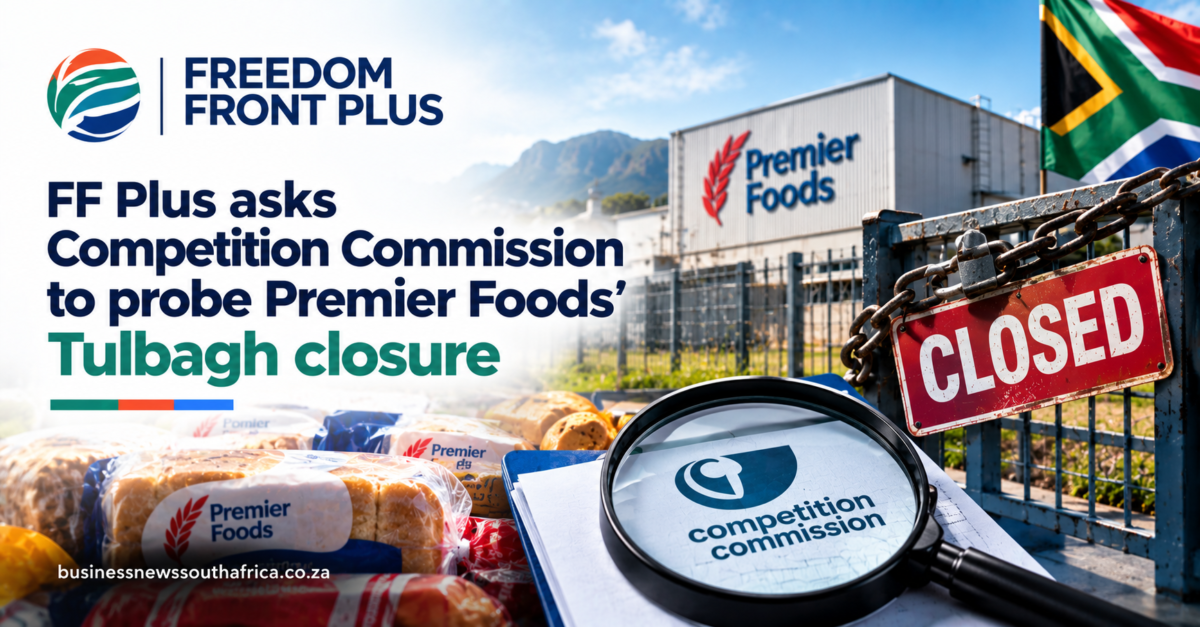
Tulbagh is not a large town, but it is, by most measures, one of the wealthier small towns in South Africa, built in no small part on the fruit that comes off the Witzenberg region’s orchards. That is what makes Premier Foods’ plan to close a fruit-canning factory there land as more than a routine corporate decision: the Freedom Front Plus has now formally asked the Competition Commission to investigate the closure, according to Daily Investor, with roughly 3,000 jobs sitting in the balance.
Premier Foods took control of the plant after completing its acquisition of Rhodes Food Group in the 2025/26 financial year. Built in the 1940s, the factory processes peach, pear and apricot harvests from the Witzenberg region and exports most of what it produces to Europe and North America, the kind of long-standing export infrastructure that does not get replaced quickly if it disappears.
Why the Competition Commission, and not just labour mediation
Premier announced earlier this year that it planned to shut the factory, describing it as no longer financially sustainable, a claim from the company rather than an independently confirmed fact. The decision has already drawn criticism from trade union Solidarity, which has raised concerns about the impact on Tulbagh’s local economy as well as its workers.
VF Plus MP Johnny Steenkamp said the party had formally approached the Competition Commission separately from the mediation process already under way between Premier Foods and stakeholders including workers and producers, framing the request as adding scrutiny rather than interfering with that mediation. The party’s specific concern centres on roughly 200 fruit producers who supply the plant, most of whom have already signed three-year delivery contracts and taken on costs tied to those agreements. A sudden closure and the termination of those supply contracts could ripple well beyond the factory floor, into farming operations that built their own planning around a buyer that may no longer exist.
VF Plus has asked the Commission to determine whether the closure and the associated contract terminations raise genuine competition concerns, and if so, to investigate before Premier’s decision becomes irreversible, a request that is as much about timing as substance: an investigation that concludes after the factory has already shut achieves considerably less than one that runs in parallel with a decision still open to reconsideration.
For the roughly 3,000 people the plant employs and the producers who supply it, the outcome now hinges on two separate processes running side by side, the direct mediation between Premier and affected stakeholders, and whatever the Competition Commission decides to do with VF Plus’s request. Neither has concluded, and Premier has not said publicly whether it will reconsider the closure, which leaves Tulbagh in the uncomfortable position of watching two slow-moving institutional processes decide the fate of one of its largest employers.
Small agricultural towns across South Africa’s fruit-growing regions share a version of this vulnerability, whether they realise it or not: a single processing facility often represents the difference between a farming community with a viable export market and one without, since fresh fruit that cannot be canned, juiced or otherwise processed close to where it is grown rarely survives the journey to a distant facility in saleable condition. Tulbagh’s situation is, in that sense, a specific instance of a structural risk facing plenty of similar towns built around a single agro-processing anchor, which is precisely why a factory closure decision draws scrutiny well beyond the workers directly employed there.
Fruit farming carries a specific vulnerability that separates it from most other agricultural products: perishability leaves almost no room for a delayed decision once harvest season arrives, since produce grown for canning or juicing cannot simply wait in a silo the way grain can while a business dispute plays out. That physical reality is part of what gives the Competition Commission approach real urgency here rather than making it a purely symbolic gesture: producers with contracted deliveries need clarity well before their next harvest is ready, not months after a factory has already gone quiet, which is exactly the timeline VF Plus is trying to force with this request.
The Competition Commission investigates conduct that may harm competition, not job losses or plant closures directly, so a probe like this one would need to establish an actual competition-law angle, such as collusion or an abuse of market power, rather than the closure itself being the violation. For related coverage of a different company facing Competition Commission scrutiny the same period, see this site’s report on Investec’s rand-rigging case.