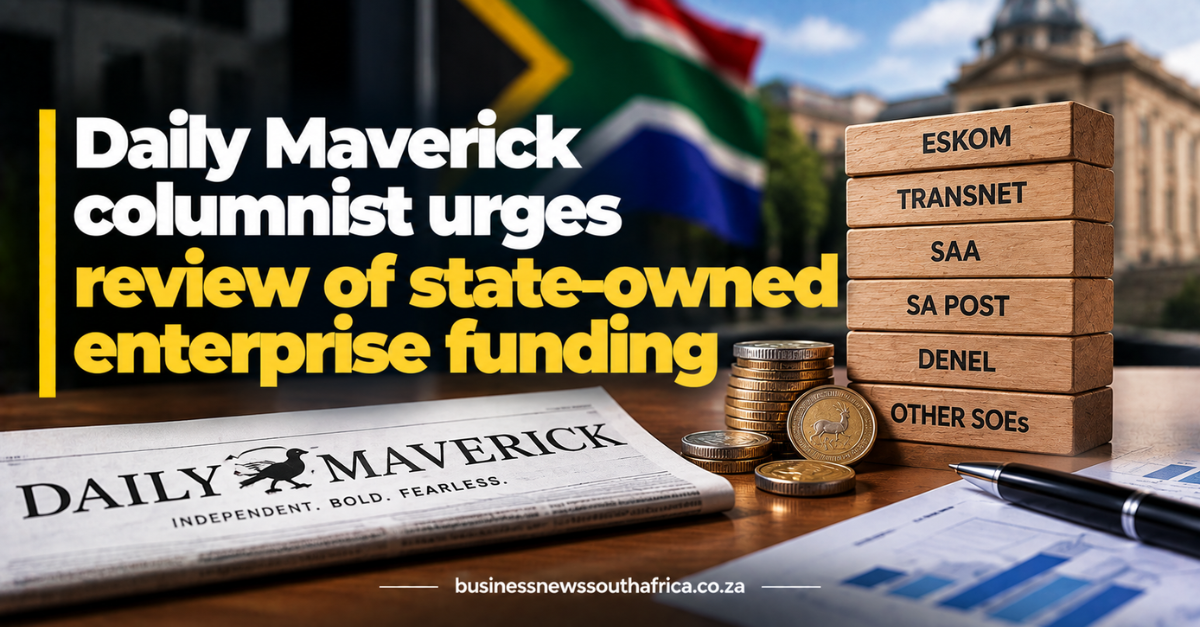
A Daily Maverick columnist wrote an opinion piece urging the government to review the way it funds South African state-owned enterprises (SOEs). The columnist argues that the current approach risks unsustainable debt levels and limits the Treasury’s ability to invest in other priorities.
The call is for a systematic assessment of capital allocations to entities such as Eskom, the national power utility, and Transnet, the state-owned rail and logistics group. Both organisations have relied on repeated bail-outs, with Eskom’s debt reported at around R400 billion and Transnet’s at roughly R300 billion. Those figures illustrate the scale of the fiscal pressure.
Why the funding debate matters for small firms
For owners of small and medium enterprises, the outcome of any funding review could affect operating costs. Higher electricity tariffs, which often follow Eskom’s cash-flow challenges, directly raise the cost of running a shop or workshop. Similarly, freight rates set by Transnet influence the price of imported raw material and the cost of exporting finished goods.
The columnist’s piece is a claim about the need for policy change; it does not represent an official decision. No government response has been confirmed at the time of writing.
If the Treasury follows the suggestion, the next steps may involve parliamentary committees examining SOE budgets, the National Treasury publishing a funding framework, and possibly tighter performance conditions for future bail-outs. Such moves could reshape the fiscal landscape that SMEs operate within.
State owned enterprises have been a recurring theme in South Africa’s fiscal debate, with Eskom and Transnet requiring billions of rand in government support and guarantees over the past decade while their own turnaround plans took shape. The National Treasury’s own fiscal risk statements carries further detail. For related coverage, see this site’s Regulatory and Policy coverage.
That funding debate has played out most visibly at Eskom, which received a multi year government-backed debt relief arrangement intended to free up cash for grid maintenance and new generation capacity, and at Transnet, whose freight rail and port operations have struggled with ageing infrastructure and cable theft even as the entity posted an improved recent set of results. Critics of the current funding model argue that state guarantees without matching accountability measures simply defer the underlying problem, while defenders note that South Africa’s electricity and freight networks are strategic assets that few private investors would be willing to fund and operate alone at the scale required.
South Africa’s broader public finances have also been shaped by how state entities are funded outside the normal budget process, through mechanisms such as government guarantees that do not always show up as direct spending but still represent a contingent liability the Treasury has to account for. Ratings agencies have previously cited this contingent exposure to state owned enterprises as a factor in their assessments of the country’s overall creditworthiness, which in turn affects the interest rate at which government itself can borrow.