Imagine a South African earning R65,000 a month being told they must join a private medical scheme. That is the scenario Thoneshan Naidoo, chief executive of the Health Funders Association (HFA), is urging the government to consider. In an interview, Naidoo argued that making medical-aid membership compulsory for formally employed workers, at least those on higher salaries, could help lower the cost of private healthcare for everyone.
For small-business owners and entrepreneurs, the proposal matters because it could become a new payroll obligation. If the rule were adopted, companies would need to deduct medical-aid contributions from employees’ salaries and remit them to insurers, adding an administrative layer and a potential cost increase for higher-paid staff.
Naidoo’s claim rests on the idea of a larger risk pool. A risk pool is the group of members whose health expenses are shared; the more healthy, younger people in the pool, the lower the average cost per person. He said South Africa’s private schemes are “effectively 20% to 30% more expensive because we never made it mandatory for employed people to belong to medical schemes.” HFA data, according to Naidoo, shows about 25 million South Africans use private health services, yet fewer than nine million are members of a medical scheme. The remaining roughly 16 million pay out of pocket.
Targeting higher-income earners, Naidoo pointed to an estimated 200 000 South Africans earning more than R750 000 a year (around R62 500 a month) who are not currently in a scheme. He described this group as “an easier enrolment opportunity.” HFA’s modelling, he said, suggests that expanding membership could cut expected benefit costs by 10% to 13% under conservative assumptions, with other models showing possible reductions of 18% to 30%.
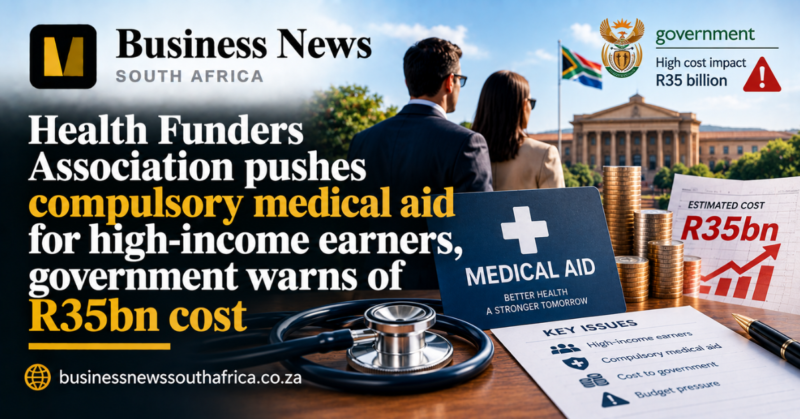
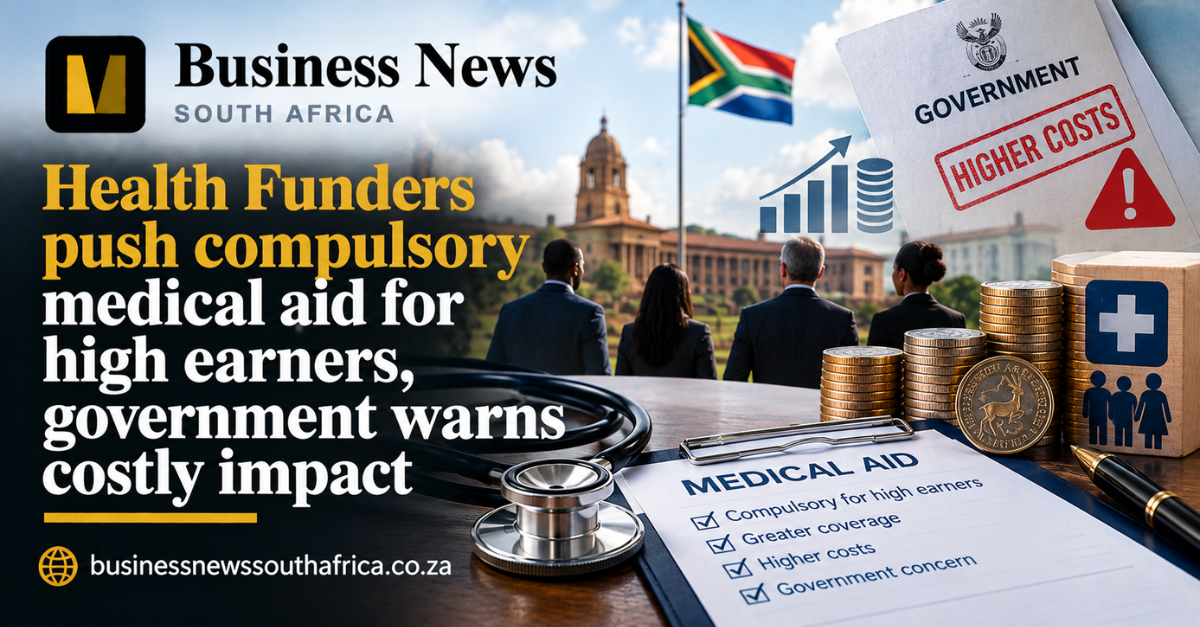
Government officials are not convinced. Nicholas Crisp, deputy director-general of the National Department of Health, warned that compulsory membership for all formally employed workers would inevitably pull in lower-income employees who cannot afford contributions without state help. He estimated that, at the current nine million scheme members, the policy could cost the fiscus an additional R34 billion to R35 billion. Even a lower estimate of R20 billion, Crisp said, would force the Treasury to divert money from other programmes, potentially from the public health budget.
Crisp’s counter-argument hinges on who pays for the enlarged risk pool. “Expanding risk pools only works if new members can afford to pay for themselves,” he said. He also reminded listeners that South Africa’s long-term health-system goal is the National Health Insurance (NHI), a universal scheme that aims to cover the whole population. In his view, compulsory private-scheme membership would be a short-term fix that does not align with the NHI agenda.
Both sides agree that private healthcare costs are high, but they differ on the remedy. The HFA sees mandatory enrolment of higher earners as a way to bring younger, healthier people into the pool, thereby lowering premiums for existing members. The health department worries about the fiscal burden and the equity of forcing contributions on workers who may already be stretched thin.
For SME owners, the key question is whether any future legislation will affect payroll calculations. If compulsory membership is limited to earners above R60 000 a month, many small-business employees may be exempt, but the policy could still set a precedent for broader mandates. Companies should monitor the debate, assess the potential impact on wage structures, and consider whether offering voluntary medical-aid benefits could become a competitive advantage in attracting talent.
Ultimately, the discussion reflects a broader tension in South Africa’s health-care landscape: balancing the need to make private insurance affordable with the fiscal reality of a strained public budget, all while keeping the long-term NHI vision in sight.