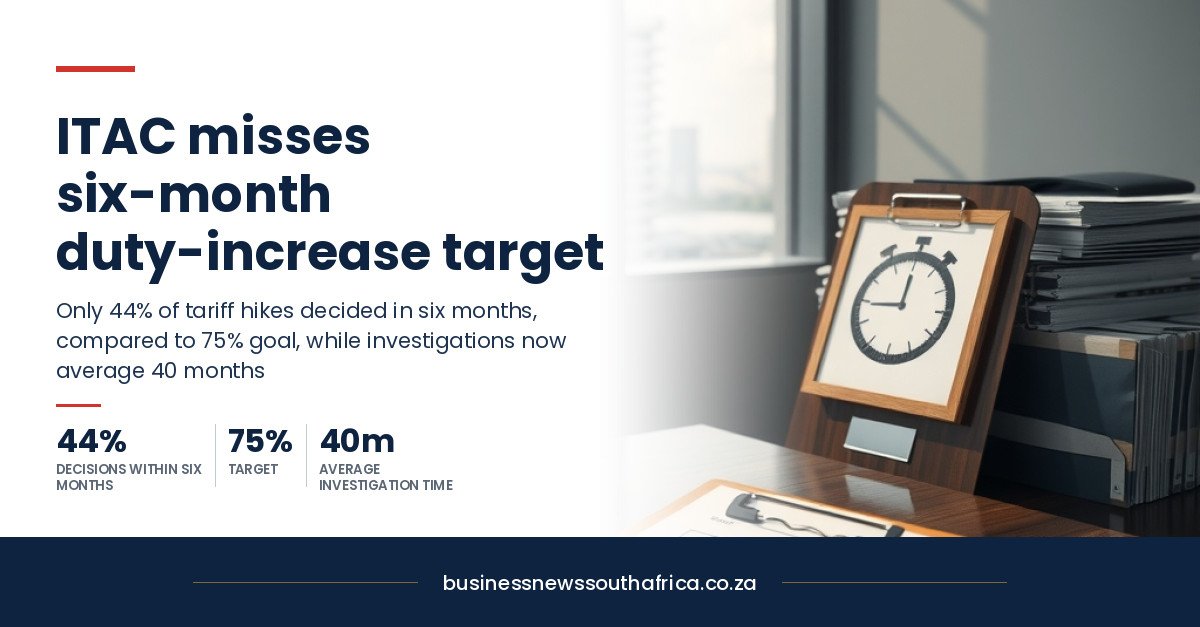
The International Trade Administration Commission (ITAC), the body that investigates and recommends changes to import duties, says in its 2025/26 annual report that 44% of its final decisions on duty increase applications were made within six months, against a target of 75%. A trade consultancy, XA Global Trade Advisors, told a webinar on 21 October that tariff investigations now take an average of 40 months, with some running to 76. The two sets of numbers measure different things, but together they show why companies that need a duty decision are waiting far longer than the commission’s own six-month benchmark.
ITAC’s own report records a missed target
The commission’s annual report for 2025/26, posted on the Parliamentary Monitoring Group’s site, sets performance targets for each type of work. For customs tariff increase investigations the planned target was 75% of final decisions within six months. The reported result was 44%, a shortfall of 31 percentage points. The table lists the two previous years as 33% and 25%. The report blames prolonged consultations with interested parties for delaying the finalisation of investigations. For rebate investigations the target was 75% and the result 67%. No duty reduction investigations were run in the year, so that target could not be assessed.
The report’s footnote defines the clock: the six months run from the date the commission makes a preliminary decision to initiate an investigation to the date it makes its final decision. That matters, because a consultancy that counts the age of a case from the date an application is lodged, or measures the age of cases still open, will arrive at a larger number. The report does not give the count of decisions behind the 44%, so I cannot say how many investigations the percentage covers.
Trade remedy work, the anti-dumping, countervailing and safeguard side, fared worse on one measure. The report sets a target of 60% of final determinations within 10 months of initiation and records 0%. It gives examples. A safeguard investigation on hot rolled steel products took 16 months in total, of which the commission completed its part in 8 and approval and implementation took a further 8. One on laminated safety glass took 18 months, of which the commission’s share was 4 and approval and implementation took 14. A soda ash sunset review took 11 months, 8 at the commission and 3 after. An anti-dumping investigation on hexagon head screws and bolts was terminated because the 18-month statutory period expired before it could be finalised. These examples show that, on the commission’s own account, time is lost both inside ITAC and after its recommendation leaves.
The consultancy’s study puts the average at 40 months
XA’s figures, reported by Engineering News on 29 October, are that investigations since 2019 have lengthened to an average of 40 months, with the longest at 76 months, compared with an average of six months in 2019. XA chief executive Donald MacKay presented the study on 21 October. I could not locate the study itself, so the figures here come from that report and from earlier XA reports covered by the press.
Earlier editions show the trend. In May, Engineering News reported XA’s eighth report, which put the average at 34 months, found that 97% of 33 active investigations were older than six months, and recorded only one new application in the previous six months, which XA called the lowest level in ITAC’s 23-year history. In the October study, MacKay said there were two private sector applications in the six months to the end of June and one in the six months to the end of December 2025. XA’s numbers are its own analysis. ITAC has disputed XA’s work before: in 2023 its spokesperson said XA’s numbers “fudge rather than illuminate the issues”. I found no ITAC response to the October study.
MacKay’s central complaint is stated in his own words: “While it is sometimes not possible to complete an investigation within six months, owing to the complexity or scope of the work, there is no scenario in which investigations should take six years to complete. But, this is the position we find ourselves in.” He told the webinar that information in an application can be years out of date by the time a decision is made, and gave the example of a groundnuts producer that, according to him, closed its plant after 15 months without a decision. That anecdote is XA’s account, and I could not verify it.
ITAC says it is short of people and money
The commission’s explanation is capacity. In May, Business Day reported that chief commissioner Ayabonga Cawe told Parliament’s trade, industry and competition committee that ITAC had 100 staff against 130 approved posts, and that it relies on a parliamentary appropriation of R123m for 2026/27, which he said was insufficient. The annual report confirms the staffing picture: 100 employees and 30 vacancies at 31 March 2026, a vacancy rate of 23%, which it calls “considerably high”. It says budget cuts to the compensation allocation meant recruitment for most vacancies could not start.
At the same May meeting, Business Day reported, DA spokesperson Toby Chance said the average tariff investigation in the reporting period had been open for 27 months and the oldest for 64 months. Cawe said the commission commits to a preliminary determination on trade remedies within eight months and wants to finish final determinations in 14 months: “We do indeed want to perform a bit better.” The World Trade Organisation limit for trade remedy investigations is 18 months, which Cawe called “somewhat of a vexing matter” given the resource constraints.
In the annual report’s foreword, Cawe writes that “additional resources have been directed towards investigations, timelines are under closer internal scrutiny, and coordination with the dtic and National Treasury has been improved, all with a view to reaching outcomes more quickly.” The report also notes that proposed amendments to the International Trade Administration Act, the first significant update of the Act in more than two decades, were published for comment during the year.
The numbers differ because they count different things
Readers will see averages of 27, 34 and 40 months in this story. They are not contradictory. The 27-month figure was quoted by an opposition MP from the commission’s reporting period, the 34- and 40-month figures come from XA’s successive reports, and the 44% figure in the annual report is a share of decisions, measured from the commission’s own start date. Different cohorts, different start dates and different counts of open versus finished cases will produce different numbers. What they share is direction: all of them are above six months, and ITAC’s own report does not claim otherwise.
What this means for businesses
For a manufacturer asking for protection, an importer asking for relief on an input, or an exporter whose rebate depends on a ruling, the length of the wait is itself a cost. XA argues that a firm that waits four years for an answer often drops the investment, and the drop in applications it reports is consistent with that, though the study cannot prove the reason. Importers should also note that duty decisions need sign-off beyond ITAC. XA points out that final duty decisions require approval from both the trade and finance ministers, which is where the annual report’s trade remedy examples show months being spent after the commission has finished its work.
Past decisions show the system does produce outcomes. Our reporting covers the 5% duty on most newsprint, ITAC’s rejection of a 20% hike on imported paper products, the dtic’s meeting with Bell Equipment and Mondi over cheap imports and growers’ view that a sugar tariff rise was not enough. Anyone importing should also read our guide to importing goods, duty, VAT and permits.
What is still unknown
- The study itself. I have not seen XA’s full report, only press coverage of its webinar.
- How many decisions sit behind ITAC’s 44% and 67% results.
- Whether ITAC accepts XA’s 40-month average. I found no response to the October study.
- When amendments to the International Trade Administration Act will reach Parliament, and whether they would set firm deadlines, as MacKay urged.
- Whether the committee will take up MacKay’s call for an inquiry into the delays.
This article reports ITAC’s published annual report, press coverage of XA’s study and Parliament-related reporting. XA’s recommendations are its own, and ITAC’s explanations are its own, and neither has been independently tested.