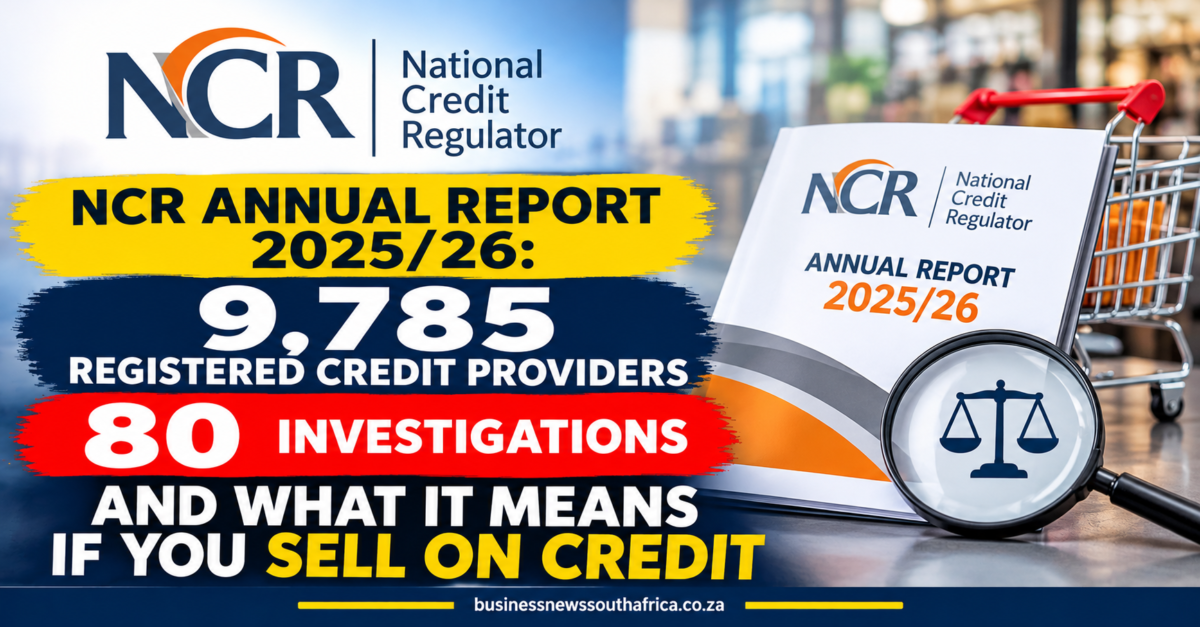
The National Credit Regulator (NCR) registered 1,794 credit providers in the year to 31 March 2026, and by that date 9,785 credit providers with 42,619 branches were on its register, according to its 2025/26 annual report. The report also sets out how many complaints reached the regulator, what it enforced, and what it plans next. For any business that sells on credit, lends to consumers or takes instalment payments, it is a useful read on how closely the National Credit Act is being policed. We read the report’s performance sections and quote only what it states.
Who is registered
As of 31 March 2026, the NCR’s register held 9,785 credit providers with 42,619 branches, 1,683 debt counsellors, 53 credit bureaus, three payment distribution agents and 10 alternative dispute resolution agents. During the year it received about 3,420 applications to register, which the report says is a 29.45% increase on 2,642 the year before, and registered 1,794 credit providers and 104 debt counsellors. The report says system outages from November 2025 forced manual processes and caused backlogs, and that the NCR ran six workshops for unregistered credit providers. It adds that it will keep engaging unregistered providers and remind registrants to renew on time to avoid their registrations lapsing.
The report does not say who must register. The National Credit Act lets the Minister set a threshold, and a determination in Government Gazette 39981 of 11 May 2016 says the threshold “is nil (R0)”. That suggests a business that provides credit under the Act should check whether it needs to register, however small it is. We found no later determination, but the NCR’s website refused automated access today, so confirm the current position with the NCR before relying on this.
The complaints that reach the regulator
The report lists the main complaints as debt review without consent, reckless lending, disputes over outstanding balances, unregistered people doing debt counselling or granting credit, debt review payments not being distributed, and cost-of-credit disputes. Through complaints it secured refunds and balance adjustments for consumers of R1,455,565.21, and about 397 consumers were removed from unlawful debt review, up from 310 the year before.
The report is also candid about capacity. Its call centre received 186,073 calls and handled 155,188 of them, an 83% handle rate, with 29,761 calls lost. Of 92,260 written enquiries, 62,614 were processed, 68% of the total, and 26,781 of those were processed within an average of nine working days. A total of 1,003 enquiries were referred to ombud offices. If you are dealing with the NCR, expect delays.
What it enforced
The investigations and enforcement department undertook 80 investigations in 2025/26, covering both credit providers and debt counsellors. It took 46 enforcement actions against credit providers, based on reckless lending and cost of credit among other contraventions, and four against debt counsellors. The complaints department separately reports six consent orders and 79 instructional letters issued against debt counsellors, credit bureaus and credit providers. The NCR also carried out 12 raids across the nine provinces with the police and the Hawks, and says it has added criminal proceedings to its existing civil ones, working with the National Prosecuting Authority.
Be careful with the report’s forward-looking numbers. For 2026/27 it sets targets of 70 investigations, R100 million in refunds and balance adjustments for consumers, and R1.2 million in administrative fines and penalties. These are targets, not results.
The market it is policing
The NCR says total outstanding consumer credit, the gross debtors’ book, stood at R2.54 trillion in March 2026, up 1.30% on the previous quarter and 4.63% on a year earlier. Banks make up almost 80% of credit granted. Within the book, secured credit, which is dominated by vehicle finance, grew 9.58% year on year, mortgages 3.11%, credit facilities 5.82% and unsecured credit 1.39%.
What it means for a business that grants credit
- Check whether you must register. Under the gazetted nil threshold, size alone may not exempt you. Ask the NCR, or an attorney, before you start extending credit to consumers.
- Get cost of credit and affordability right. Reckless lending and cost-of-credit contraventions are named in the report’s enforcement actions.
- Keep your registration current. The NCR is reminding registrants to renew on time to avoid lapses.
- Watch the fees. The report says the NCR is developing a new funding model alongside proposals to review registrant fees, but gives no figures.
If your concern is customers who do not pay you, see our guide to debt recovery and late-paying customers and our explainer on late-payment interest and letters of demand.
This article reports figures from the NCR’s 2025/26 annual report and a gazetted determination. It is general information, not legal advice. Check the NCR’s own website for the current registration rules.