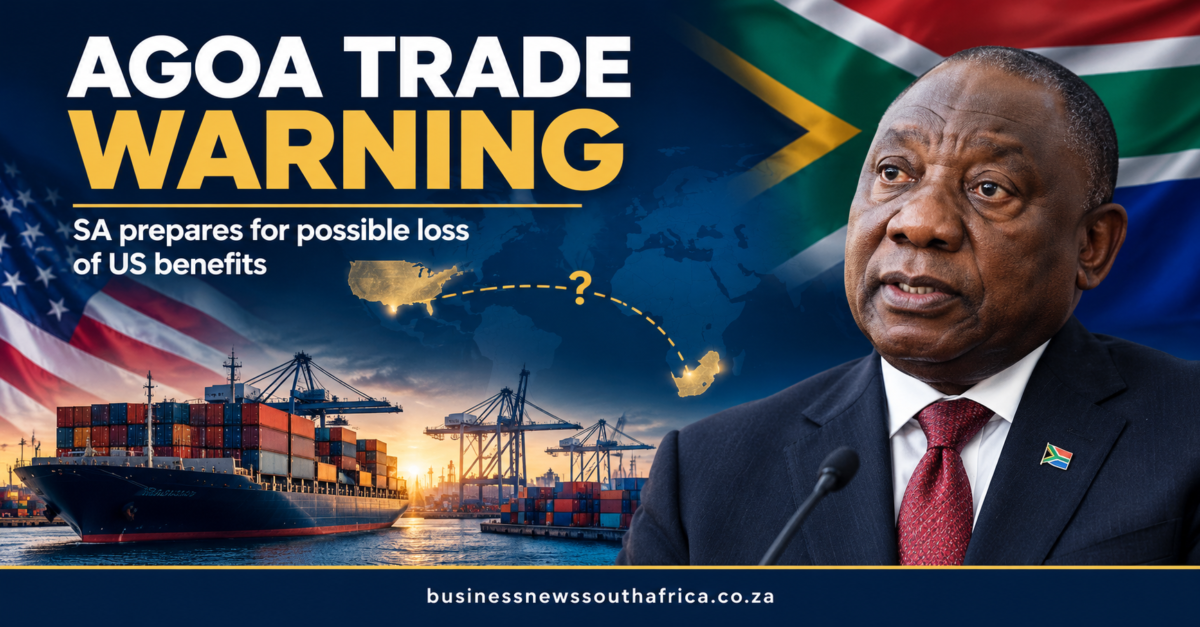
President Cyril Ramaphosa has warned that South Africa must prepare for a possible loss of AGOA benefits, the duty-free access to the United States market that local exporters have used for years. Speaking on Monday, 19 October, he said it was still unclear whether South Africa would keep its place in the African Growth and Opportunity Act and that the effect on jobs of an exclusion would be devastating, BusinessTech reported, carrying a Reuters story.
What Ramaphosa said
Ramaphosa made the remarks at a briefing with editors and journalists in Johannesburg, according to Briefly News. He said his government was in talks with its US counterparts, but that the outcome remained uncertain. “I need, as president, to prepare us if it ever happens,” he said.
According to the Reuters report, some US officials have suggested that South Africa should be excluded from the programme. Relations between Pretoria and Washington have deteriorated as the Trump administration has acted against South Africa over Donald Trump’s claim that the country persecutes white people. The South African government rejects that claim as a falsehood spread by fringe groups.
Ramaphosa said he and Deputy President Paul Mashatile had been travelling abroad to look for alternative markets. He pointed to the trade arrangement with China as a positive step: in May, China introduced a zero-tariff scheme for qualifying South African goods.
Where AGOA stands legally
AGOA lapsed in September 2025. On 2 September 2026, Trump signed the Continuing Appropriations and Extensions Act, 2027, a government funding law that also moved AGOA’s end date from December 2026 to December 2028, BusinessTech reported at the time. That date change was the only alteration to AGOA in the law.
South Africa remains on the list of eligible countries for now. The programme itself is secure until 2028, but which countries qualify is decided separately by the US executive, and the eligibility list can be reviewed and changed before January 2027. Two bills introduced in the US Congress in 2025 to exclude South Africa have not gained traction. Trade union Solidarity has warned that the country’s continued eligibility is not guaranteed and that exclusion would hit the automotive and agricultural industries hardest.
Vehicles: tariffs already bite
The motor industry has the most at stake. According to Business Day, citing figures from the National Association of Automobile Manufacturers of South Africa (naamsa), automotive exports to the US were worth R20.4bn in 2025, making the US the country’s fourth-largest automotive export market.
Vehicle volumes have already collapsed. Exports of vehicles to the US fell 83.2%, from 24,682 units in 2024 to 4,136 in 2025, after Washington imposed a 25% tariff on imported vehicles in April 2025 and on components in May 2025. Naamsa’s position is that this tariff largely cancels out AGOA’s duty benefit for vehicles, so the extension alone has not restored the industry’s access.
Citrus and farm exports
Agriculture is the other sector most exposed. A FreshPlaza report published when AGOA lapsed in October 2025 put South Africa’s average annual orange exports to the US at US$55m over the previous five years, and mandarin exports at US$30m. It cited industry estimates that up to 35,000 jobs could be at risk if citrus exports to the US shrink.
The jobs at risk
Estimates of total employment linked to AGOA vary. BusinessTech cited estimates that around half a million South African jobs depend on the programme and that about 22% of South Africa’s exports to the US benefit from it. Briefly News put the figure at about 250,000 jobs, mainly in automotive, agriculture and clothing. Neither figure comes from an official count, and the gap between them shows how hard the exposure is to measure.
Ramaphosa gave no timeline for a decision and did not set out what a contingency plan would contain. For exporters, the immediate signal is that the presidency now treats losing AGOA as a real possibility rather than a remote one, while the law that keeps the programme alive runs to the end of 2028.