The South African Reserve Bank (SARB) says South Africans effectively pay a R12 billion “robbery tax” each year because cash is stolen, mugged or otherwise taken in crime.
The figure comes from the SARB Cost of Cash Industry Report 2026, which puts the total annual consumer cost of using physical cash at R88.5 billion. Roughly half of that amount, R43.5 billion, is classified as direct cost, the rest as indirect cost.
Direct costs include bank fees that total R31 billion a year, R17.7 billion for withdrawals and R13.3 billion for deposits, plus R12.5 billion spent on travelling to ATMs or bank branches. The travel cost covers taxi fares, fuel and other transport expenses.
Indirect costs are less visible. The report estimates R27.8 billion is lost to time: R19.5 billion while people wait in queues and R8.3 billion travelling to cash points. Retailers and informal traders add about R3.9 billion by passing cash-handling costs onto prices, and consumers forfeit R1.3 billion in interest they could have earned if the money had stayed in an interest-bearing account.
People earning between R0 and R1 250 a month spend about 5 % of their income on these cash-related costs, while those earning more than R20 000 a month spend about 1 %.
The security problem also hurts businesses. A case study in the report describes a national retailer in a low-income area that stopped accepting cash after repeated armed robberies. Because many local customers do not have cards, the retailer saw sales fall by more than a third.
Cash-in-transit (the movement of physical currency by security firms) adds another R6.95 billion to the cost picture, while the industry moves roughly R2.8 trillion in cash each year.
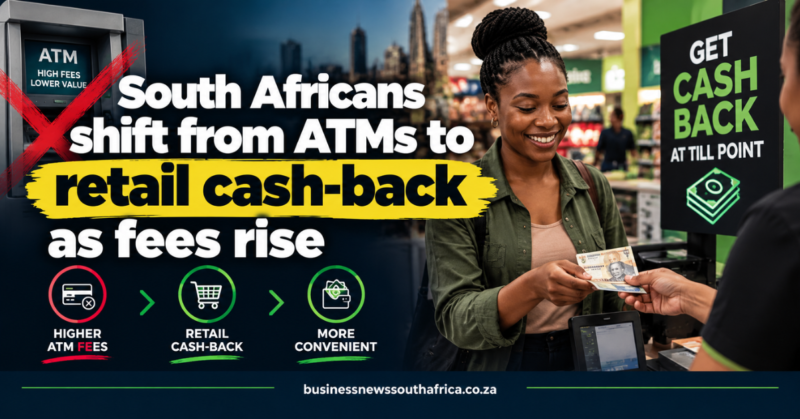
Access costs vary widely. The report finds a bank branch costs about R1.53 for every R100 handled, an ATM about R0.68, and a till cash-back service, where a retailer gives cash back at the point of sale, only R0.12.
Despite the expense and risk, cash remains popular. About 40 % of South Africans say they will still prefer cash for future payments, rising to 65 % for taxi fares, 66 % for spaza shops (small informal retail outlets) and 68 % for informal traders.
To reduce the overall cost, the SARB recommends expanding till cash-back services, increasing shared ATMs in underserved areas and encouraging shared cash-transport and storage infrastructure. The aim is to make cash safer and cheaper for both consumers and businesses.
For more on how cash costs affect the economy, see our Regulatory & Policy coverage.
The SARB placed the total cost of keeping the cash supply chain running at R27.1 billion each year. Banks shoulder the biggest slice at R21.6 billion, while retailers and informal businesses together account for R4.3 billion and essential industry services add another R1.2 billion. These figures sit alongside the R88.5 billion total consumer cost, showing that the infrastructure behind cash handling imposes a heavy financial burden on the economy. By breaking down the supply chain expense, the report highlights how each segment contributes to the overall price tag that consumers ultimately bear through fees and price adjustments.
Cash-in-transit firms move roughly R2.8 trillion of physical currency across South Africa and charge about R6.95 billion for the service each year. The operation involves armored vehicles, security personnel and specialised logistics to collect cash from banks, distribute it to ATMs and deliver it to retailers. Because the value in transit is so high, firms invest heavily in tracking, secure storage and rapid response teams to deter robbery. The annual cost reflects salaries, vehicle maintenance, insurance and the technology required to safeguard the cash as it travels between points of origin and destination.
Bank fees dominate the direct cost side of the cash equation, totalling R31 billion annually. Within that, withdrawal charges amount to R17.7 billion and deposit fees add R13.3 billion, leaving a smaller share for other transaction-related charges. These fees are applied each time a customer accesses cash at a branch or ATM, and they accumulate quickly for high-frequency users. The report shows that the fee structure creates a sizeable financial drag, especially for low-income earners who rely heavily on cash for daily transactions.
Time-related losses form a substantial portion of indirect costs, with R27.8 billion attributed to waiting and travelling. Consumers spend R19.5 billion waiting in queues and another R8.3 billion travelling to cash points, a calculation based on average wages and the hours lost. The methodology multiplies the number of hours people report spending on cash access by an estimated hourly earnings rate, converting the total into a monetary value. This approach captures the hidden expense of time that does not appear on bank statements but erodes disposable income.
To bring the overall cash cost down, the SARB urged a rollout of till cash-back services, a boost in shared ATMs for underserved locations and the creation of shared cash-transport and storage facilities. Expanding till cash-back means retailers would offer customers cash withdrawals at the point of sale, lowering reliance on separate ATM trips. Shared ATMs involve multiple banks pooling resources to install machines in high-need areas, spreading the operational cost. Shared transport and storage would see security firms consolidating routes and vaults, reducing duplication and achieving economies of scale, ultimately aiming to make cash handling cheaper and safer for everyone.