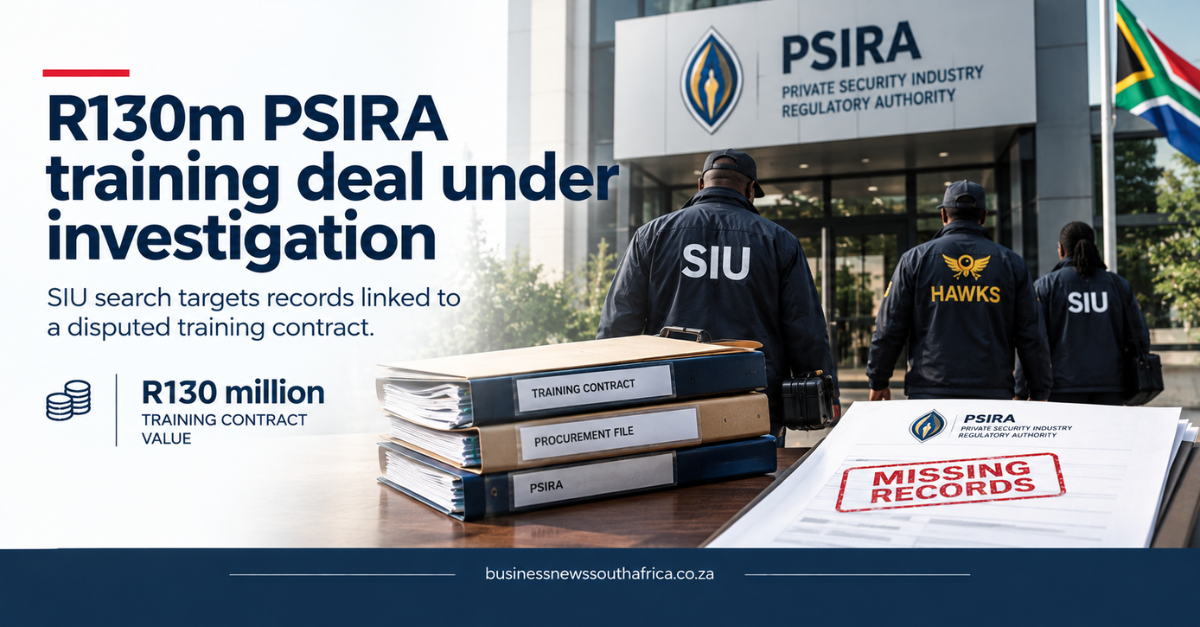
The Special Investigating Unit (SIU), backed by the Directorate for Priority Crime Investigation (the Hawks), executed a search and seizure warrant at the Private Security Industry Regulatory Authority’s (PSIRA) Centurion offices this month, after the regulator’s own response to the SIU’s document requests came back missing a year’s worth of records the investigation needed.
The Special Tribunal granted the warrant on 17 September 2026. The SIU says it turned to search and seizure only after PSIRA failed to fully cooperate through ordinary engagement, a last-resort step that signals the regulator’s own document trail, not just the underlying tender, is now part of what investigators are trying to establish.
What is actually being investigated
President Cyril Ramaphosa authorised the probe by signing Proclamation 316 of 2026 on 3 June, empowering the SIU to investigate the procurement and contracting of training services by or on behalf of PSIRA and the Unemployment Insurance Fund (UIF). The contracts in question covered Election Observer Training, End-User Computing Training and ‘PSIRA Grade E to C’ training, intended to reach 7,071 targeted learners across all nine provinces. The combined contract value is estimated at roughly R130 million.
PSIRA is the statutory body that regulates South Africa’s private security industry, licensing security companies and individual guards and setting the training standards the sector has to meet. A training tender funded partly through the UIF, the fund most South African formal-sector workers and employers already contribute to, means the money under investigation is not an abstract government line item: it is the same pool that pays unemployment benefits and funds programmes like this one, which makes the missing documentation more consequential than a routine procurement dispute.
Why search and seizure, not just a request
Search and seizure warrants are not the SIU’s default tool. The unit generally prefers document requests and cooperative engagement with the entity under investigation, since search and seizure operations are resource-intensive, legally involved, and signal a breakdown in that cooperation. PSIRA’s partial compliance, specifically a year of missing records, is what pushed the investigation to this stage. Whether that gap reflects genuine record-keeping failure or something more deliberate is exactly what the seized documents and electronic devices, including computers and phones, are meant to help establish.
What this means for businesses in the private security and training sectors
For private security companies and training providers who work with PSIRA or bid on its contracts, an active SIU investigation of this kind typically means slower turnaround on unrelated PSIRA processes for a period, as staff and resources get diverted to cooperating with investigators, and heightened scrutiny on any new training tenders the regulator issues in the near term. Businesses with existing PSIRA-funded training contracts should keep their own documentation, invoices, attendance records and deliverable sign-offs, in better order than they might otherwise, since a live SIU probe into the same class of contracts increases the odds that adjacent, unrelated agreements get pulled into a wider document request.
The Democratic Alliance has separately called for PSIRA’s CEO and CFO to be suspended pending the outcome of the investigation, a call the SIU probe itself does not confirm or require, but which reflects the political pressure building around the case. No criminal charges have been announced at this stage; the SIU’s mandate is to investigate maladministration and recover any funds improperly spent through civil proceedings, a separate track from any criminal prosecution the Hawks’ involvement could eventually lead to.
What happens next depends on what the seized records show. If the missing documentation turns out to reflect genuine record-keeping failure rather than concealment, the case may resolve as a governance and compliance finding rather than a fraud matter. If it does not, PSIRA becomes the latest in a lengthening list of state and quasi-state entities where an SIU proclamation this year has followed a specific, named tender rather than a general audit finding, a pattern worth watching for any business that contracts with a public entity currently facing similar scrutiny.