Johannes, who runs a boutique graphic-design studio in Cape Town, opened his mailbox in early September to find a letter from the South African Revenue Service (SARS). The notice was an auto-assessment, a tax calculation that SARS produces automatically for taxpayers whose affairs are considered straightforward. For Johannes, who files as a provisional taxpayer because he pays tax in advance on estimated earnings, the letter meant he could either accept the amount or ask for a reduction or additional assessment. The deadline to make that request was originally tied to the end of the 2026 tax year, but SARS has now moved it.
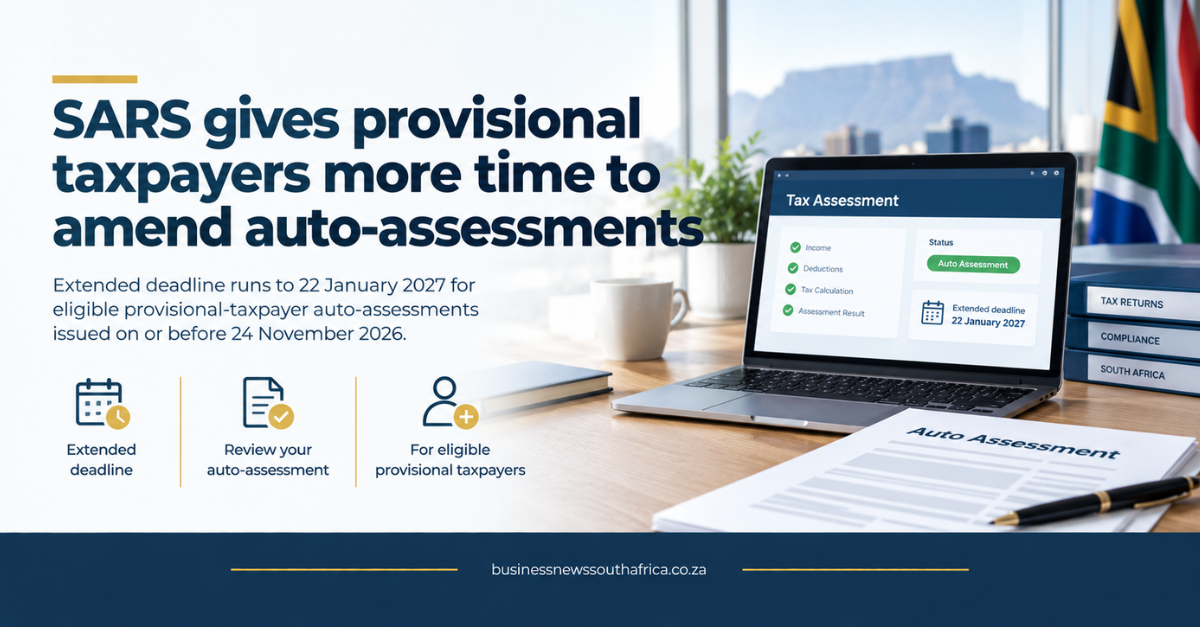
The South African Revenue Service said the request deadline is now 22 January 2027, matching the provisional taxpayer closing date. The extension only applies to auto-assessments that were issued on or before 24 November 2026. SARS framed the change as a practical response to the growing number of provisional taxpayers being brought into its auto-assessment system.
A provisional taxpayer is someone who pays income tax in advance, usually in two instalments during the year of assessment, with a possible third instalment after the tax year ends. This contrasts with non-provisional taxpayers, typically employees who receive a single source of income and have tax deducted at source through PAYE (pay-as-you-earn). Auto-assessment is a tool that pulls data from third-party sources to produce a tax notice quickly for taxpayers with simpler affairs.
The extension matters most to small-business owners and freelancers who fall into the provisional taxpayer category. Because their cash flow often depends on irregular client payments, an extra month to request a reduction or additional assessment can ease the pressure of meeting tax instalments. It also gives accountants and tax practitioners more time to review the auto-assessment figures before they become final.
SARS has been slowly expanding its auto-assessment processes since 2021, when it was limited to standard taxpayers with very simple returns. A 2025 trial brought provisional taxpayers into the system, and the rollout was completed in 2026. At the same time, the tax authority has stepped up enforcement on trusts, with new penalties for non-compliance taking effect from May 2026. The 2026 trust filing season opened on 19 September 2026, and trustees must file by 22 January 2027.
Taxpayers who received an auto-assessment before 24 November 2026 should log onto the SARS eFiling portal, review the notice, and submit a request for a reduced or additional assessment before the new deadline. Those who need help preparing supporting documents can use the compliance document generator to ensure they have the correct paperwork ready.
By aligning the auto-assessment request cut-off with the provisional taxpayer closing date, SARS gives self-employed individuals and small enterprises a clearer timetable to settle their tax affairs. The change is a reminder that, as the tax service automates more returns, staying on top of deadlines remains essential.
BusinessTech reported that the 2025 trial to bring provisional taxpayers into the auto-assessment system was the first step toward the broader 2026 rollout, meaning the tool now pulls information from a host of third-party sources for a larger pool of self-employed earners. The extension to 22 January 2027 therefore covers assessments issued on or before 24 November 2026, but it does not affect the earlier batch of notices that most individual taxpayers received in the first two weeks of July. Those who rejected their auto-assessment or did not receive one at that stage now enjoy an extra month to finalise their returns, a relief for many who were previously excluded from the automated process.
The auto-assessment mechanism works by matching data supplied by banks, payroll providers and other reporting entities with the taxpayer’s declared income, then generating a provisional notice that can be accepted or contested. For provisional taxpayers, the amount shown is offset against the advance payments they have already made, and any shortfall or surplus is settled after the year-end assessment. Because the system relies on third-party data, accuracy hinges on timely submissions from those sources; any delay can trigger mismatches that require a reduced or additional assessment request before the 22 January 2027 cut-off.
For South African business owners, understanding this workflow matters because it determines cash-flow timing. An auto-assessment that overestimates liability may force a provisional taxpayer to make a larger instalment than necessary, straining finances until the correction is processed. Conversely, an understated figure could result in a larger balance due after the final assessment, potentially attracting interest. Owners should therefore monitor their eFiling portal regularly, keep supporting documents ready, and be prepared to lodge a request promptly if the auto-assessment does not reflect their actual earnings.
Looking ahead, the next area of focus is the trust filing season that opened on 19 September 2026, with trustees also required to file by 22 January 2027. SARS has emphasized that trustees remain personally accountable for compliance, especially after the introduction of administrative penalties for non-compliance that began in May 2026. As the tax authority tightens enforcement, both individual provisional taxpayers and trust representatives should expect stricter scrutiny of their submitted data and may need to engage tax practitioners early to ensure all records and registrations are in order before the deadline.