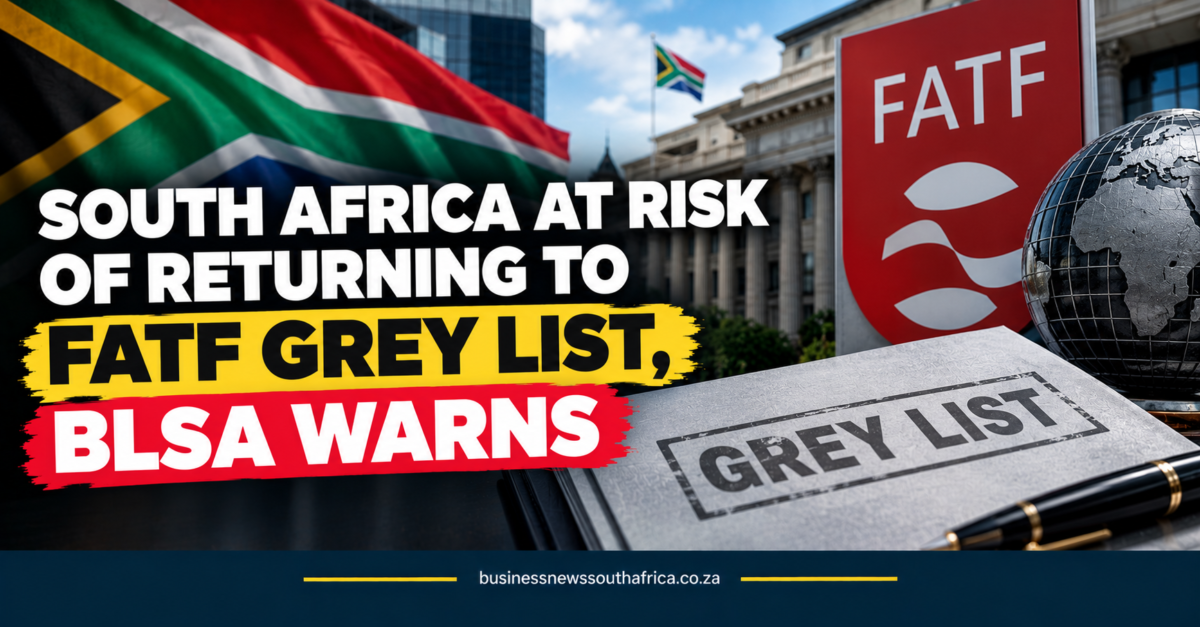
Business Leadership South Africa (BLSA) has warned that South Africa could land back on the Financial Action Task Force (FATF) grey list, a year after leaving it. The warning comes in the October 2026 edition of the BLSA Reform Tracker quarterly review, released on 28 October, which says anti-corruption reform has stopped moving while the FATF assesses the country again.
The tracker’s headline reform completion index rose to 72.5 in the July to September quarter, from 71.3 in the previous quarter, which BLSA says is the highest reading since tracking began in March 2024. The corruption reform index, however, stayed at 51.2, with no movement in the quarter.
What the tracker says about the grey list
According to the October 2026 review (PDF), continued stagnation “poses risks” as South Africa is reassessed by the FATF. BLSA chief executive Busisiwe Mavuso says two reform areas that have not moved put the country at risk of being reinstated on the grey list. The first is the FATF reforms themselves. The second is the anti-corruption reforms that flow from the Zondo commission’s recommendations on state capture.
The review also quotes Ismail Momoniat, who it describes as acting director-general of National Treasury and the official who led the campaign to get South Africa off the list. In June, it says, he told Parliament’s Standing Committee on Finance that the country’s ability to investigate organised crime, prosecute successfully and recover criminal assets could come under the spotlight if weaknesses in law enforcement persisted. In an interview with Financial Mail, as cited in the review, he said: “if we do poorly in the mutual evaluation, it will just reinforce the reality that our systems are not working.”
At the briefing, Reuters reported, Stuart Theobald, executive chairman of research firm Krutham, which compiles the tracker, said: “We are at risk of re-entering that grey list. There is significant risk.” The Reuters report, carried by TechCentral, says National Treasury did not immediately respond to a request for comment. These are BLSA’s and Krutham’s assessments of the risk, not a finding by the FATF, which has not placed South Africa back on any list.
When South Africa left the list
The FATF removed South Africa from its list of “Jurisdictions under Increased Monitoring” on 24 October 2025, at the end of a plenary held in Paris on 22 to 24 October, according to a National Treasury statement on gov.za. South Africa had been listed in February 2023 and, in Treasury’s account, spent 32 months working through an action plan of 22 items. Nigeria, Mozambique and Burkina Faso were delisted in the same week.
Treasury said at the time that leaving the list was “only start of a broader process”, and that the FATF expects countries that exit to show continued commitment through measurable outcomes such as investigations, prosecutions and sanctions. Those results, it said, would form the basis of the next mutual evaluation.
The evaluation that will decide the question
Treasury said in 2025 that the evaluation was expected to begin in the first half of 2026 and conclude in October 2027. BLSA’s review says the FATF began its Fifth Round Mutual Evaluation of South Africa in mid-2026. Reuters, via TechCentral, reports that a peer review is expected in the first quarter of 2027. We could not confirm that timing in the BLSA review or the Treasury statement, and the FATF’s own site was not accessible to us, so it rests on the Reuters report.
BLSA argues the evaluation is likely to focus on law enforcement, and points to the Madlanga commission, led by retired Constitutional Court justice Mbuyiseli Madlanga, which it says has exposed deep-rooted criminality in the South African Police Service. The commission submitted interim reports in December 2025 and May 2026, and BLSA says several law enforcement officials have since been charged. The final report is due with President Cyril Ramaphosa on 25 January 2027. BLSA notes that even if it is published before the FATF decides, there will be little time left to implement its recommendations.
The review also says the tracker’s Zondo recommendations area rose from 19.6 in March 2024 to a peak of 53.6 in June to August 2025, then plateaued for three periods before dipping to 51.2 in April to June 2026. BLSA adds that it halted tracking of the proposed national anti-corruption charter after it made no progress.
What a return would mean for business
Reuters says a return to the list would bring closer scrutiny of South African financial transactions, higher compliance costs for banks and businesses, and a risk that some international banks pull back from correspondent banking relationships, the links local banks use to move money through foreign banks. That would make cross-border payments and trade finance slower and more expensive. Reuters also says business groups warned during the earlier listing that it had deterred foreign investment.
For companies, the practical point is that compliance expectations have not eased since the exit. Our report on beneficial ownership filing penalties after the grey list exit shows how the rules on company ownership disclosure are being enforced. We also looked at how the commission’s revelations are affecting business in South Africa.
What is still unknown
The FATF has not published its findings for the new evaluation, so the size of the risk BLSA describes cannot be checked yet. Treasury, which has said it was confident in 2025 that South Africa could sustain its progress, had not commented on the BLSA warning at the time Reuters filed its report. More background is in our Regulatory & Policy coverage.