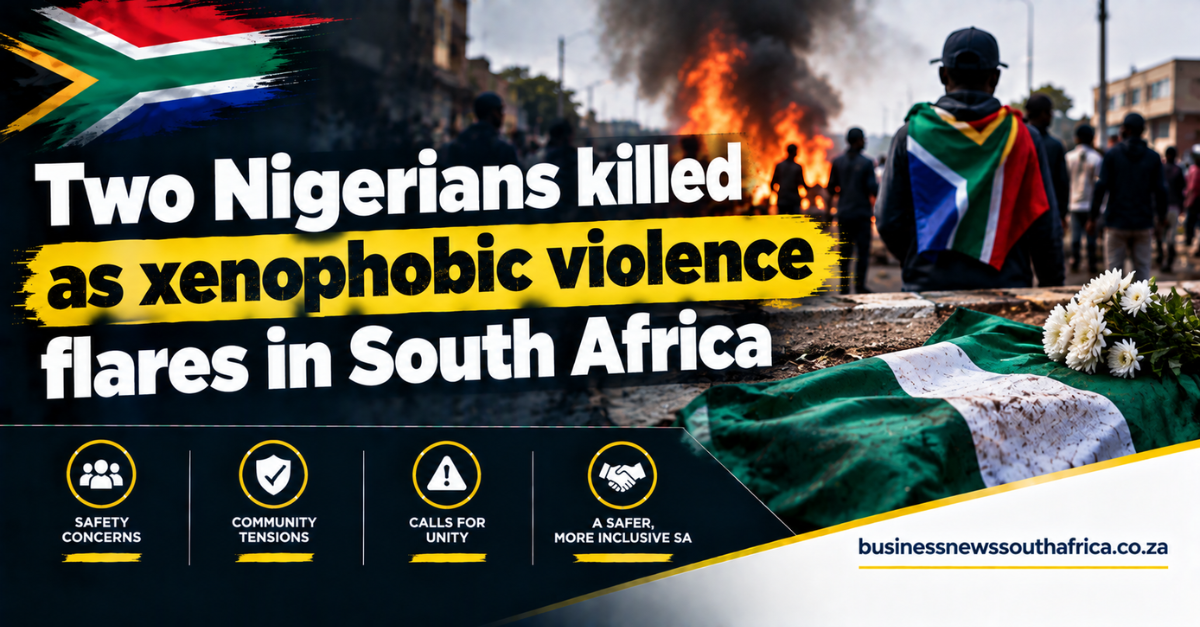
According to a report by NigerianEye, two Nigerian nationals lost their lives in the latest episode of anti-migrant tension in South Africa, according to Nigeria’s government. The deaths add to a series of attacks that have periodically erupted across the country, targeting foreign-born residents and their businesses.
Xenophobic unrest in South Africa typically manifests as mob assaults on shops, homes and informal traders owned by people from other African nations. Nigeria’s foreign ministry says the latest attacks have followed other incidents in recent months, and it counts 98 Nigerian deaths in South Africa since 2022. These are Nigeria’s own figures and have not been independently verified by South African authorities.
Nigeria’s Ministry of Foreign Affairs said Bishop Taiwo Michael Fakunle was shot and killed at his home in Kensington, Johannesburg, on Friday 4 September, and James Uchechukwu Nwankwo died on 5 September in police custody in Somerset West, near Cape Town, allegedly after “gruesome interrogation techniques” by South African Police Service officers. The statement was issued by ministry spokesperson Oluwafemi Adeniyi. These are Nigeria’s allegations: the Independent Investigative Directorate and the police had not commented when Eyewitness News reported on the matter on 12 September.
Impact on the property market
For property investors and landlords, the resurgence of violence carries tangible risks. Retail spaces that depend on foreign-owned businesses may see a sudden drop in tenancy rates if owners fear for their safety. Commercial landlords often respond by increasing security expenditures, a cost that can erode rental yields. In residential sectors, heightened fear can depress demand for rentals in neighbourhoods perceived as unsafe, potentially lowering occupancy levels and rental prices.
The statement did not identify any suspects or give a possible motive for Fakunle’s killing, and the allegation about Nwankwo’s death has not been independently established. Until the circumstances are clear, the perception of risk may stay elevated for businesses that rely on foreign staff or customers.
While the immediate human tragedy is clear, the ripple effects on the property sector will depend on how quickly law enforcement can restore order and how businesses adapt to heightened security demands. For owners and investors, monitoring the situation closely and factoring potential security costs into financial models will be essential steps in navigating the uncertain environment.
The diplomatic response this has already triggered
Nigeria’s National Assembly confirmed in a statement that it has suspended all official visits to South Africa and ordered a boycott of legislative activities hosted or organised by South African authorities, until further notice. The decision was announced by the Clerk to the National Assembly, Kamoru Ogunlana, citing continuing reports of xenophobic attacks, and it remains subject to review by the Assembly’s leadership, according to The ICIR.
Nigeria’s Minister of State for Foreign Affairs, Sola Enikanolaiye, told reporters in July that official records show 98 Nigerians have been killed in mob and hate-related attacks in South Africa since 2022, a figure that is the Nigerian government’s own account rather than one independently verified by South African authorities. That is the scale of grievance behind the diplomatic action, and it places continued incidents like this one directly in the path of a deteriorating bilateral relationship between two of the continent’s largest economies, with trade and business links between them as the most immediate casualty of a prolonged diplomatic freeze. For related coverage of South Africa’s other current diplomatic pressure points, see this site’s report on the US five-point demand list.