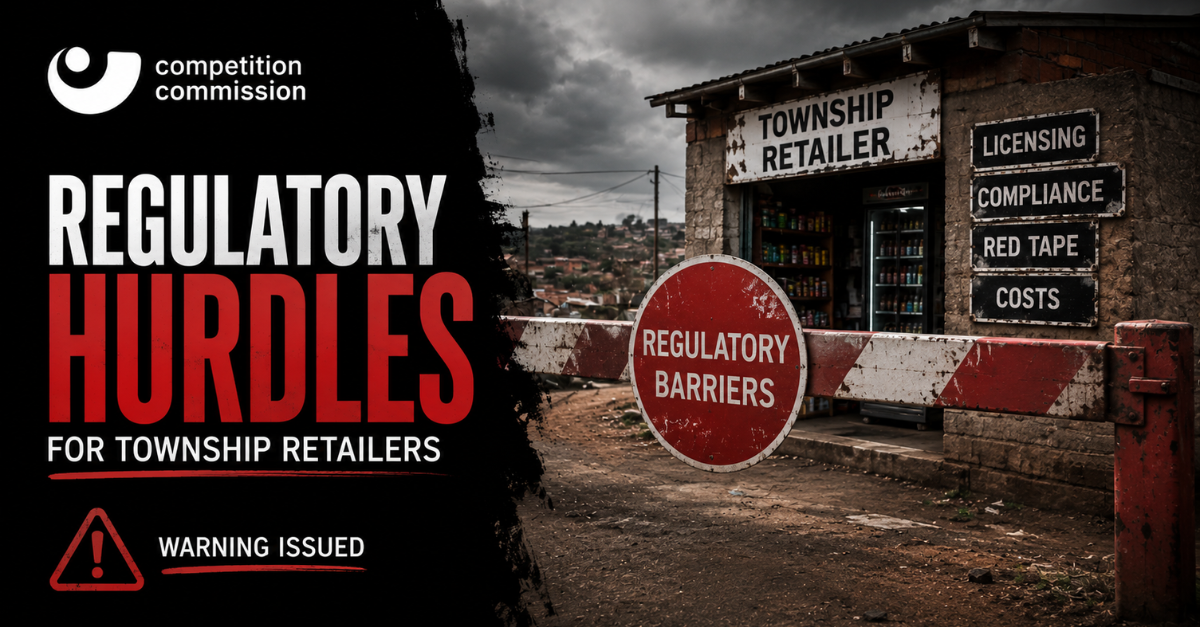
A small shop owner in Soweto opens his store each morning knowing his wholesale costs are higher than those of the national chains that dominate the market. The price gap squeezes his margins and limits the variety he can offer to customers. That everyday reality sits at the centre of a new report released by the Competition Commission, which maps the size and shape of South Africa’s rural and township economy, an informal sector estimated at R900 billion.
The commission’s analysis, described by Ahmore Burger-Smidt, head of regulatory at Werksmans Attorneys, as “explicitly forward-looking”, points to a set of administrative and procurement barriers that could soon become the focus of enforcement action or new policy. Burger-Smidt told BusinessTech that any organisation with a presence in or connection to township and rural markets should pay close attention, because the commission now has a “rich empirical foundation, a clear analytical framework, and an evident appetite for follow-through”.
According to the report, the first priority for the commission is to cut the administrative red tape that stops many small enterprises from registering formally. The lack of formal registration keeps businesses in the informal sector, where they avoid taxes and industry standards but also miss out on legal protections and access to formal supply chains. While the government has introduced initiatives to simplify registration, the commission argues that the measures are still insufficient.
One of the most concrete findings relates to procurement. The commission observed that larger retailers and national chains enjoy sophisticated logistics networks that keep wholesale prices low. In contrast, small township retailers often cannot reach wholesalers directly, forcing them to buy in smaller quantities at higher prices. This “procurement asymmetry” not only raises costs for the small business but also narrows product ranges for consumers. The report cites agriculture, hospitality and retail services as sectors where the gap is most pronounced.
Burger-Smidt warned that the commission’s language does not shy away from the possibility of enforcement. She said the report identifies “exclusionary access to retail channels, discriminatory procurement conditions and supply arrangements that disadvantage smaller firms”, which could become the basis for market conduct investigations. The commission also signalled an interest in “prioritising procurement and upstream access” and in shaping competition conditions that address service delivery and infrastructure.
What does this mean for a small retailer? If the commission moves from report to enforcement, businesses could face investigations for practices that the commission deems anti-competitive, such as exclusive supply agreements that lock out smaller players. On the policy side, the commission plans to engage with municipalities, the South African Local Government Association and the Department of Small Business Development to identify regulatory burdens that can be simplified or better supported. The outcome could be streamlined registration processes, clearer guidelines for supplier contracts, or even new rules that level the playing field for small retailers.
For entrepreneurs eyeing the township market, the stakes are clear: the R900 billion informal economy offers a huge customer base, but navigating the regulatory landscape may become more complex. Companies that invest early in compliant supply chains, formal registration and transparent procurement practices could avoid future penalties and gain a competitive edge as the sector evolves.
In short, the Competition Commission’s report is a warning shot. Whether the practical impact arrives through enforcement, policy reform or a mix of both, the direction is unmistakable, the informal economy will face tighter scrutiny, and businesses that adapt now may be better positioned for the changes ahead.
South Africa’s informal economy has been the subject of policy attention for years precisely because its scale, the Competition Commission’s R900 billion estimate sits alongside similar figures from Statistics South Africa’s informal sector surveys, means that barriers facing township and rural retailers are not a marginal concern but a meaningful drag on national economic participation. Previous competition-authority interventions in South African retail, including market inquiries into the grocery retail and healthcare sectors in recent years, have generally followed the same arc this report suggests: a data-gathering phase establishing where the asymmetries lie, followed by targeted enforcement action or negotiated remedies with the dominant players identified, rather than blanket new regulation applied across an entire sector.