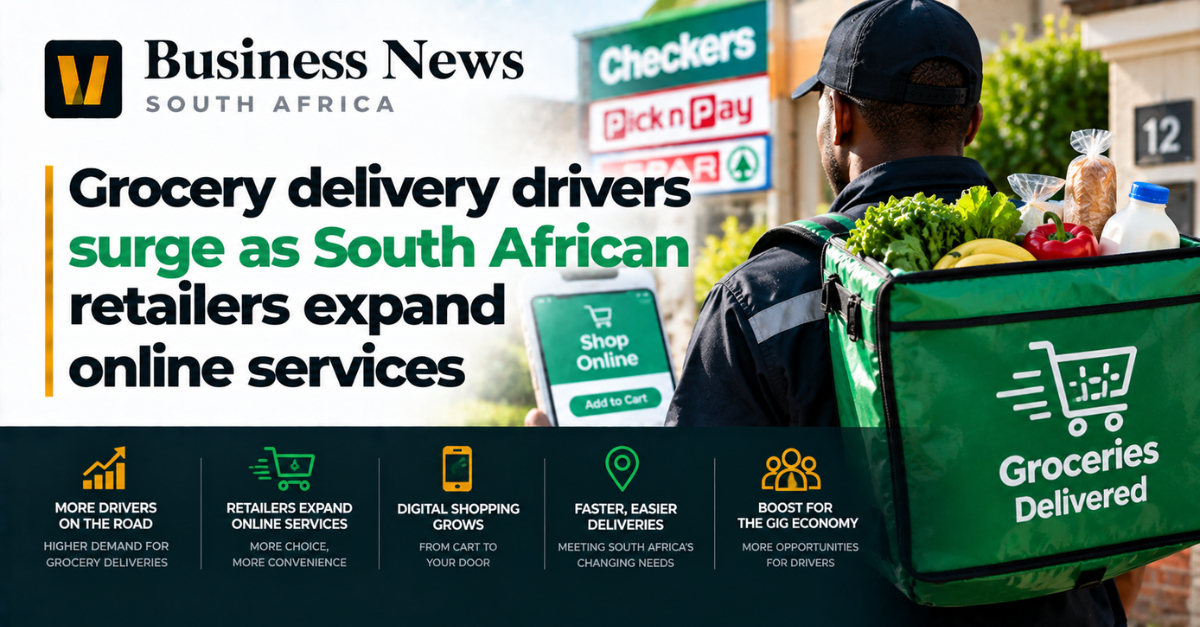
According to BusinessTech, the rapid expansion of on-demand grocery delivery is reshaping South Africa’s retail landscape and labour market. For owners of small businesses, the trend signals both new competition from large chains and a growing pool of independent drivers who could be hired for last-mile logistics.
Shoprite’s digital commerce arm, run through its Checkers and Sixty60 brands, posted a 34.5% rise in online sales to R25.5 billion in the 2026 financial year. The service now runs from 976 stores, roughly 89% of the group’s total, and is supported by Pingo, a subsidiary that employs about 18 000 people. Of those, around 10 000 are delivery drivers who work as independent contractors.
Pick n Pay’s online turnover grew by roughly 32.7% for the 52 weeks to 1 March 2026, with its ASAP! and Mr D delivery services contributing a 37.6% increase. The retailer says it has over 2 500 drivers, a figure it links to faster and more reliable deliveries.
Woolworths reported that its Woolies Dash platform accounted for 7.3% of total food sales in 2026, and the company plans to focus future operations on the food segment. Spar, meanwhile, operates its Spar2U service in 636 stores and is pushing to expand its online footprint after noting that tech-savvy shoppers are gravitating towards rivals with stronger delivery platforms.
What the numbers mean for small retailers
The data show that digital sales are now a core growth engine for the country’s biggest retailers. For a small grocery store, this creates pressure to offer a comparable delivery option or risk losing urban customers who expect same-day service. Partnering with independent drivers, many of whom are already registered with the larger chains, could be a cost-effective way to test a delivery model without the capital outlay of a dedicated fleet.
However, the contractor model also carries risks. Drivers are not classified as permanent employees, meaning they do not receive paid sick leave or other benefits. They also bear the cost of vehicle maintenance and fuel. For a small retailer, hiring contractors may reduce payroll overhead but could expose the business to higher turnover and variable service quality.
From a broader economic perspective, the surge in gig-style delivery jobs adds thousands of flexible work opportunities, but the lack of employment security raises questions about long-term labour sustainability. The Independent Contractors Act does not obligate companies to provide the same protections as for full-time staff, leaving drivers to manage their own insurance and retirement savings.
For entrepreneurs considering entry into the delivery space, the market size is evident: the combined online sales of the major retailers exceed R70 billion, and the driver pool is already in the tens of thousands. The barrier to entry is relatively low, a smartphone, a vehicle and a registration with a platform, but competition for orders is intense, especially in densely populated urban areas.
In summary, the expansion of grocery delivery services is a double-edged sword. It creates a sizeable, flexible workforce and opens new channels for retailers, yet it also intensifies competition and highlights the precarious nature of gig work. Small business owners will need to weigh the cost savings of contractor drivers against the potential impact on service reliability and employee welfare.
The arithmetic that decides whether delivery works
Last mile delivery is one of the few parts of retail where scale is not just an advantage but close to a precondition, and the reason is drop density. The cost of a delivery is dominated by the time between drops rather than the time at them, so a driver completing several orders within a few streets costs a fraction per order of a driver crossing a suburb for each one. Everything else in the model, the picking, the packaging, the app, is comparatively fixed. This is why the same service can be profitable in a dense urban block and lose money on the outskirts of the same city, and why the large chains have concentrated the offer where their store footprint is already thickest.
It also explains the store as warehouse approach. Picking orders from an existing shop avoids building dedicated fulfilment centres and puts inventory close to customers, which shortens the drive. The cost is that picking competes with shoppers for the same aisles and the same stock, and a shelf emptied by an online order is a walk in customer who does not find what they came for. Retailers running both have to decide who wins that conflict, and the decision shows up in whichever channel gets the substitutions.
Before hiring drivers as contractors
The classification question deserves more care than it usually gets. In South African law the label on the contract does not settle whether someone is an employee. What matters is the substance of the relationship: how much control the business exercises over how and when the work is done, whether the person is integrated into the organisation, whether they are economically dependent on it, and whether they are genuinely free to work for others and to send a substitute. A contract that says independent contractor while the business dictates shifts, routes, uniform and pricing can be found to describe an employment relationship, with the obligations that follow.
For a small retailer testing delivery, the safer starting points are usually contracting through an established platform that carries the relationship itself, or paying per delivery to genuinely independent operators who serve several businesses. Either way the costs to model are not only the fee. Insurance, what happens when a vehicle breaks down mid round, who carries the loss on a damaged order, and how a customer complaint reaches somebody who can resolve it are the details that decide whether the service builds the brand or quietly erodes it.