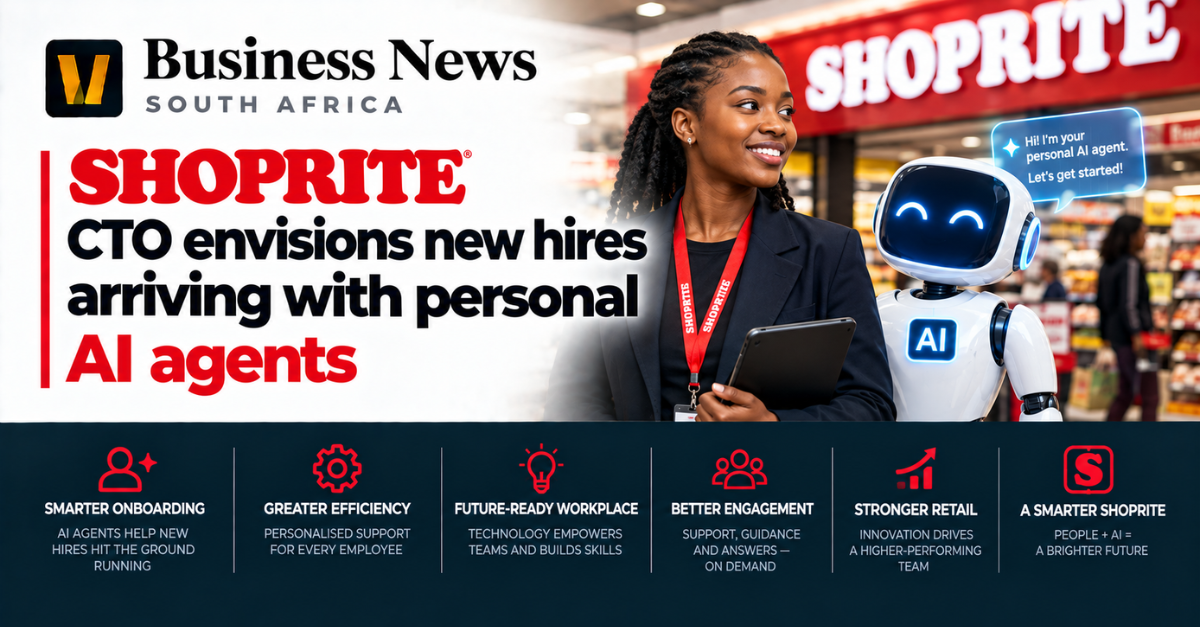
When Shoprite Group’s chief technology officer, Chris Shortt, talks about the future of work, he pictures a scenario where a fresh graduate walks in with a personal AI assistant already primed for the job. Shortt raised the idea during TechCentral’s Meet the CIO podcast, noting that the retailer is already planning how to enable such agents and whether they might become part of a remuneration package.
Shoprite’s AI rollout is already well beyond the experimental stage. About 12 000 employees, roughly one in fifteen of the group’s 174 400 staff, are using generative AI tools, according to Shortt. Generative AI refers to software that can produce text, code or other content on demand. The retailer built an internal platform, called Shoprite AI, that presents users with a chat-style interface similar to ChatGPT. Behind the scenes, the system selects the most cost-effective large language model, the type of AI that powers ChatGPT, to answer each request. Shortt warned that “if you don’t watch the economics of these things they can really get out of hand very fast”, highlighting a least-cost computing approach.
Model selection and development speed
The platform’s model-selection logic is designed to keep spend low while still delivering the right capability. For more complex queries, the system may route the request to a higher-priced model; for simpler tasks it uses a cheaper alternative. This “gateway” architecture lets the retailer balance performance and cost across thousands of daily interactions.
Shortt also described how the AI tools have reshaped the software development lifecycle. Engineers now start with a specification written by an AI model such as Claude Code, then cross-check the output against another model like Gemini. “Between those two, you kind of get a very elegant outcome, because there’ll always be something that each model will find on each other,” he said. The result is a faster turnaround from requirement gathering to code delivery, with human engineers still responsible for validating the probabilistic outputs.
Beyond the development team, the AI platform is being used for customer-facing applications and internal productivity tools. In the retail decision-making arena, AI helps shorten the lag between insight and action in category management, pricing, promotions and replenishment. Shortt confirmed that these AI-driven processes are already in production and feeding daily decisions.
Talent development is another pillar of Shortt’s strategy. Shoprite runs a tech academy that sponsors university students from their second year, funneling them into software engineering, data science and industrial engineering roles. Shortt advises newcomers to build a skill set that lets them “tell the machines what you need from them” and, crucially, to verify the output. He sees the future where new recruits arrive with their own AI agents, and is already discussing with the chief people officer how such agents might be supported, perhaps through a token allowance or other remuneration element.
While no formal policy exists yet, the conversation marks a rare glimpse into how South Africa’s largest private-sector employer is grappling with the practical and legal implications of employee-owned AI. Intellectual-property questions, data security and cost control are all on the table, according to Shortt.
For smaller retailers and other businesses, Shoprite’s experience offers a concrete example of moving AI from pilot projects to everyday operations at scale. The retailer’s emphasis on cost-aware model selection, cross-model validation and a clear talent pipeline could inform how mid-size firms approach their own AI journeys.
The gap between deployed and used
Adoption figures in enterprise technology reward careful reading, because the easiest number to produce is the least informative one. Licences issued, accounts created and users who have opened a tool once are all straightforward to count and tell you very little. What matters is repeat use in the ordinary course of a job, and by that measure most large organisations discover that adoption concentrates in a minority of teams doing a minority of tasks, while the rest of the workforce tries a tool and returns to the way they worked before.
The pattern is consistent enough to be predictable. Uptake sticks where the task is frequent, where the output is easy to check, and where being wrong is cheap. It stalls where verification costs more than doing the work unaided. That is why drafting, summarising and code generation tend to move first, and why anything touching a customer commitment or a regulated disclosure moves slowly and with a person in the loop.
Routing requests between models by cost is the same logic applied to spend. The expensive part of running these systems at scale is not any single request but the volume of ordinary ones, and sending simple questions to a cheaper model is the difference between a manageable bill and one that grows faster than the benefit. It also creates a dependency worth planning for, since a system built to switch between providers is considerably easier to keep running when one of them changes its pricing or retires a model.
The questions an employee owned AI agent raises
The suggestion that new staff might arrive with their own tools is genuinely novel as an employment question, and it lands on ground the law has not settled. Ownership of work produced with a personal tool, confidentiality when company information passes through a service the employer has no contract with, and record keeping when a decision was partly made outside systems the employer controls are all real and none of them have a settled answer.
Smaller businesses face a compressed version of the same problem without the option of building an internal platform, because staff are already using these tools on personal accounts whether or not a policy exists. The pragmatic response is usually to supply an approved tool rather than to prohibit, since a ban tends to move the activity out of sight rather than stop it, and to be specific in writing about which categories of information may never be pasted into an external service. That is a policy question rather than a technology one, and it is available to a business of any size.