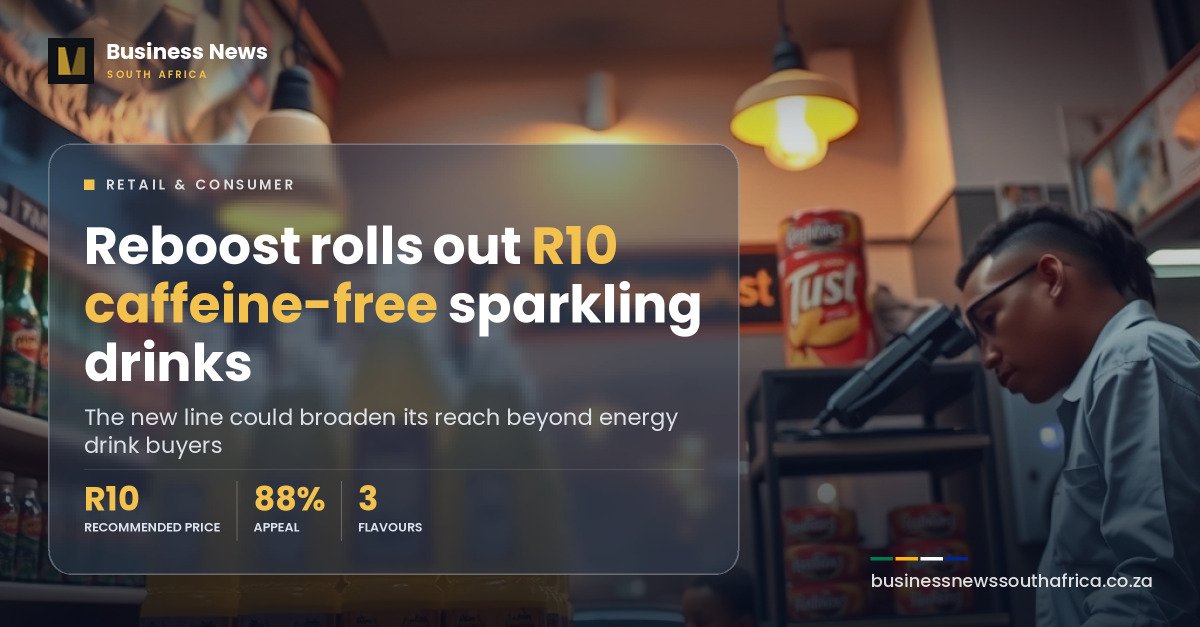
The Beverage Company, known as BevCo, says it has extended its Reboost energy drink brand into caffeine-free sparkling drinks under the name Reboost Plus, with a recommended retail price of R10. The details below come from a company statement sent to us on 21 October 2026, and we have added what we could check ourselves. The headline number, 88% appeal, is the company’s own and we have not seen the study behind it.
What this means for your business: if you stock, distribute or compete in soft drinks, this is a signal that a mass-market brand is chasing shoppers who do not want caffeine, and doing it at a price a spaza shop customer can pay without thinking. If you run a brand of any kind, it is a worked example of extending a product line into a new need without changing the price promise.
What the company says
According to the statement, Reboost Plus is a caffeine-free sparkling functional beverage range with different functional ingredient combinations. It is sold at a recommended retail price of R10. A recommended price is not what every shop charges, and we could not confirm shelf prices or which retailers carry the range.
The company says the range was informed by pre-launch research conducted by IQbusiness among 516 consumers who had bought an energy drink in the previous month, and that 88% of respondents found the Reboost Plus concept appealing overall. Concept appeal is a measure of how people respond to an idea, not of how many will buy it once it is on a shelf, and the statement does not say how respondents were chosen or who paid for the work. Silungile Cebekhulu, described in the statement as Brand Manager at The Beverage Company, is offered as a spokesperson; we have not interviewed them.
Who is behind Reboost
BevCo holds the PepsiCo franchise and distribution rights for South Africa, Lesotho, Eswatini, Namibia and Botswana, and lists Reboost among its own brands, alongside Refreshhh, Coo-ee and Jive. Since 26 March 2024 it has been a subsidiary of India’s Varun Beverages, described as PepsiCo’s largest franchise bottler, according to Food Business Africa’s report on the completed deal. On 31 March 2026 the group finished buying the family-owned drinks maker Twizza for R2.1 billion through BevCo, Daily Investor reported. So a product decision at Reboost now sits inside a larger group that is adding factories and brands in South Africa.
What the Reboost website shows
The brand’s own website, reboostenergy.com, lists six caffeinated energy drink flavours and a caffeine-free sparkling range in three flavours: Cranberry (with calcium, zinc and magnesium), Prickly Pear and Passion Fruit (with probiotics) and Triple Citrus (with vitamin C, zinc and glucose). The page has no product page for Reboost Plus by name; it appears only as a footer link to competition terms and conditions. We could not tell from the site whether the three caffeine-free flavours are the new range or a line that was already on sale, so the claim that this is a new category rests on the company’s statement alone.
The market it is entering
The most recent independent sizing we found is dated. In December 2022, Euromonitor International’s Christopher Day told the Sunday Times that South African energy drink volumes reached 306 million litres in 2022 and the industry’s value was heading for about R12.1 billion. He ranked the top brands by value as Red Bull, Monster, Power Play, Reboost and Score, expected a slight decline in the average unit price as brands competed for volume, and expected the smaller reduced-sugar segment to keep growing. At the time, Nampak’s chief executive said a 500ml energy drink can cost between R10 and R20. Those figures are four years old, so treat them as background, not as today’s market.
Two things follow from that, and they are our reading, not the company’s. First, R10 sits at the bottom of the range that packaging maker quoted, so the price is an aggressive part of the offer. Second, a caffeine-free product widens the buyer pool beyond energy drink drinkers to people who want a flavoured, fortified soft drink, which puts it closer to the soft drink aisle than the energy drink fridge. Whether shoppers see it that way is the open question. Our earlier coverage of the return of FMCG volume growth shows how uneven gains have been for local brands, and our reports on PepsiCo’s decision to pull ProNutro and on the Coca-Cola HBC and CCBA merger give more of the competitive backdrop.
What to watch if you sell or compete
- Check the shelf price, not the recommended one. A R10 recommended price only matters if wholesalers and spaza shops can buy at a margin that lets them hold it.
- Ask for the research. If a supplier quotes the 88% figure, ask for the sample, the method and whether respondents tasted the product.
- Read the label. Functional claims about immunity or probiotics are regulated, and a supplier should be able to show what each claim rests on.
- Watch repeat purchase. The test of any new range is the second purchase, which no launch statement can show.
What we could not confirm
We could not confirm the launch date of Reboost Plus, where it is sold, its shelf price, whether the three caffeine-free flavours on the Reboost website are part of it, or any sales figures. We have not seen the IQbusiness study. We have not downloaded the company’s press release or images. No independent, current market share figure for Reboost was available to us without a paid report. If The Beverage Company supplies the research summary or retailer details, we will update this article.