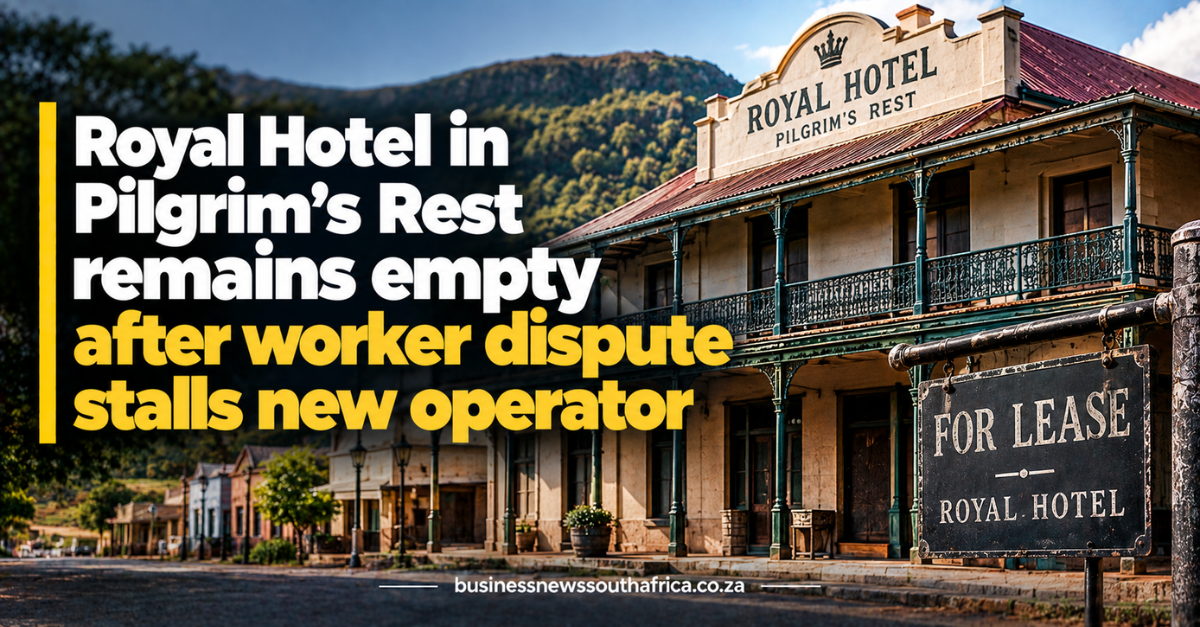
At the end of a dusty street in Pilgrim’s Rest, the Royal Hotel’s Victorian façade stands silent, its brass beds and claw-foot bathtubs hidden behind boarded windows. The empty building is more than a relic; it represents a lost source of jobs and tourist income for a town that relies on heritage visitors.
According to BusinessTech, the hotel was built in 1894 by prospector George Edward Roy as a meeting place for gold diggers. Constructed from corrugated iron and timber, it survived the harsh mining frontier and later became a local landmark when Scotsman John McIntyre bought it in 1913. When Pilgrim’s Rest was declared a National Monument in 1986, the Royal Hotel was preserved with much of its original character intact.
The state-owned Mpumalanga Regional Training Trust (MRTT) took over management in 2012. While the arrangement initially kept the doors open, mounting financial losses, worsened by the collapse in tourism during the Covid-19 pandemic, pushed the hotel towards closure.
In September 2022 private operator Kruger on Sabie assumed the lease and initially absorbed all 50 employees. The operator soon found the staffing costs unsustainable and proposed a shift-work system (a schedule that splits staff into alternating work periods). Employees rejected the change, leading to a dispute that forced Kruger on Sabie to vacate the premises until the matter could be resolved.
A progress report to the Portfolio Committee on Public Works, Roads and Transport revealed that the subsequent tender attracted bids that were non-responsive, meaning they did not meet the tender compliance requirements (the specific conditions set out in the public procurement notice). The Bid Adjudication Committee therefore recommended re-advertising the tender.
Provincial legislature member Teboho Sekaledi warned that the prolonged closure is hurting tourism and economic development. “The extended closure of the Royal Hotel, Pilgrim’s Rest, left many people jobless while the province has the third highest rate of unemployment,” he said. Sekaledi added that Pilgrim’s Rest’s status as a heritage and tourism destination makes the hotel’s operation especially important for the local economy.
Pilgrim’s Rest sits on Mpumalanga’s Panorama Route, a corridor that includes attractions such as God’s Window, Bourke’s Luck Potholes and the Blyde River Canyon. The town’s limited accommodation options mean that the Royal Hotel’s vacancy creates a bottleneck for visitors, reducing potential spend in restaurants, craft shops and transport services that small businesses depend on.
The situation highlights a broader challenge: heritage sites often require operators who can meet strict tender conditions while also coping with the high cost of preserving historic fabric. For small-scale entrepreneurs, the compliance hurdle can be a barrier to entry, leaving larger firms or the state as the only viable bidders. Until the provincial government either relaxes the tender criteria or finds a partner capable of balancing preservation with profitability, the Royal Hotel is likely to remain a silent monument, and Pilgrim’s Rest will continue to miss out on a key driver of its tourism economy.
Provincial governments own a number of heritage properties that are leased to private operators through public tender processes, intended to preserve historic buildings while generating income, and when a tender fails to attract a compliant bidder the property can sit vacant for extended periods while the process is revised and reissued. The South African Heritage Resources Agency’s own guidance carries further detail. For related coverage, see this site’s Retail and Consumer coverage.
Heritage hospitality properties like this one are often central to a small town’s local economy, since a closed hotel can mean lost income not just for its own staff but for the local suppliers, tour operators and informal traders who depend on visitor traffic passing through the town.