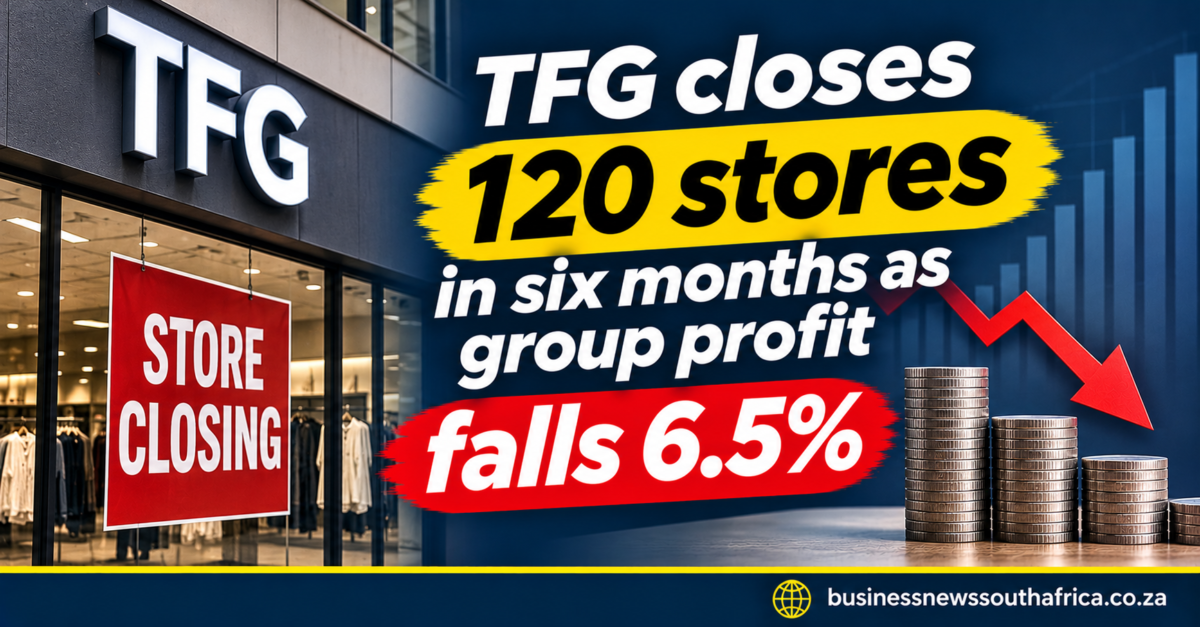
TFG (The Foschini Group) closed 120 underperforming stores and opened 41 new ones in the six months to 30 September 2026, and says a further 60 to 80 closures are planned for the second half of its financial year. The numbers come from the group’s half-year media release, published on 6 November 2026. Group retail turnover was broadly flat, down 0.4% at R29.0 billion, while operating profit fell 6.5% to R2.1 billion.
The headline numbers
Headline earnings per share, the measure of profit per share that strips out one-off items, fell 6.8% to 272.8 cents. The board declared an interim dividend of 121 cents per share. Net debt before IFRS 16 (the accounting standard that brings leases onto the balance sheet) was reduced by R1 billion to R9.1 billion.
Group chief executive Anthony Thunström described the period as “a tough six months”, but said TFG Africa, the group’s largest business, grew sales, profit and market share. The weaker result at group level came from the United Kingdom and Australia, where trading was soft enough to offset the African growth.
Africa grows in a pressured market
TFG Africa grew retail turnover by 3.8% to R19.7 billion and operating profit by 2.7% to R1.7 billion. Gross margin improved by 10 basis points and growth in trading expenses was held to 4%. TFG says it achieved this despite a sharp rise in fuel prices and consumer confidence falling to -19 in the second quarter.
According to Retailers’ Liaison Committee data cited by the group, TFG Africa gained 20 basis points of market share and gained share year on year in five of the six months. In September, its sales grew 5.2% against market growth of 1.8%, almost three times the market’s rate.
Where the 120 closures fall
The closures were concentrated in places where trading has been hardest. TFG says 49% of them were in distressed central business districts, mostly at lease expiry, and that releasing those stores freed R190 million in working capital. The group estimates that about 20% of the closed stores’ turnover will migrate to sister stores or to its Bash online platform.
The release does not give a country-by-country split of the 120 closures, so the figure should be read as a group-wide one. The release also does not name individual stores or towns. In September we reported on a separate plan to close 280 stores and the union response in our report on TFG’s store closures and COSATU’s warning; the half-year release does not say how the two sets of figures relate.
Costs, cash and inventory
TFG removed R257 million in costs from TFG Africa in the half: R184 million from stores and R73 million from head office and overheads. Of that, R130 million flowed through to profit, and the balance was gross profit forgone on closed stores. A further R222 million of savings is expected in the second half, with a profit benefit of R171 million. On an annualised run-rate basis, the actions total R854 million, with a profit impact of R543 million.
Cash generated from operations rose 20% to R3.7 billion. Capital expenditure fell 37% to R672 million and inventories were 4% lower at R15.3 billion. The group describes its objective as higher earnings from a leaner, more productive and less capital-intensive business.
Bash and the store link
Online sales grew 53.3% to R2.2 billion. E-commerce reached R1.8 billion, while BashStore, where store staff sell on a Bash device, grew 65.4% to R326 million. TFG says 191,000 customers placed their first online order through BashStore in a store, and 779,000 browsed online before buying in store, up 30%. It estimates its online capabilities have avoided about R1.3 billion in capital expenditure.
International pressure and board changes
In local currency, TFG London’s retail turnover fell 2.2% and operating profit fell 26.5%. TFG Australia’s turnover fell 4.4% and operating profit fell 28.3%. Brand, cost and store-footprint resets are under way in both, led by new leadership at Phase Eight in London and at Tarocash in Australia. For earlier context on the UK brands, see our report on the cyberattack TFG confirmed on its UK fashion operations.
Michael Lewis will step down as chairman and retire from the board on 31 December 2026. He joined the board in 1989 and has chaired it since June 2015. Professor Alexandra Watson, emeritus professor at the University of Cape Town and chair of ADvTECH, will succeed him as chairperson from 1 January 2027.
What it means for businesses
For landlords, suppliers and neighbouring traders, the practical signal is that a large retailer is trimming weak sites at lease expiry while directing growth to online and to stronger stores. Businesses that depend on foot traffic beside these stores should check lease terms and tenant mix early. Retailers of any size can take the pattern from the release: cutting costs and stock while keeping cash generation strong, and using stores to feed online sales rather than treating them as separate channels. Our festive season trading playbook covers the cash and stock decisions for the weeks ahead.