Business speaker and investor Vusi Thembekwayo says South African retail is splitting in two: value-focused food chains are holding their ground or advancing, while clothing and discretionary retailers are losing shareholder value. “South Africa’s retail sector has been taking a pounding for the past 7 months, and that’s not an exaggeration,” he told his YouTube audience in a talk published on 26 September 2026.
His firm researches food, clothing and general merchandise retail for its keynote and client services business. Share prices of major retailers are down, he said, earnings per share are under pressure and analysts’ outlooks are “cautious to negative”.
Households are cutting clothing first
Thembekwayo describes households under sustained pressure: elevated living costs, sticky inflation in key categories and a shrinking middle class as real incomes lag. Add high interest rates for an extended period, structural unemployment and weak formal job creation, and consumers are trading down and not buying non-essentials. He said relief on rates had only begun to arrive, but the Reserve Bank has since moved the other way: the Monetary Policy Committee raised the repo rate to 7.25% on 23 September, its second increase of 2026, according to the government news agency.
Fashion is the first casualty. “Fashion and apparel are one of the first things household cut when they cut budgets or when budgets tighten,” he said.
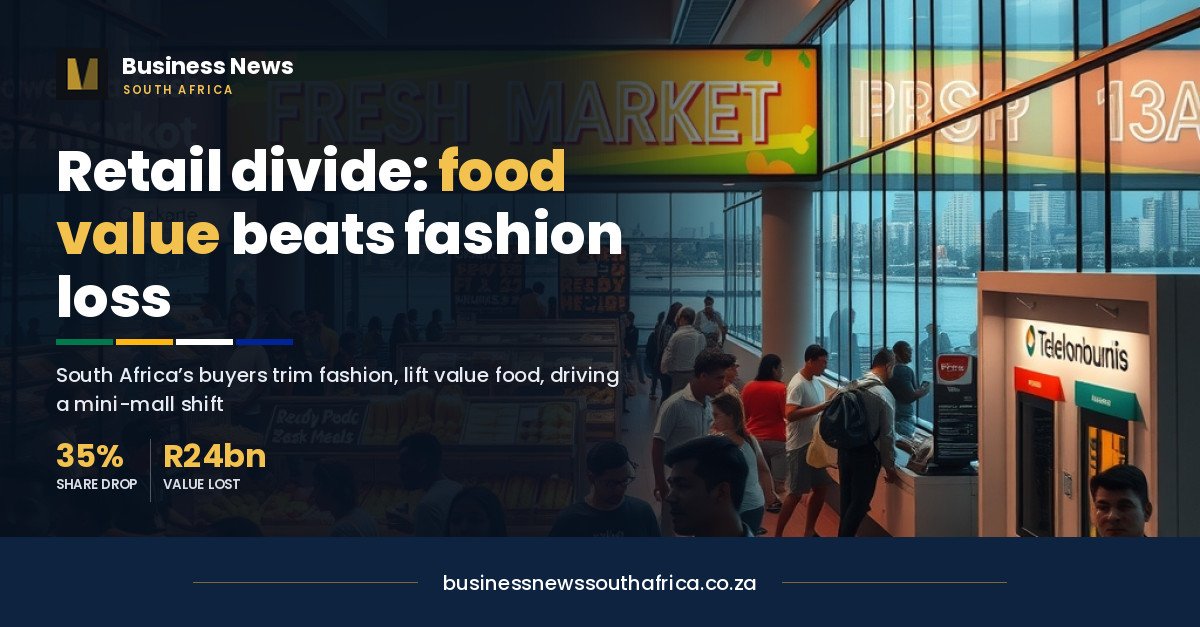
He used TFG (The Foschini Group) as his main example, after disclosing that it is a client of his firm. The share price was down roughly 35% year-to-date “at points”, he said, having wiped out something like R24 billion in value “in some periods”. He listed weak discretionary spending, margin pressure from promotions and cost inflation, and competition from fast fashion such as Shein and from second-hand markets. He rejected criticism that TFG’s stores are cluttered or disconnected from household budgets.
TFG’s own numbers show the strain. In a trading update in May 2026 it guided to a decline in headline earnings per share of 30% to 40% from 1 015.6 cents in the 2025 financial year, and the shares fell by as much as 14% on the day, Moneyweb reported. The group booked R750 million in brand impairments, and blamed lost margin over Black Friday and the festive season in TFG Africa.
Woolworths, Edgars and the cost of debt
Woolworths’ share price was down in the mid-teens of percentages year-to-date, Thembekwayo said. Its food business is higher quality and more defensive, but fashion and beauty remain exposed. Its premium positioning limits volume recovery when consumers trade down, yet lets it defend margin.
On Edgars and Jet he was blunter. Edcon, he said, “truly serves as a cautionary tale of what happens when a clothing retailer fails to adapt to structural shifts in consumer trends”, and was then “overlain with debt” by private equity owners. The history bears him out on the facts. Bain Capital took Edcon private in 2007, it recorded net debt of R24.7 billion in 2016 and filed for business rescue in 2020, after which Edgars was sold to Retailability and Jet went to TFG, according to Wikipedia’s Edcon entry.
Boxer and Shoprite are winning on value
Among the winners, he singled out Boxer. “Boxer was the brand you mentioned in the boardroom to make a joke,” he said of his time working in retail. “Today, Boxer is bigger than the company I worked for in retail.” He conceded it is growing off a low base, but praised its execution and store expansion in the right locations. Boxer listed on the JSE on 28 November 2024 at R54 a share, valuing it at R24.7 billion, more than Pick n Pay’s own market value at the time, Daily Investor reported.
He was equally strong on Shoprite, saying its media business is now a billion-rand operation and that its private label strength and logistics are hard to match. Shoprite’s results for the 52 weeks to 28 June 2026 back the picture of a resilient grocer: headline earnings per share rose 12.2% to 15.32 rand and sales grew 7.2% to R270.8 billion, CNBC Africa reported. Thembekwayo was less kind to Pick n Pay, whose turnaround, he said, has taken years, and to Massmart, whose cash-and-carry and general merchandise exposure he called very difficult.
His summary of the pattern: “The closer the retailer sits to everyday essentials and sharp value, the better it has been at navigating the current environment.”
Stores are becoming mini malls
Thembekwayo expects stores to become “mini malls”, a trend he sees in Shoprite and Woolworths: hot food, a food section, furniture, general merchandise and ancillary services such as money, banking and telecommunications under one roof. “Today if you go to a Shoprite, you actually don’t need to go to many of the other any other store in the mall,” he said.
He also said the ground rules of the sector have changed since he worked in it. Private label was something people scoffed at; “today private label is how you defend margin and margin structure”. Hot food was only being introduced then; “today, if you don’t have a hot food section in the food game, you’re finished”. The winners of the future, he argued, will respond well to online pressure and import competition, and manage inventory and working capital tightly.
His closing point was that fast fashion and new technology may disrupt retailers, but they “will never be a replacement” for plain, simple value. More on Retail & Consumer and on how interest rates and markets are shaping shoppers’ budgets is in our coverage.