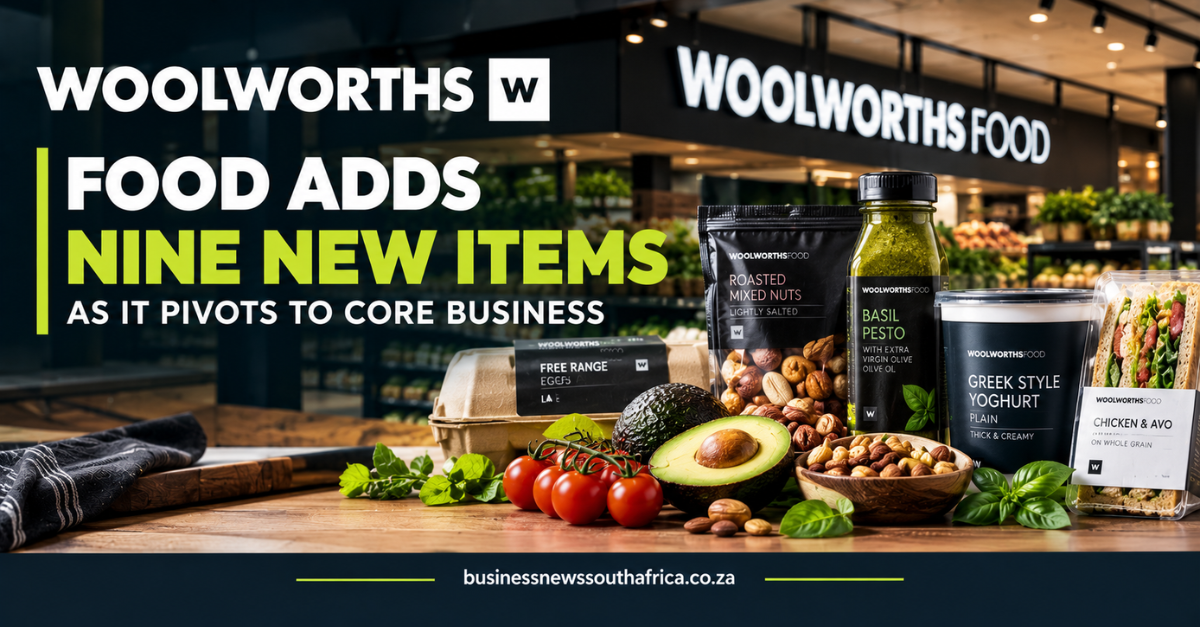
Woolworths Food announced on its social channels that nine new products are now available in South Africa, ranging from overnight oats and egg-based breakfast pots to beef ribs, burgers, juice and desserts. The announcement was made by Woolworths on its official social media feed.
The launch is part of a broader push by Woolworths Holdings Ltd (WHL) to grow its Food division, which the 2026 Integrated Annual Report says contributed 66.5% of the group’s total turnover and 69.5% of adjusted earnings before interest and tax (EBIT). Adjusted EBIT means profit before interest and tax, stripped of one-off items, giving a clearer view of operating performance.
In the 2026 financial year Food turnover rose 5.7% to R55.37 billion and adjusted EBIT increased 3.2% to R3.71 billion, delivering an adjusted EBIT margin of 6.7%. The company claims the Food business gained profitable market share despite a difficult economic backdrop.
Online channels also grew, with Woolies Dash on-demand sales up 19.6% and digital sales now representing 7.3% of South African Food sales. Physical store space for Food expanded by 3.5% to 319,970 square metres across 710 stores.
Store format changes accompany the product rollout. In August the retailer opened its Dainfern Square store, the second Food Emporium after the Durbanville location. The Emporium format adds a bakery, fishmonger, butcher, specialist cheese, sushi counters and an expanded pantry to meet “more than just convenience” expectations, according to Food CEO Chan Pillay.
Woolworths says product development follows its Good Food Journey, a set of initiatives covering responsible sourcing, animal welfare and sustainable farming and fishing. CEO Sam Ngumeni reiterated that Food is the “heartland” and “greatest competitive advantage” of the group, and that while other businesses remain important, Food is the engine that propels the ecosystem.
For local suppliers and small producers, the emphasis on new, premium-grade items and expanded store space could open additional shelf space and higher-volume contracts, especially if the Food division continues to capture market share. However, the competitive pressure also means that any partner must meet Woolworths’ quality, sustainability and price standards.
Woolworths’ focus on Food mirrors a wider trend among South African retailers to double down on high-margin, high-turnover categories while leveraging digital sales and larger format stores to stay ahead in a constrained economy.
Read more about Woolworths’ strategy in the Retail & Consumer section.
Sam Ngumeni stressed that the group is reorienting its strategy around Food, calling it the “heartland” and “greatest competitive advantage”. He said Food is the primary engine of the Group’s value creation, underpinned by a customer proposition that blends quality, innovation, sustainability and value. This positioning follows the Integrated Annual Report’s emphasis on targeted investments in high-return areas, signalling that future capital will be steered toward expanding the Food portfolio and related services.
The report also highlighted that Food accounted for 66.5% of WHL’s total group turnover and generated 69.5% of adjusted earnings before interest and tax. While turnover and adjusted EBIT figures were already noted, the proportion of concession sales underscores the division’s dominance within the broader business mix, reinforcing why Woolworths is concentrating resources on expanding its Food footprint.
Product development is guided by the Good Food Journey, a framework that embeds responsible sourcing, animal welfare and sustainable farming and fishing into every new item. By aligning each launch with these criteria, Woolworths ensures that the nine new offerings meet both internal standards and consumer expectations for ethical and environmentally conscious food choices.
When a new product is conceived, the idea moves through a series of internal reviews that assess market demand, supply-chain viability and compliance with the Good Food Journey. Once approved, suppliers are vetted for quality and sustainability, prototypes are trialled in select stores, and performance data are collected. Successful pilots are then rolled out across the expanded Food trading space, with the Emporium format providing additional shelf capacity for a smoother national launch.
The Emporium format, exemplified by the recent Dainfern Square opening, offers a broader assortment that includes specialist cheese, sushi and an expanded pantry. This larger footprint allows Woolworths to allocate dedicated space for premium-grade items such as the new beef ribs and desserts, giving customers greater choice while supporting the division’s goal of capturing profitable market share.